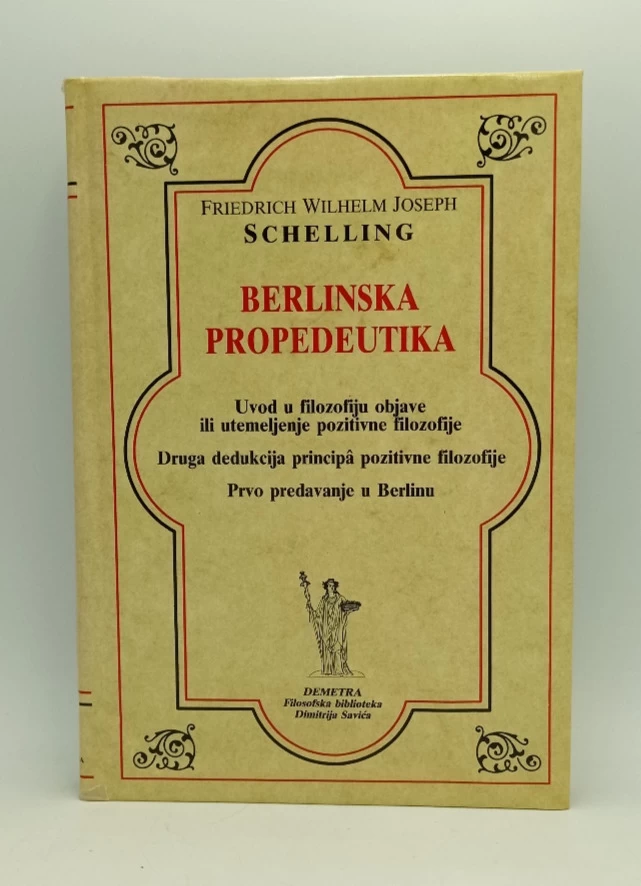

Schelling Friedrich Wilhelm: Berlinska propedeutika
€ 30,00
Free delivery in Croatia for orders over EUR 70
Basic information
- Author: Schelling Friedrich Wilhelm
- Publisher: Demetra
- Availability: Available
- Condition: Odlično
- Code: 33027
Shipping options
GLS Croatia
5€
Delivery
0€
Personal collection at the antique store
0€
GLS parcel machine
3€
Payment methods
Pay on pickup
CorvusPay
By general payment / Virman / Internet banking
Cash on delivery
Berlinska propedeutika
Schelling Friedrich Wilhelm
Summary
Friedrich Wilhelm Joseph Schelling: Berlin propaedeutics
Introduction to the philosophy of revelation or the foundation of positive philosophy
The second deduction of the principles of positive philosophy
The first lecture in Berlin
In our particular case, this substantialization is reflected in the fact that Schelling's discourse does not depart from the all-systematic paradigm by replacing it with a project of reflection on its possibilities, but precisely reaching for pre-reflexive patterns. From this point of view, it becomes visible that the double-headedness of Schelling's philosophy is not ultimately reduced to the school-interpreted difference between positive and negative as a systematic expression of the reflexive irreducibility of what (the mind) and what (its foundation as mere existence) to a common denominator, but that this duality is already reflexively produced and is only a manifestation of the aporetic nature of reflection itself, independent of the transcendental-mystical problem of existential foundation. The critique of reflection in the late Schelling does not become transcendent because it simply raises the question of a battle outside of a systematic construct, that is, a battle that would be transcendentally demonstrable and not immanently deducible. On the contrary, this very question of late philosophy manages to be formulated as different and opposite to the question about battle that Schelling posed from the point of view of his middle phase - that is, from the point of view of the critique of idealism as he carried out, for example, in the Writings on Freedom and the Ages of the World - only thanks to the structural reversal of the very direction of reflection in the context of his project of criticism as a critique of the systematic mind. The existential categorization of battle, introduced by the distinction between transcendent and immanent battle in late Schelling's philosophy, cannot be recognized as having a primordial importance for the radical sharpening of the critique of idealism in that period, but can only be explained as a manifest form of the internal refraction of the reflexive model as such. And that refraction - and really only that - is the act that makes that philosophy an epochal turning point.
(16)
Additional information
- Author: Schelling Friedrich Wilhelm
- Publisher: Demetra
- Year of publication:1996
- Place of publication:Zagreb
- Pages:178
- Dimensions:17x24 cm
- Script:Latinica
- Condition:Odlično
- Binding:Tvrdi
You may also like







Recently viewed
Biblos Newsletter
For book lovers who enjoy finding the rare
New titles, special copies and quiet recommendations from the antiquarian bookshop.