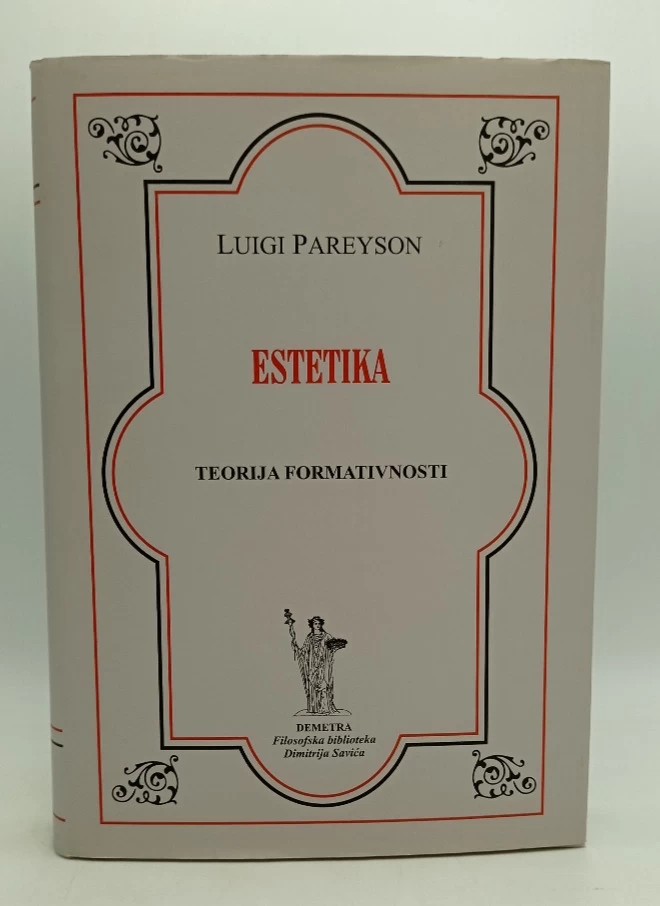

Pareyson Luigi: Estetika
€ 45,00
Free delivery in Croatia for orders over EUR 70
Basic information
- Author: Pareyson Luigi
- Publisher: Demetra
- Availability: Available
- Condition: Odlično
- Code: 48507
Shipping options
GLS Croatia
5€
Delivery
0€
Personal collection at the antique store
0€
GLS parcel machine
3€
Payment methods
Pay on pickup
CorvusPay
By general payment / Virman / Internet banking
Cash on delivery
Estetika
Pareyson Luigi
Summary
Luigi Pareyson: Aesthetics
Theory of Formativeness
Instead of dwelling for a long time on one and the same criticism of Croce's aesthetics, this book immediately moved on to the subject itself, proposing, instead of Croce's principles of intuition and expression, the aesthetics of production and formativeness. It was time that in art more emphasis was placed on making than on observing. If this theory, despite the clumsiness of the expression, was rather called «aesthetics of formativeness» rather than «aesthetics of form», this happened primarily for two reasons. First of all, because the term «form», due to the multiplicity of its meanings, becomes ambiguous in the end and risks being presented as a simple opposition of «matter» or «content», thus evoking the vexal quaestio of formalism and emphasis on content, while form is understood here as something alive that lives its own life and is endowed with internal lawfulness: a totality that is unrepeatable in its individuality, independent in its independence, exemplary in its value, closed and open in its unity definedness that encompasses something infinite, perfect in the harmony and unity of its law of coherence, complete in the mutual correspondence between parts and the whole. Secondly, to immediately illuminate the dynamic character of the form, the essence of which is that it gives the result, rather the success of a "process" of shaping, since the form can be seen as such only if it is observed in the act of completion, and at the same time of inclusion, the movement of production that comes to completion in it and achieves its own success.
*
(113)
Additional information
- Author: Pareyson Luigi
- Publisher: Demetra
- Year of publication:2008
- Place of publication:Zagreb
- Pages:430
- Dimensions:18x25 cm
- Script:Latinica
- Condition:Odlično
- Binding:Tvrdi s ovitkom
You may also like



Recently viewed
Biblos Newsletter
For book lovers who enjoy finding the rare
New titles, special copies and quiet recommendations from the antiquarian bookshop.