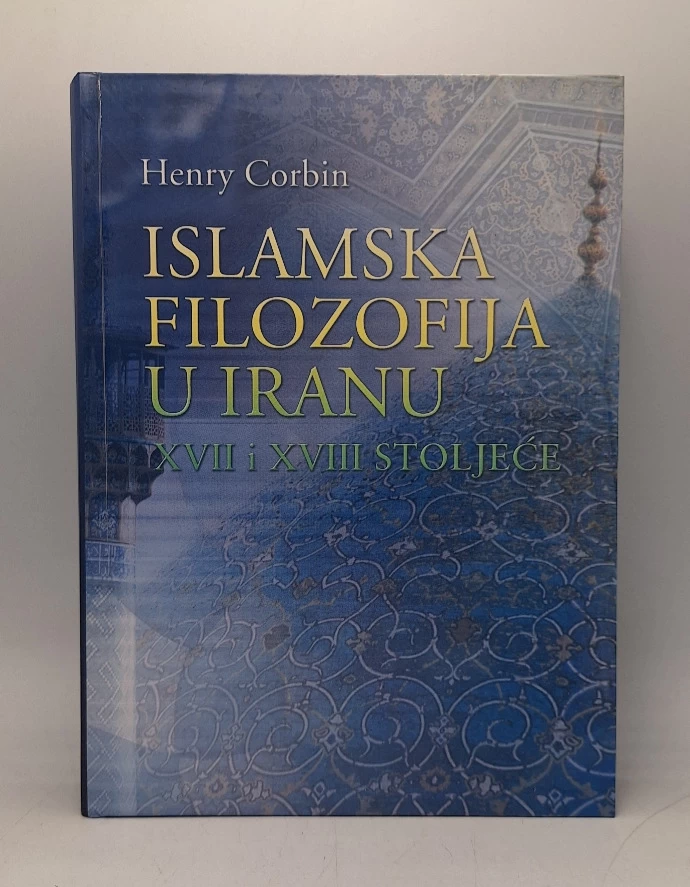

Corbin Henry: Islamska filozofija u Iranu
€ 25,00
Free delivery in Croatia for orders over EUR 70
Basic information
- Author: Corbin Henry
- Publisher: Ibn Sina
- Availability: Available
- Condition: Vrlo dobro
- Code: 75625
Shipping options
GLS Croatia
5€
Delivery
0€
Personal collection at the antique store
0€
GLS parcel machine
3€
Payment methods
Pay on pickup
CorvusPay
By general payment / Virman / Internet banking
Cash on delivery
Islamska filozofija u Iranu
Corbin Henry
Summary
Henry Corbin: Islamic Philosophy in Iran
XVII and XVIII centuries
Philosophy is thinking, so the history of philosophy would be the history of human thought. It is not possible to get acquainted with philosophy or any other science if you do not pay attention to the past, to what previous philosophers said about certain issues. Although philosophy is not a necessary introduction to other sciences, considering its suspicion even towards itself, it helps other sciences in many ways, especially in high-level theological debates.
Those who are insufficiently familiar with Islamic philosophy usually have the idea that it ended with Ibn Rushd and that the Islamic world did not produce significant philosophers after him. There is also a common prejudice that Islamic philosophy is nothing more than a translation of Hellenic philosophy. In the past few decades, due to the efforts and efforts of scholars such as Allama Seyyed Mohammad Tabataba'i, Seyyed Jalaluddin Ashtiyani, Mahdi Haeri Yazdi, Seyyed Hossein Nasr and Henry Corbin, the dust of oblivion has been removed from Islam to a significant extent, and it has been presented to world scientific circles. However, there is still a lot of effort and research, so that Islamic philosophy would gain its real valorization, and then, as an important agent of self-knowledge and self-awareness, play its role in the revitalization of Islamic culture and civilization.
One of the eras in which philosophy and theosophy in Iran experienced its greatest flourishing is the period of the Safavid dynasty (XVI and XVII centuries). At that time, the Isfahan school of philosophy reached an extremely high level, and in terms of the number of thinkers it produced, it is certainly unparalleled in the Islamic world. The Isfahan school actually represented an effort to shake Islamic philosophy out of the apathy caused by the Mongol invasion and rule for a century and a half.
After the Mongol invasion, philosophical thought in the Arab countries gradually declined, so that even famous philosophers like Ibn Khaldun were unable to lead it out of the impasse. In Iran, on the other hand, philosophical thought did not experience such decadence, and continued to live despite unfavorable social and political conditions. Henry Corbin's book, which you have in your hands, presents to us the Iranian thinkers of the Isfahan school and their works.
Additional information
- Author: Corbin Henry
- Publisher: Ibn Sina
- Year of publication:2002
- Place of publication:Zagreb
- Pages:570
- Dimensions:17x24 cm
- Script:Latinica
- Condition:Vrlo dobro
- Binding:Tvrdi
You may also like








Recently viewed

Biblos Newsletter
For book lovers who enjoy finding the rare
New titles, special copies and quiet recommendations from the antiquarian bookshop.