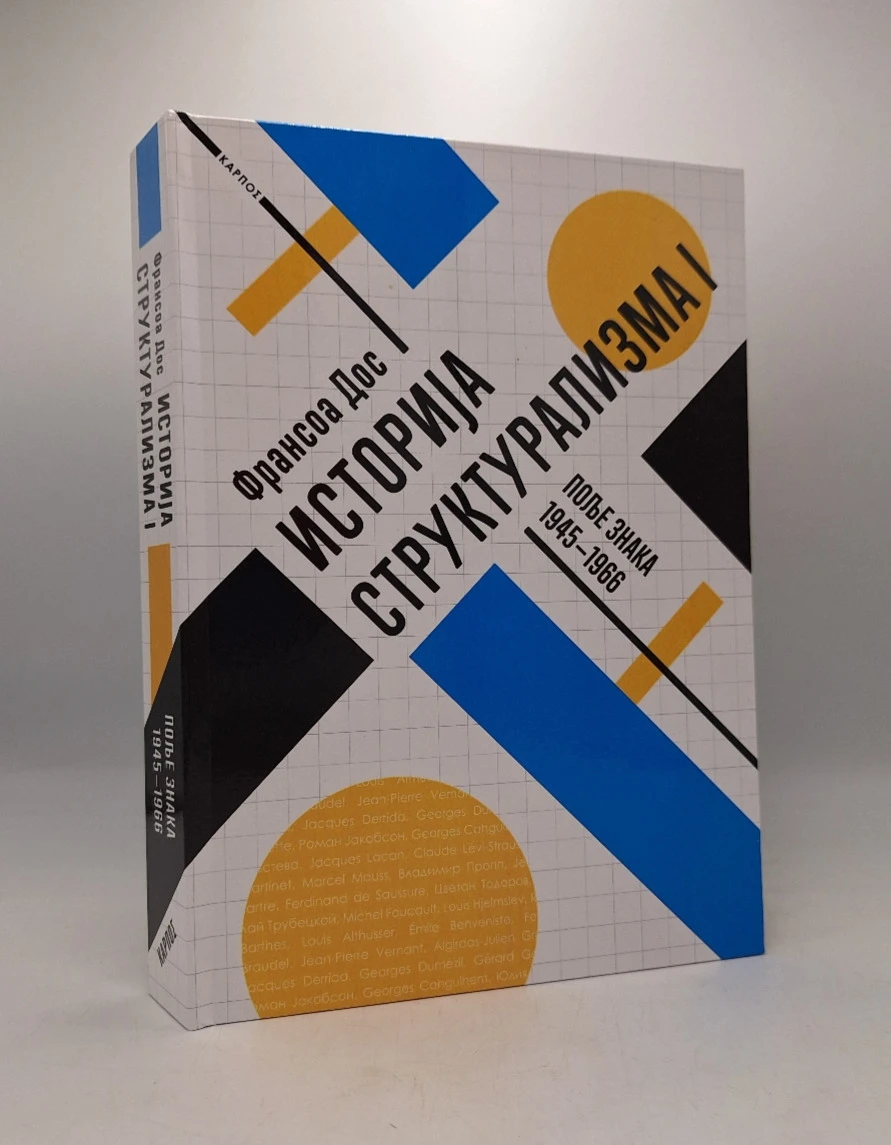

Dosse Francois: Istorija strukturalizma I: Polje znaka 1945-1966
€ 40,00
Free delivery in Croatia for orders over EUR 70
Basic information
- Author: Dosse Francois
- Publisher: Karpos
- Availability: Available
- Condition: Nova knjiga
- Code: 53080
Shipping options
GLS Croatia
5€
Delivery
0€
Personal collection at the antique store
0€
GLS parcel machine
3€
Payment methods
Pay on pickup
CorvusPay
By general payment / Virman / Internet banking
Cash on delivery
Istorija strukturalizma I: Polje znaka 1945-1966
Dosse Francois
Summary
Francois Dosse: History of Structuralism
1. part - Field of Signs
1945-1966
"The period in which structuralist activity will flourish is a period of spectacular development of the social sciences, and especially of all new offshoots that are trying to find a place under the sun in an already well-filled field. However, these new social sciences are in search of legitimacy. In order to get it, they will create an identity for themselves based on a break, and try to win over an intellectual audience that is getting bigger and bigger in the 50s and In the 1960s, the structuralist break, which will present itself as a scientific revolution, is looking for an intensive socialization in order to gain a share. In structural linguistics, it found a common language to impose a change anthropology, literary criticism, and even history, and it renewed the mode of philosophical inquiry. […] Levi-Strauss was the first to formulate this unifying program of the humanities, immediately after the war. Under the direct influence of Roman Jakobson, Levi-Strauss assigns a privileged place to the linguistic model in his anthropological approach and draws inspiration from the natural and exact sciences in order to derive from them a certain number of logical-mathematical models. for the construction of his anthropology. His ambition is to erase the boundary between the natural sciences and the humanities thanks to scientific rigor."
In the work "The History of Structuralism Part I Field of Signs 1945-1966", Francois Doss traces the rise of the structuralist movement to its peak in the second half of the 1960s. It sheds light on the wider historical context in which this phenomenon developed, presents and explains the starting points of the opinions of its main representatives (starting with Ferdinand de Saussure), maps the theoretical lines of inheritance and the targets of its attacks, describes the intellectual state of post-war France from where the "structuralist flash" spread its influence in Europe. Due to the unquestionable importance of structuralism and the great reputation of its main actors (Levi-Strauss, Lacan, Foucault, Kristeva, Barthes, Todorov, etc.), this book is at the same time an indispensable chapter in the intellectual history of post-war Europe, which may be the last great spiritual movement. The book has been translated into many European languages, and it appears in Serbian in a translation by Olje Petronić.
Additional information
- Author: Dosse Francois
- Publisher: Karpos
- Year of publication:2023
- Place of publication:Loznica
- Pages:534
- Dimensions:14x21 cm
- Script:Ćirilica
- Condition:Nova knjiga
- Binding:Tvrdi
You may also like





Recently viewed

Biblos Newsletter
For book lovers who enjoy finding the rare
New titles, special copies and quiet recommendations from the antiquarian bookshop.