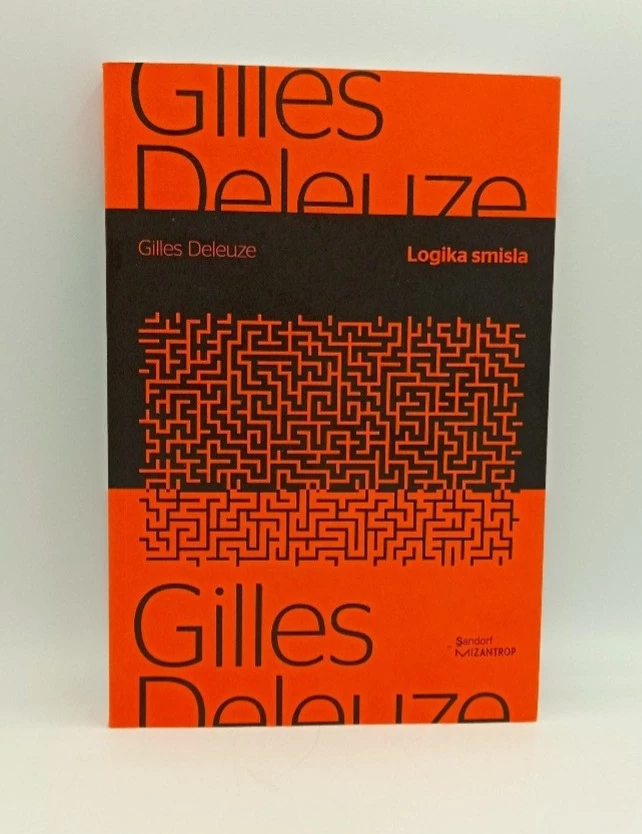

Deleuze Gilles: Logika smisla
€ 17,00
Free delivery in Croatia for orders over EUR 70
Basic information
- Author: Deleuze Gilles
- Publisher: Sandorf
- Availability: Available
- Condition: Nova knjiga
- Code: 49964
Shipping options
GLS Croatia
5€
Delivery
0€
Personal collection at the antique store
0€
GLS parcel machine
3€
Payment methods
Pay on pickup
CorvusPay
By general payment / Virman / Internet banking
Cash on delivery
Logika smisla
Deleuze Gilles
Summary
Gilles Deleuze: Logic of Sense
Gilles Deleuze's book Logic of Sense (Logique du sens, 1969) immediately precedes - not only chronologically but also as a kind of precondition or foundation - the collaboration of the great French philosopher with the psychiatrist and activist Felix Guattari, the result of which will be the monumental double-conscious work Capitalism and Schizophrenia (composed of the books Antiedipus and Thousand Plateaus, also published in translation in Croatian part of the publishing project Sandorf&Mizantrop). Consisting of thirty-four "paradoxes" and an Appendix that, in addition to five previously published essays, includes a brief review of Deleuze's ontology entitled "Plato and the Simulacrum," The Logic of Meaning develops a "philosophy of events" that undermines the entirety of traditional ontology through analysis of authors as diverse as Lewis Carrol, Seneca, Pierre Klossowski, Michel Tournier, Emile Zola, and Sigmund Freud. An exercise in "non-totalizing thinking", the Logic of Meaning is, however, far more than that: a radical attempt to think the unthinkable and the unthinkable, and a daring undertaking to reveal and reflect on everything that has been forgotten or obscured in philosophy. In this perspective, which is also historical, its importance lies in the fact that it is one of the first works that reactualizes Stoic thought in an original way. It was precisely on the occasion of the Logic of Sense that Michel Foucault made his famous prophecy that "one day our century will be called Deleuz's".
Additional information
- Author: Deleuze Gilles
- Publisher: Sandorf
- Year of publication:2015
- Place of publication:Zagreb
- Pages:308
- Dimensions:16x23 cm
- Script:Latinica
- Condition:Nova knjiga
- Binding:Meki
You may also like












Recently viewed


Biblos Newsletter
For book lovers who enjoy finding the rare
New titles, special copies and quiet recommendations from the antiquarian bookshop.