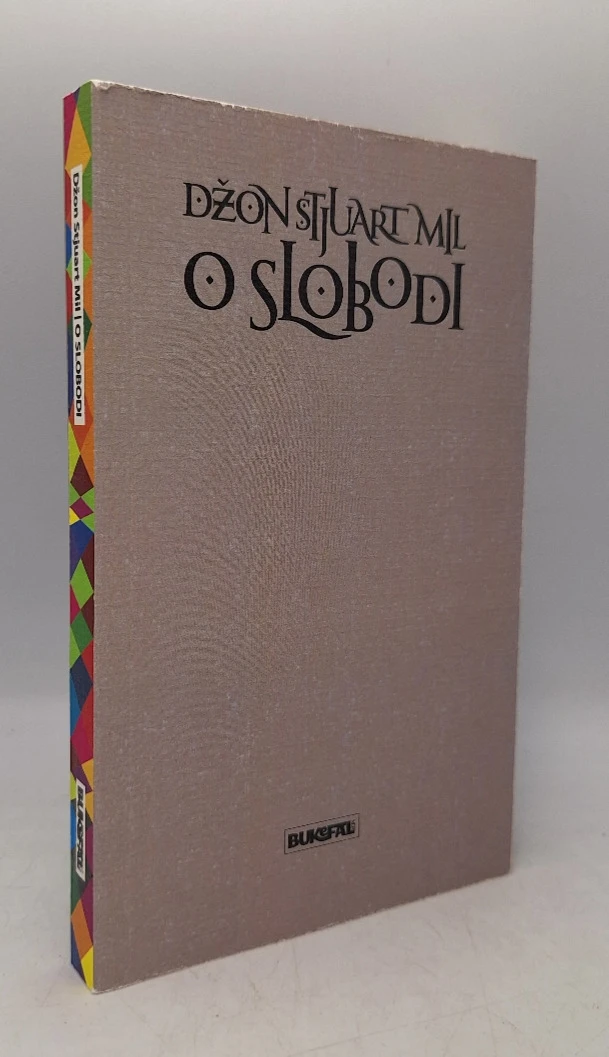

Mill John Stuart: O slobodi
€ 13,00
Free delivery in Croatia for orders over EUR 70
Basic information
- Author: Mill John Stuart
- Publisher: Bukefal
- Availability: Available
- Condition: Odlično
- Code: 81521
Shipping options
GLS Croatia
5€
Delivery
0€
Personal collection at the antique store
0€
GLS parcel machine
3€
Payment methods
Pay on pickup
CorvusPay
By general payment / Virman / Internet banking
Cash on delivery
O slobodi
Mill John Stuart
Summary
John Stuart Mill: On Liberty
The subject of this essay is not so-called liberty of the will, which so unhappily resists the misnamed doctrine of philosophical necessity, but civil or social liberty, the nature and limits of the power which society may lawfully exercise over the individual. The question was rarely asked and almost never considered, in a general sense, but by its latent presence it profoundly influenced the practical disputes of the age and will probably soon contribute to its acceptance as a vital question in the future. Far from being a new issue, that is, in a certain sense, it has divided the human race, almost from the earliest times, but at the level that the more civilized parts of the species have reached at the moment, it arises only in new circumstances and requires a different and much more thorough solution. The struggle between liberty and power is the most striking feature in those parts of history with which we are first introduced, especially in the history of Greece, Rome, and England. However, in ancient times this conflict took place between the subjects, or a certain class of subjects, and the government. Freedom meant protection from the tyranny of political rulers. Rulers (with the exception of some popular governments of Greece) were thought to be inevitably in an antagonistic position towards the people they ruled.
Additional information
- Author: Mill John Stuart
- Publisher: Bukefal
- Year of publication:2020
- Place of publication:Beograd
- Pages:169
- Dimensions:11.5x18 cm
- Script:Latinica
- Condition:Odlično
- Binding:Meki
You may also like









Recently viewed







Biblos Newsletter
For book lovers who enjoy finding the rare
New titles, special copies and quiet recommendations from the antiquarian bookshop.