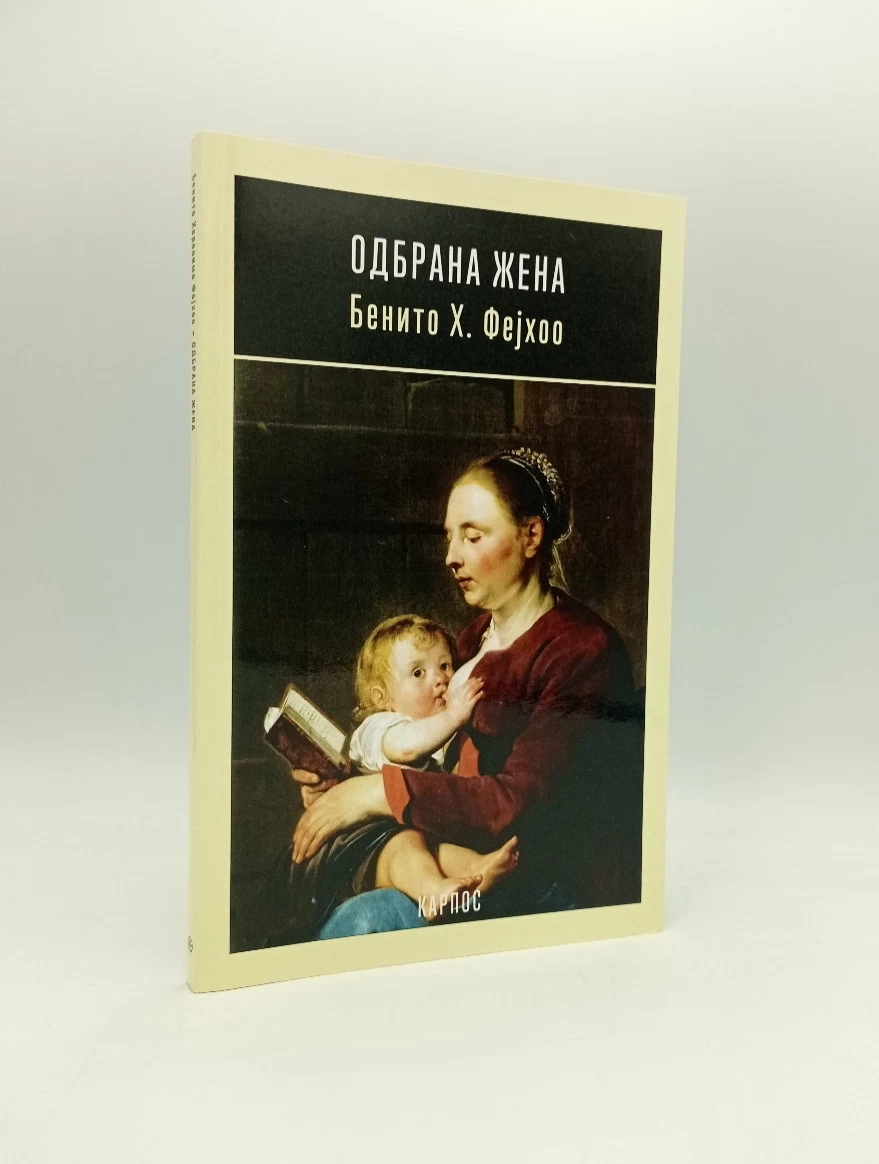

Feijoo Benito Jeronimo: Odbrana žena
€ 10,00
Free delivery in Croatia for orders over EUR 70
Basic information
- Author: Feijoo Benito Jeronimo
- Publisher: Karpos
- Availability: Available
- Condition: Nova knjiga
- Code: 54192
Shipping options
GLS Croatia
5€
Delivery
0€
Personal collection at the antique store
0€
GLS parcel machine
3€
Payment methods
Pay on pickup
CorvusPay
By general payment / Virman / Internet banking
Cash on delivery
Odbrana žena
Feijoo Benito Jeronimo
Summary
Benito Jeronimo Feijoo: Defense of Women
Unlike the famous educators, their Spanish forerunner, the Benedictine Hieromonk Benito Jerónimo Feijoo (Benito Jerónimo Feijoo, 1676–1764), in his attacks on ignorance, prejudices and heresies, included the then widespread belief that women were inferior to men in every respect, especially in intellectual abilities. The idea of gender equality was foreign to the French enlighteners, and hence Fejho's ideas about equality from the "Defence of Women", a treatise first published in 1726, will find a counterpart only at the end of the 18th century, while his method of defending and proving the value of the female gender - citing women of different nationalities who are significant as rulers, artists or wise women - will be met again 150 years later by John St. Milla in the work "Subjugation of women" (1869). "Defense of Women" is undoubtedly an avant-garde text, which has been neglected or unknown for a long time in feminist literature and in Western European cultural memory in general, a text whose argumentation partly still seems progressive and convincing today. If it is true that women are more uneducated than men, it is certainly not, Feijoo claims, because there are some medical predispositions for this (and these were then often understood within the framework of the pseudo-scientific Aristotelian tradition of thought, which Feijoo vehemently criticizes), but because they are systematically denied opportunities for education. Feijoo sees a woman as a person who deserves the same respect as a man, sees motherhood as a woman's choice, and intelligence and ability as something that is not conditioned by a person's gender.
Additional information
- Author: Feijoo Benito Jeronimo
- Publisher: Karpos
- Year of publication:2019
- Place of publication:Loznica
- Pages:90
- Dimensions:14x21 cm
- Script:Ćirilica
- Condition:Nova knjiga
- Binding:Meki
You may also like




Recently viewed

Biblos Newsletter
For book lovers who enjoy finding the rare
New titles, special copies and quiet recommendations from the antiquarian bookshop.