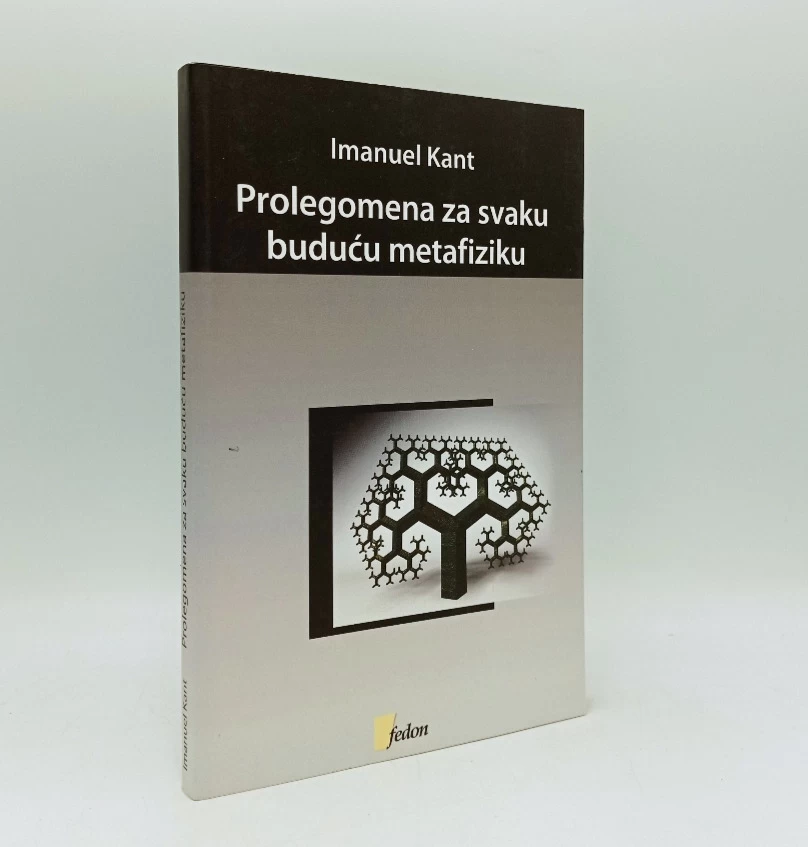

Kant Immanuel: Prolegomena za svaku buduću metafiziku
€ 10,00
Free delivery in Croatia for orders over EUR 70
Basic information
- Author: Kant Immanuel
- Publisher: Fedon
- Availability: Available
- Condition: Nova knjiga
- Code: 41324
Shipping options
GLS Croatia
5€
Delivery
0€
Personal collection at the antique store
0€
GLS parcel machine
3€
Payment methods
Pay on pickup
CorvusPay
By general payment / Virman / Internet banking
Cash on delivery
Prolegomena za svaku buduću metafiziku
Kant Immanuel
Summary
Immanuel Kant: Prolegomena for any future metaphysics
Certainly the three great Critiques (Critique of Pure Reason, Critique of the Power of Judgment, and Critique of Practical Reason) are Immanuel Kant's most famous works. But these ingenious books are extremely complex, and Kant's ideas are very original and astonishing, that Kant himself, on several occasions, composed shorter writings to clarify some particularly difficult parts. In time, these shorter writings attained the fame—though probably not the importance—of Kant's great works. The prolegomena for any future metaphysics is one of those books. Already in the first sentence, Kant says that he did not intend the book for students, but for teachers, and immediately adds that this is not a mere manual, an instruction for lectures of an already existing science, but material for the construction of a new science. This future science has an old name but, according to Kant, a completely new content. The name metaphysics no longer means what it meant for thousands of years, the study of what transcends nature, but now metaphysics refers to the conditions of the possibility of knowledge. Therefore, in order to examine the conditions of the possibility of cognition, it is necessary to understand what are analytical and what are synthetic judgments a priori, what is reason and what is mind, and what is empiricism and what are categories. Therefore, the repertoire includes everything that is already in Critique of the Pure Mind, the only thing is that the text is not 600 but 150 pages long. After all, this is exactly what justifies the introductory nature of this book. The characteristic of a genius author like Kant is that he does not repeat mechanically what he came up with, but introduces something new into the text each time. The precise and successful formulation itself is a step further compared to the previous text, but in the process of explaining to others, Kant also explained to himself the insufficiently transparent parts. Therefore, Prolegomena is undoubtedly, despite its relatively modest ambition, a separate work of perhaps the greatest philosopher in history.
Additional information
- Author: Kant Immanuel
- Publisher: Fedon
- Year of publication:2008
- Place of publication:Beograd
- Pages:174
- Dimensions:13x20 cm
- Script:Latinica
- Condition:Nova knjiga
- Binding:Meki
You may also like




Recently viewed


Biblos Newsletter
For book lovers who enjoy finding the rare
New titles, special copies and quiet recommendations from the antiquarian bookshop.