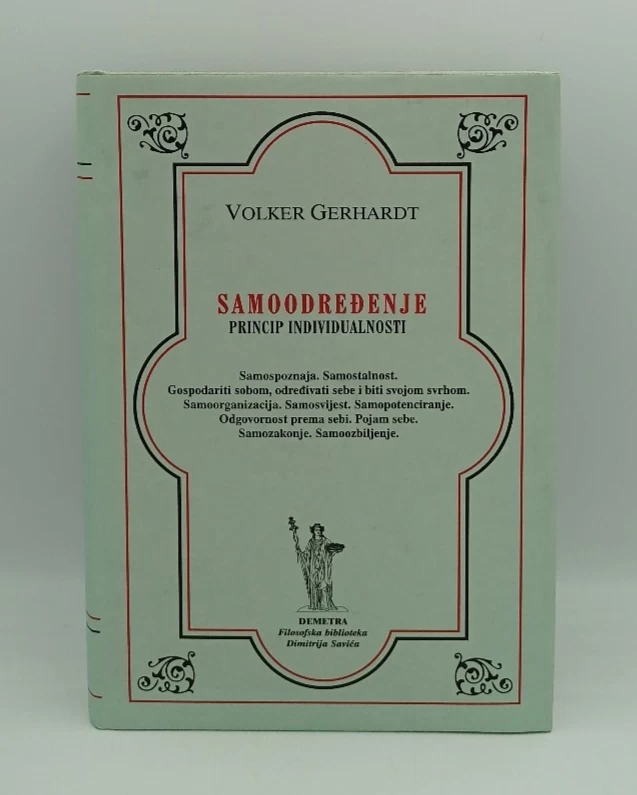

Gerhardt Volker: Samoodređenje princip individualnosti
€ 38,00
Free delivery in Croatia for orders over EUR 70
Basic information
- Author: Gerhardt Volker
- Publisher: Demetra
- Availability: Available
- Condition: Odlično
- Code: 48458
Shipping options
GLS Croatia
5€
Delivery
0€
Personal collection at the antique store
0€
GLS parcel machine
3€
Payment methods
Pay on pickup
CorvusPay
By general payment / Virman / Internet banking
Cash on delivery
Samoodređenje princip individualnosti
Gerhardt Volker
Summary
Volker Gerhardt: Self-determination, the principle of individuality
Self-knowledge. Independence. Mastering yourself, defining yourself and being your own purpose. Self-organization. Self-awareness. Self-empowerment. Responsibility to yourself. The concept of self. Self-law. Self-realization.
The author undertakes an attempt to establish a new type of ethics in the explicit preparation of a 'philosophy of politics'. He offers a whole philosophy in order to explain what a free relationship with oneself consists of. The book is a rare case in the German language area of a purely systematically written text, which does not first lead its reader through lengthy interpretations of older and newer classics. This draft is beneficially free from false considerations and excessive caution. At the same time, the concept of self-determination formulated by Gerhardt is extremely powerful. A self-determined individual is able to dispose of himself. He appropriates the internal and external conditions of his existence by developing insights and norms that become the basis of his actions. But self-determination in the full sense is achieved only where the individual 'as a whole' is understood from its own foundations: where it has developed a unique 'concept of self', which acts as an obligatory measure of its behavior. Only in this way does he reach the 'self-establishment of his own act', in which he has the freedom to live the way he wants.
Additional information
- Author: Gerhardt Volker
- Publisher: Demetra
- Year of publication:2003
- Place of publication:Zagreb
- Pages:336
- Dimensions:18x25 cm
- Script:Latinica
- Condition:Odlično
- Binding:Tvrdi s ovitkom
You may also like









Recently viewed

Biblos Newsletter
For book lovers who enjoy finding the rare
New titles, special copies and quiet recommendations from the antiquarian bookshop.