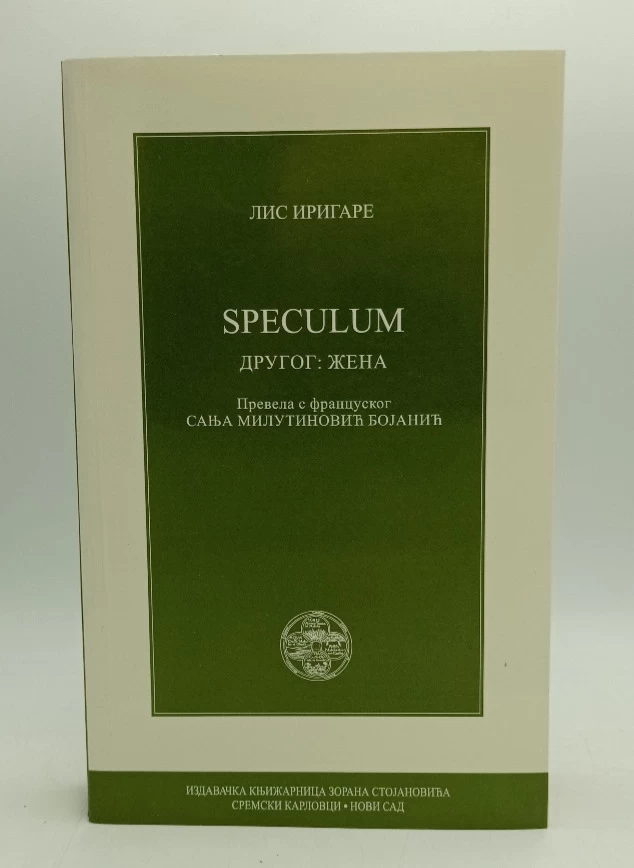

Irigaray Luce: Speculum, drugog: žena
€ 33,00
Free delivery in Croatia for orders over EUR 70
Basic information
- Author: Irigaray Luce
- Publisher: Izdavačka knjižarnica Zorana Stojanovića
- Availability: Available
- Condition: Nova knjiga
- Code: 47040
Shipping options
GLS Croatia
5€
Delivery
0€
Personal collection at the antique store
0€
GLS parcel machine
3€
Payment methods
Pay on pickup
CorvusPay
By general payment / Virman / Internet banking
Cash on delivery
Speculum, drugog: žena
Irigaray Luce
Summary
Luce Irigaray: Speculum, of the Other: Woman
Luce Irigaray explores the notion of woman as the "Other". Irigaray argues that women in Western patriarchal culture function as mirrors for men. The title of the first part is suggestive: Speculum is an instrument that gynecologists use when examining the internal organs of the female body, an instrument of power that makes women objects of interest. The world focuses on "the man" as the subject. All others are marginalized or made an object for his use. Irigaray says that woman "doesn't exist yet" because our discourse is incapable of presenting woman as anything other than a negative reflection of man. Dealing with the discursive constructions of "female sexuality", she would like to talk about it without using the terms prescribed by the male way of thinking. Women should be freed from "expropriation" within the framework of patriarchal culture.
Irigarayeva's work has its starting point in linguistics and psychoanalysis and was influenced by the ideas of the French theorist Jacques Lacan, whom she criticizes. She engages in a philosophical discussion about the reality of women's lives and expresses concern for ethics and social contracts. Irigaray modifies Lacan's concepts of "imaginary" and "symbolic" because he believes that his theories can only be applied to male subjects. When Lacan offers explanations of the development of women and men, he is in effect offering a "representation" that identifies woman with the mother, with the primordial lost object that creates desire. Although he argues that human identity is formed in discourse, he reduces the female body to a function of biological reproduction, which lies beyond culture or the symbolic. Irigaray points out that women, in the history of thought or symbolic organization, have been given unwanted characteristics of men. They are associated with loss, worthlessness and death drives. A woman is at the same time "decline" and "elevation". As long as a woman is viewed through the eyes of men, she remains in the domain of "unrealized possibility". As a way of fighting against this symbolism, Irigaray advocates and adopts the strategy of "mimesis", which should deliberately assume the "female role" in order to point out the exploitation of women by the phallic discourse.
One of the most important contributions to Irigaray's feminist literary criticism is her valorization of women's relationships and experiences. Irigaray observes that the theories of the unconscious, shaped by men, hardly touch on the relationship of a woman with her mother and the relationship between women themselves. She believes that the "murder" of the mother results in the "non-punishment" of the son and the burial of the woman "in madness". According to Irigaray, mothers, and women among them, are "trapped" in the role of one who "satisfies needs" but at the same time does not have access to desire. This is why women are paralyzed or become hysterical, because they have no way, no metaphor to express their desire. In her works, Irigaray often uses wordplay to suggest the fluidity and plurality of female sexuality and expression. Therefore, her metaphor for women's style is "two lips", which indicates contact with one's body, self-sufficient jouissance (fr. pleasure, enjoyment), exchange and the existence of an alternative discourse. She prefers to use the vaginal lips rather than the phallus as a model of textual sexual subjectivity. "Parler-femme" - to speak as a woman, will become possible only when women can find their imaginary experience in which they can place their desires and lived experiences.
Additional information
- Author: Irigaray Luce
- Publisher: Izdavačka knjižarnica Zorana S...
- Year of publication:2014
- Place of publication:Novi Sad
- Pages:462
- Dimensions:14x23 cm
- Script:Ćirilica
- Condition:Nova knjiga
- Binding:Meki s ovitkom
You may also like




Recently viewed
Biblos Newsletter
For book lovers who enjoy finding the rare
New titles, special copies and quiet recommendations from the antiquarian bookshop.