
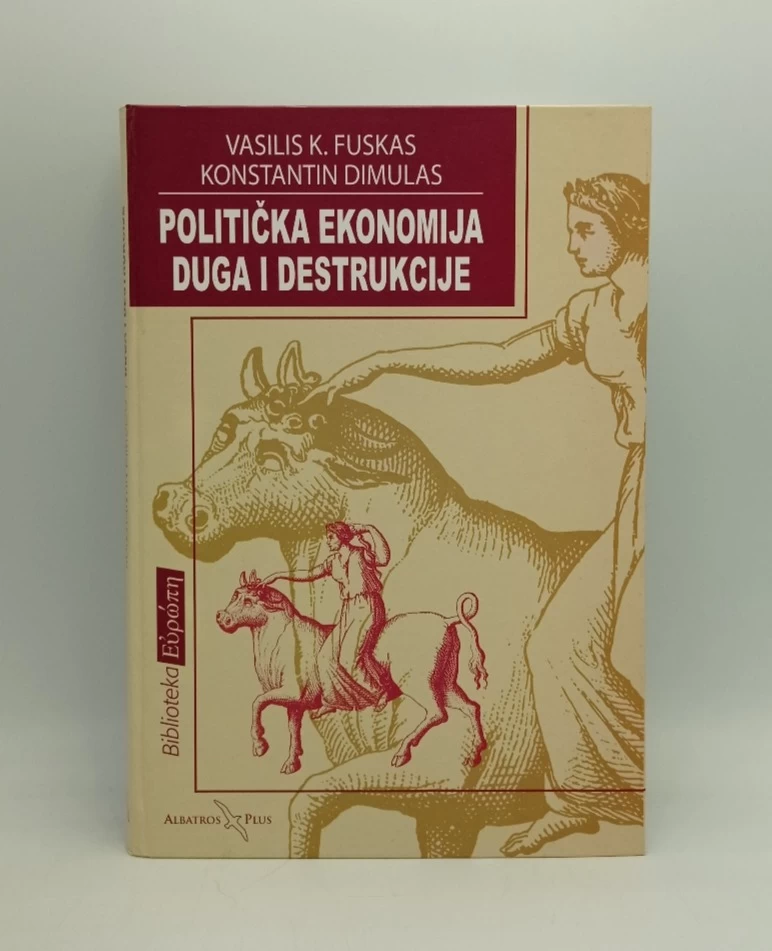
Politička ekonomija duga i destrukcije
Basic information
- Author: Dimoulas Constantine | Fouskas Vassilis
- Publisher: Albatros plus
- Availability: Available
- Condition: Excellent
- Code: 48519
Shipping options
Payment methods
Explore more
Politička ekonomija duga i destrukcije
Dimoulas Constantine | Fouskas Vassilis
Summary
Vassilis Fouskas, Constantine Dimoulas: The Political Economy of Debt and Destruction
The book provides an overview and interpretation of the Greek debt crisis, but also its stimulating factor found in the economic and monetary policy of the European Union. The authors analyze the economic factors of the Greek financial disaster observed in a historical and contemporary perspective. That broader temporal and deeper structural context of the crisis conditioned a view that strengthens the economic approach with a geopolitical explanation of the contemporary Greek and European situation. According to the authors, not only Greece but also the crisis situation of the entire European Union is characterized by a relationship of dependence on the Washington center from where multiple bilateral relations with numerous subordinate participants are managed according to the point model (hub and spider).
Greece differs from other EU members in its long-term continuity of dependence, practically from the acquisition of independence in the thirties of the 19th century until today. It built a bad tradition of comprador elites - political and economic - who knowingly sacrificed the nation's interests for their narrow, lucrative ties with Western partners. In the wave of borrowing, systematically encouraged since the beginning of this century, the Greek ruling political-economic class, embodied in the two-party alternating rule, was the most comfortable and the most hazardous towards the future of the nation. In the socio-Darwinian conditions of the ruling neoliberal model, the disorganized financial capital swallowed up the Greek economy.
The book covers events and situations up to the middle of 2013, but the reader will easily find a link to the interpretation of Fuskas and Dimulas until today, when it is clear that the great efforts of Greek and European actors produce only movement in the same place of crisis. For our reader, the book is particularly useful, as it provides a sobering look at the nature of the European Union and Western financial capital beyond the seductive theories and ruling political narratives.
Slobodan Samardžić
Additional information
- Author: Dimoulas Constantine | Fouskas...
- Publisher: Albatros plus
- Year of publication:2015
- Place of publication:Beograd
- Pages:272
- Dimensions:17x24 cm
- Script:Latin script
- Condition:Excellent
- Binding:Hardcover
Reviews
0 reviewsWrite a review
Share your experience and help other readers choose.
This item has no reviews yet. Be the first to share your experience.
More books from Albatros plus





You may also like