
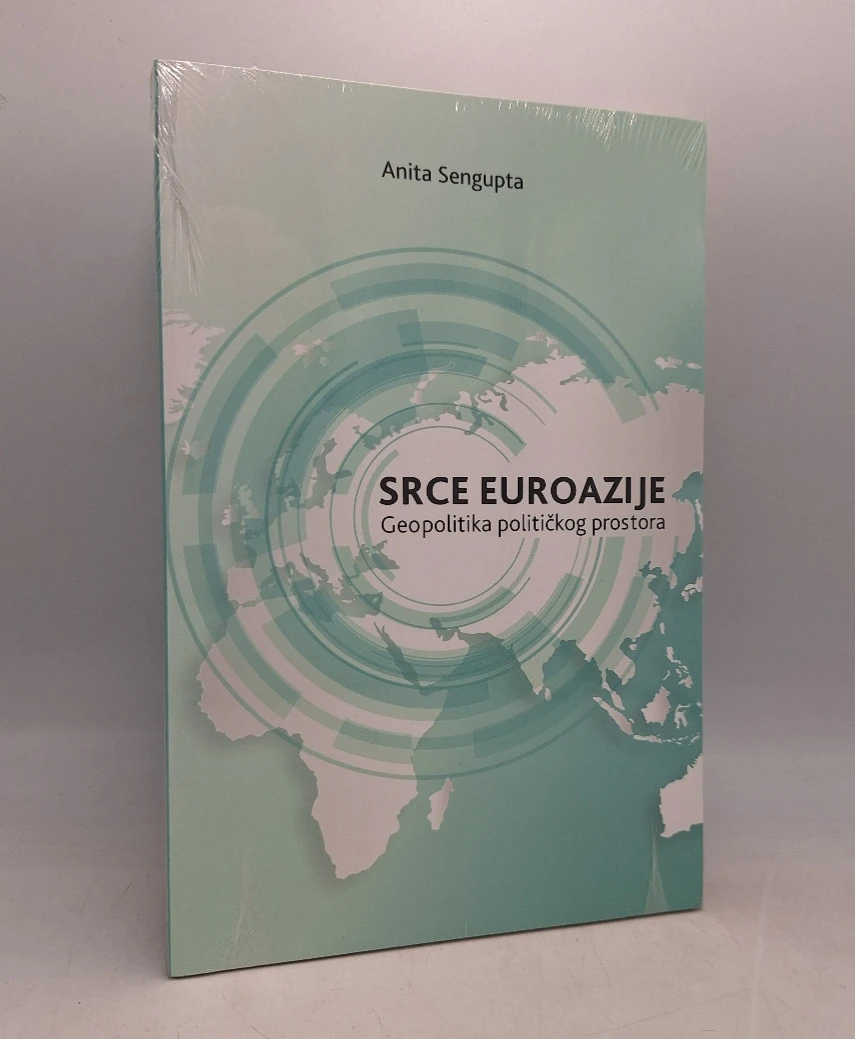
Srce Euroazije - Geopolitika političkog prostora
Basic information
- Author: Sengupta Anita
- Publisher: MATE | ZŠEM
- Availability: Available
- Condition: New book
- Code: 83304
Shipping options
Payment methods
Explore more
Srce Euroazije - Geopolitika političkog prostora
Sengupta Anita
Summary
Anita Sengupta: The Heart of Eurasia - The Geopolitics of Political Space
The Heart of Eurasia is a fascinating and detailed study of the interpretations and reinterpretations of Halford Mackinder's theory of the center of history and the "heartland" that Eurasia is now considered to be. Although the theory has been discussed and expanded for decades, it has not lost either its significance or its importance. In Russia, the debate about Eurasianism is eternal. Where is the fate of Russia? Is Central Asia Mackinder's center of history? From the perspective of space, identity, ethnic composition and natural resources, Central Asia is the hub and Uzbekistan is the center. These aspects are examined in detail in the book and the author should be commended for including the views of Central Asian scholars and leaders. A valuable contribution to knowledge and learning. - Nirmala Joshi, India-Central Asia Foundation
The book explores how acquired metageographical knowledge affects the understanding of global processes and is subsequently transformed into geopolitical thinking with foreign policy implications. The book provides a detailed survey of writings, both from the region and beyond, that consider the significance of Halford Mackinder's legacy in the context of a vastly changed world situation. In particular, it seeks to examine how policy makers and strategic thinkers used these geopolitical concepts as a justification for their policies in the region. Finally, it tries to analyze the extent to which this political thinking has been translated into practice.
From the foreword by Zvonimir Stopić
The current crisis of globalism that the world is facing at this moment is caused by the clash of opposing administrative and management ideologies, in which the American, Chinese, Russian and European ones are leading the way. These state and supra-state entities, against the backdrop of various "interventions" in countries such as Iraq, Afghanistan, Syria and Libya or strategic positioning, such as the one in the South China Sea, Ladakh, Georgia or Ukraine, always under the pretext of national or "global security", have diligently educated their statesmen, politicians, creators of economic and political solutions and bureaucrats for decades, creating an ideal basis for misunderstanding almost any or any "other". This process, which has its origin in the clashes of the "big" during the Cold War history, continued to develop in the background of media news after the collapse of the Soviet Union, and gained particularly recognizable momentum during the administration of US President Donald Trump. First of all, Trump's trade war with China, during which the "West" began to learn how to see China as an enemy, only gave rise to the ever-present Chinese suspicion of Western powers to further flare up and put itself on an even greater "state of alert". pulled between different state and economic systems, cultures, "nations", religions and societies. Immediately before and especially during Trump's presidency, we also learned how easy it is to take a step backwards in the ecological sense and how to effectively, with the manipulation of technology and media full of "real truths", "post-truths" or "half-truths", focus on internal and external enemies who, despite the general growth or stabilization of living standards in the West, threaten us for one reason or another.
Ultimately, the circumstances of Russia's "special intervention" in Ukraine, as well as what preceded it, developed the West, and above all the European Union, faced partly with the fact that despite the denial of its possibility and probability in Europe, war is very possible, and partly with the fact that outside the European Union, war has never ceased to be seen as a tool of foreign policy...
For Croatia itself, the book Heart of Eurasia is significant because it brings discussions and authors closer to almost completely unknown Croatians. to the academic community. It introduces new terms into the Croatian scientific vocabulary related to geopolitics, such as the very term "heartland region", many of which are an integral part of the vocabulary used in the theory and practice of international relations. Furthermore, the book talks about relations between countries and parts of the world that are not discussed in Croatia, and the understanding of which will certainly prove to be important in constructing a better, more stable and safer future for both the European Union and the Republic of Croatia. Considering the current position of the European Union, the "heartland region" should certainly not become another European failure.
About the author
ANITA SENGUPTA is a research associate at the Maulana Abul Kalam Azad Institute of Asian Studies in Kolkata. She is the author of the books Russia, China and Multilateralism in Central Asia, The Formation of the Uzbek Nation-State: A Study in Transition, Lanham, Boulder and Forntiers into Borders: The Transformation of Identities in Central Asia.
Additional information
- Author: Sengupta Anita
- Publisher: MATE | ZŠEM
- Year of publication:2022
- Place of publication:Zagreb
- Pages:189
- Dimensions:15x23 cm
- Script:Latin script
- Condition:New book
- Binding:Softcover
Reviews
0 reviewsWrite a review
Share your experience and help other readers choose.
This item has no reviews yet. Be the first to share your experience.
More books from MATE | ZŠEM
You may also like