
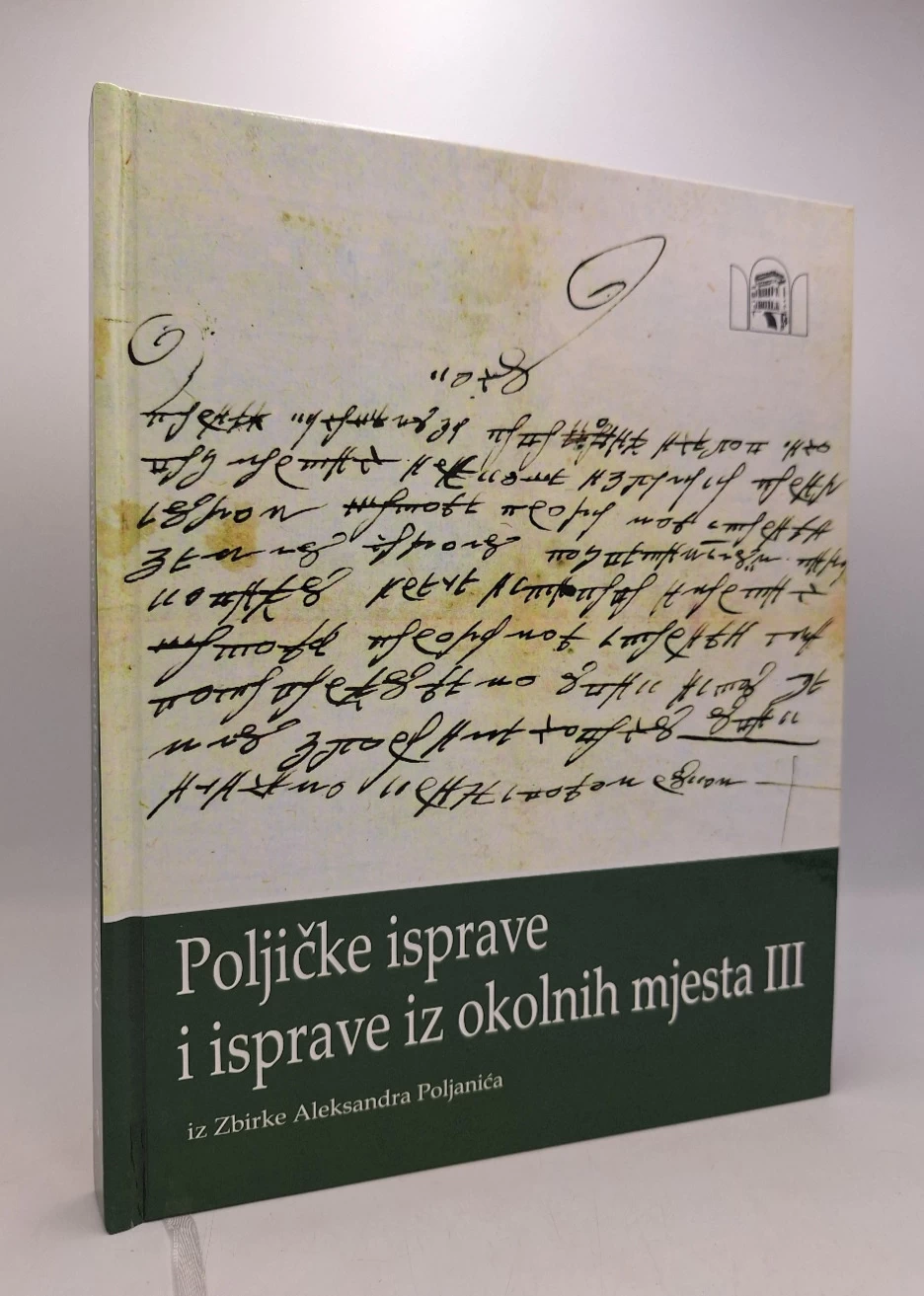
Poljičke isprave i isprave iz okolnih mjesta III (iz Zbirke Aleksandra Poljanića)
Basic information
- Author: Žero Adisa
- Publisher: Nacionalna i univerzitetska biblioteka
- Availability: Available
- Condition: New book
- Code: 80073
Shipping options
Payment methods
Explore more
Poljičke isprave i isprave iz okolnih mjesta III (iz Zbirke Aleksandra Poljanića)
Žero Adisa
Summary
Polish documents and documents from surrounding towns III (from the Collection of Aleksandar Poljanić)
Chief and responsible editor: Adisa Žero
Aleksandar Poljanić was born in Gradačac on January 7, 1884, in the family of Marko Poljanić, a well-educated official among whose close friends Fr. Grga Martić stood out. Father Marko died already in 1895; Alexander was only 11 years old at the time, but he still managed to get a good education. In Zagreb, he graduated from the Real Gymnasium, in Vienna he studied at the Academy of Commerce as a scholarship holder of the Government of Bosnia and Herzegovina, and for some time he also studied at the Faculty of Arts in Zagreb. After finishing his studies, he returned to Bosnia. He spent most of his working life in Sarajevo as director of the Zemaljska banka for Bosnia and Herzegovina (since 1943, general director).
He certainly started collecting before, but his collection was primarily created in the Sarajevo years (1922 - 1945). Sitting on the board of the largest monetary institution in Bosnia and Herzegovina, Poljanić had quite a solid income that allowed him to indulge his passion for collecting. He invested the acquired funds in the collection and preservation of cultural treasures, unlike some other bankers and businessmen whose money, invested in shares, would later be thrown into the wind (Poljanić owned only 84 shares of Zemaljska banka, and some other directors ten times more).
In search of various valuable objects, Poljanić maintained an extensive correspondence, but the Sarajevo banker's wide interest in collecting became known far and wide, so people from various parts of Bosnia and Herzegovina came to him and offered him the most diverse objects from Bosnia and Herzegovina's cultural heritage. Poljanić did not selfishly hide the collected cultural treasures, but, moreover, gladly offered them for inspection to interested researchers, and at the same time donated parts of the collection to public institutions. First of all, his multiple gifts to the Yugoslav (Croatian) Academy of Sciences and Arts, and especially the Academy's Oriental Collection, are worth mentioning, for which he remains one of the most significant individual donors to our highest scientific and artistic institution. In this case, we are talking about Poljanić's real pre-war gifts, but it is interesting that certain other parts of his alienated collection are also mentioned in the literature as gifts. Perhaps it is ignorance, but perhaps also an effort to avoid the mention of Poljanić's unfortunate fate...
After the confiscation, his collection was distributed and, to the greatest extent, incorporated into the collections of eight public institutions in Bosnia and Herzegovina. Certain particularly significant and valuable items from the collection were lost under unexplained circumstances. Perhaps the most valuable among them - the quadruple gold coin of the Bosnian king Stjepan Tomašević - briefly appeared in 1996, after which it sank into obscurity again (it was sold at a public auction in Zagreb to an anonymous bidder for HRK 235,000). Other parts of the collection were forgotten for a long time, so the almost bizarre case of one of Poljanić's bank safes, which remained forgotten until 1961, is known. Since there was no key, the safe had to be forcibly opened, and in it were found, among other things, the charter of the Bosnian king Stjepan Tomaš from 1459, a rich numismatic collection and a collection of old Bosnian books printed in the Bosnian script. Finally, it is worth mentioning at this point that Aleksandar Poljanić most likely stored the famous Sarajevo Haggadah, as well as other valuable items from the collection of the Sarajevo National Museum, in the vault of the Zemaljska Bank during the Second World War. Unsubstantiated theories have been circulated for decades about the rescue of the Haggadah, which have turned into legends to this day.
Aleksandar Poljanić was a distinctive personality who left a deep mark and gained immense merit for the culture of the people of Bosnia and Herzegovina, but the course of historical events pushed him into deep oblivion.
Additional information
- Author: Žero Adisa
- Publisher: Nacionalna i univerzitetska bi...
- Year of publication:2024
- Place of publication:Sarajevo
- Pages:306
- Dimensions:22x28 cm
- Script:Latin script
- Condition:New book
- Binding:Hardcover
Reviews
0 reviewsWrite a review
Share your experience and help other readers choose.
This item has no reviews yet. Be the first to share your experience.
More books from Nacionalna i univerzitetska biblioteka
You may also like