
Alexander Solzhenitsyn from the Gulag to the Nobel Prize
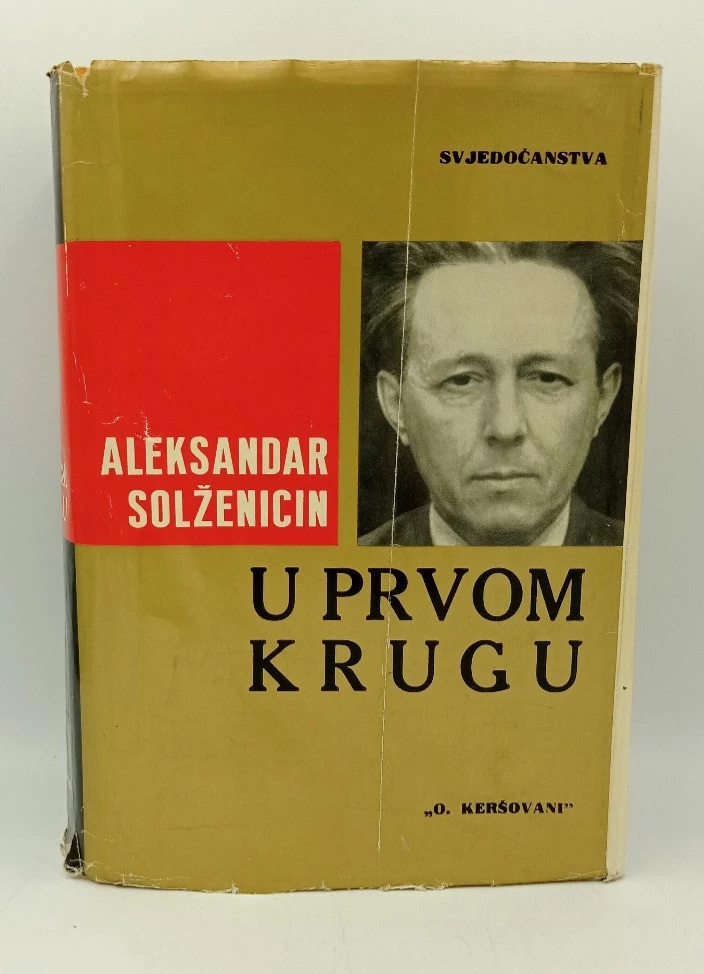
Aleksandar Solzhenitsyn was born in 1918 in Kislovodsk, Russia, in a family of Cossack intellectuals.
His father, who was of Russian origin, died in an accident before Alexander was born, and he was raised by a Ukrainian mother. They lived in difficult financial circumstances. His mother was educated, so she encouraged her son to read from childhood.
He started writing at an early age, but still decided to study physics and mathematics.
After the attack of Nazi Germany on the Soviet Union, Solzhenitsyn voluntarily enlisted in the Red Army where he rose from an ordinary soldier to commander, and participated in the liberation of the Russian city of Orel and the German capital of Berlin.
During those military actions, he witnessed war crimes against civilians committed by Soviet troops. It was the beginning of Solzhenitsyn's disillusionment with the communist regime.
At the beginning of 1945, he wrote a private letter to a friend in which he criticized the Soviet dictator Joseph Stalin, after which he was arrested and imprisoned for "counter-revolutionary activities".
Solzhenitsyn spent eight years in prisons and labor camps, during which he also suffered from cancer. In the camps, he did manual labor such as mining and bricklaying and at the same time participated in scientific research.
After the end of his prison sentence, in 1953, he was sent to internal exile in Kazakhstan. In that period of his life, Solzhenitsyn completely abandoned Marxism and accepted the Orthodox faith.
"The meaning of earthly existence is not, as we are used to thinking, in prosperity, but in the development of the soul." Alexander Solzhenitsyn
Literary style
Alexander Solzhenitsyn's writing style He followed the tradition of classical Russian narrative prose, mainly Tolstoy, with several innovations that are characteristic of European modernism. In most of his works, the writer told the events of the past exactly as they happened, following a logical sequence and connection.
Through his characters, he gave readers an insight into the human psyche and the political pressure he endured during his stay in the camps. Some of the main themes in his works are:
- warfare
- politics
- Soviet socialist realism
- history
Alexander Solzhenitsyn, according to his literary work, belongs to the most significant prose writers of the 20th century.
Works of Alexander Solzhenjicin
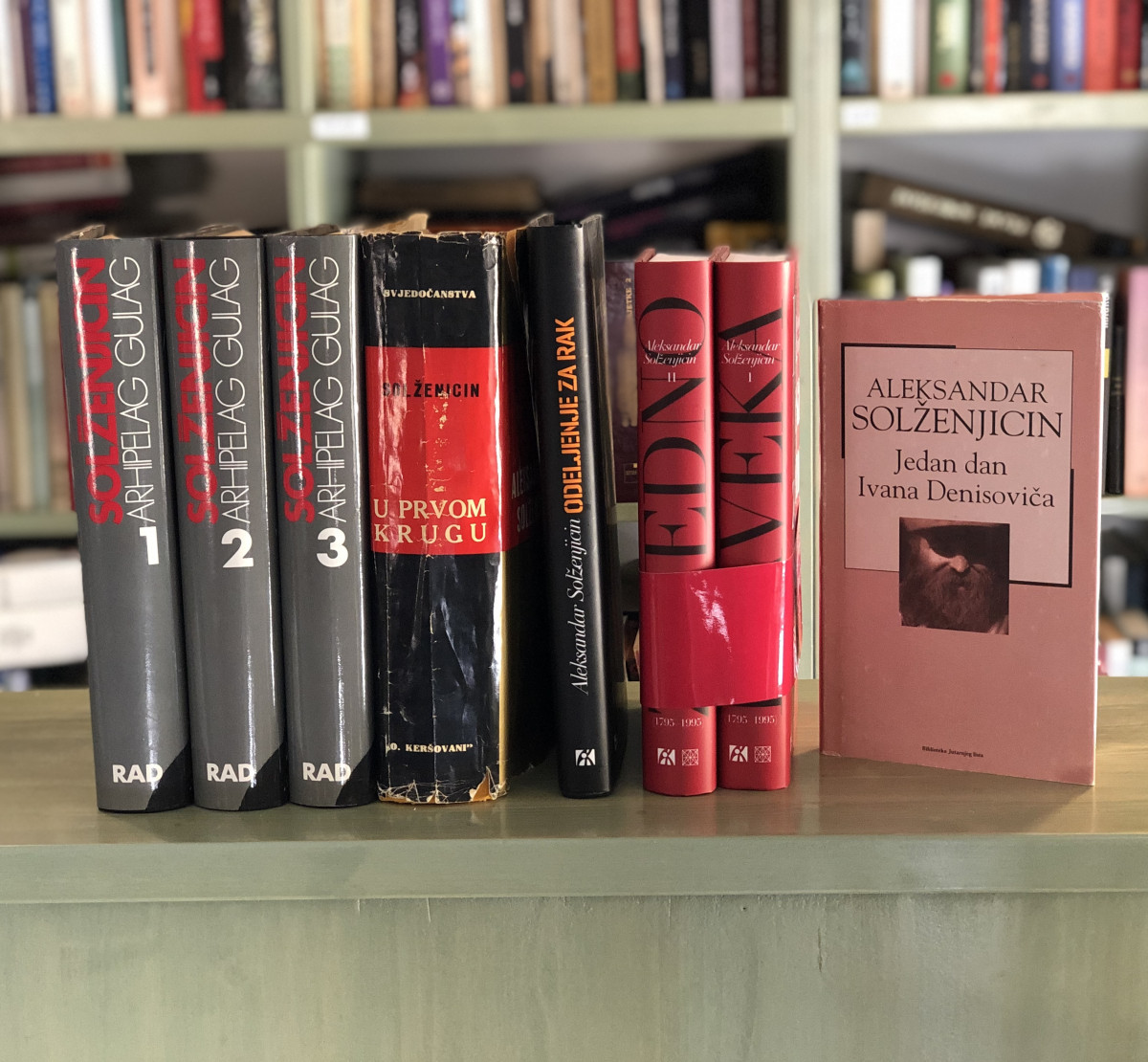
Photo: Antikvarijat Biblos
The Gulag Archipelago
This is a book that was included among the hundred best works of the 20th century. It was written in 3 volumes. The Gulag Archipelago is an exhaustive and convincing account of life in the Soviet prison camps. It is based on the personal experience of Alexander Solzhenitsyn, who spent almost eight years in them, then on the stories of other prisoners and historical sources. The book represents the author's attempt to write a literary and historical account of the terror of the Soviet Union. regime against its own population.
The first two volumes describe the arrests, convictions, transportation and imprisonment of Gulag victims. The third volume documents escape attempts and subversion within the system.
In the West, it was believed that Stalin was primarily responsible for forced labor in the camps, and not indirectly the Soviet regime. In his book, however, Solzhenitsyn explains that the problem of the camps goes back to Lenin and the beginning of the socialist state.
One Day by Ivan Denisovič
The short novel by Alexander Solzhenitsyn was published in 1962. In the book, the author described a typical day in the life of a camp inmate.
It is the story of a labor camp prisoner, Ivan Denisovič, who struggles to maintain his dignity despite the constant oppression of the dark communist regime.
On every page of the novel the reader can feel the pain that the author himself experienced in the Gulag. It is narrated in the direct and vivid language of an uneducated prisoner and clearly depicts not only Stalin's camp, but also Russian society in general.
The novel is significant in that it is the first Russian literary work in which this taboo topic was openly discussed. Censorship was avoided only because at the time of the book's publication, the demolition of Stalin's personality cult had begun.
In the first round
In the first round literary critics evaluated it as an important stage in the writer's oeuvre and as one of the most important texts written in contemporary Russia.
The action takes place in a Stalinist camp, but a camp on a "higher level", infinitely far from the usual level of Siberian camps. It is a camp that is actually a scientific and research center, called šaraška.
There, a group of scientific workers, arrested for no particular reason, work on a highly specialized project - the creation of special encrypted telephony systems.
The novel takes place in the period from Christmas to New Year, and describes the experiences of numerous men and women who endured the horrors of the camps, the experience of forced labor, and absurd accusations, but regardless of everything, they still hold on to their humanity made of love and intense spirituality. of life.
Satire is visible on all levels, and primarily in the sarcastic portrait of Stalin.
Two centuries together (1795 - 1995) I-II (Ekavica edition)
The book was published in two volumes. The first volume covers the period from 1772 to the Russian Revolution in 1917. Solzhenitsyn talks about the history of the Russians and their coexistence with the 100,000 Jews who lived there.
He writes that the crimes against Jews that took place in the Russian Empire were mostly not organized by the government, but rather spontaneous outbursts of violence.
Solzhenitsyn says that the life of Russian Jews was difficult, but no more difficult than the life of Russian peasants. In the second part, the action takes place in the period after the revolution until 1970. During that period, many Jews left Russia and went to Israel and Western countries.
In the book, the author does not impose his opinion, but by quoting many public figures of the time, he gives the reader the opportunity to look at the problem from different angles. ekavici)
The novel Cancer Department was banned in the Soviet Union. The author based the book on his own hospitalization and successful treatment of supposedly terminal cancer during forced exile in Kazakhstan in the mid-1950s of the 20th century. ;
The story explores the moral responsibility of those who were involved in Stalin's great purge from 1936 - 1938. During those years, political dissidents were exiled, killed or sent to camps.
The patients as a group, however, represent the spectrum of characters and values of the people of modern Russia, excellently analyzed both in normal conditions and in advanced stages of the disease.
This is a significant literary work that represents a faithful testimony of the difficult life in the Soviet Union.
Private life
Aleksandar Solzhenitsyn married twice. He met his first wife, Natalia Alekseevna Reshetovska, at the University of Rostov, and the couple married in 1940. A year later, he went to the war that took fifteen years of his life. He was imprisoned and tortured in the Gulag.
He married Natalia Dmitrievna Svetlova a second time and they remained together until the writer's death.
His Soviet citizenship was revoked, so Alexander Solzhenitsyn lived briefly in West Germany and Switzerland.
Then, at the request of Stanford University, he moved to the United States, and in 1978 he was awarded an honorary literary degree at Harvard University. There, in his famous speech, he strongly criticized Western materialism and excessive Western focus on individualism.
After almost twenty years spent in exile, Solzhenitsyn returned to his homeland where he continued to criticize the Russian government and society.
He won the Nobel Prize for Literature.
"Happiness is not a series of blessings, but our attitude towards them."
Aleksandar Solzhenitsyn Prepared by Marijana Matijević
Biblos Newsletter
For book lovers who enjoy finding the rare
New titles, special copies and quiet recommendations from the antiquarian bookshop.