

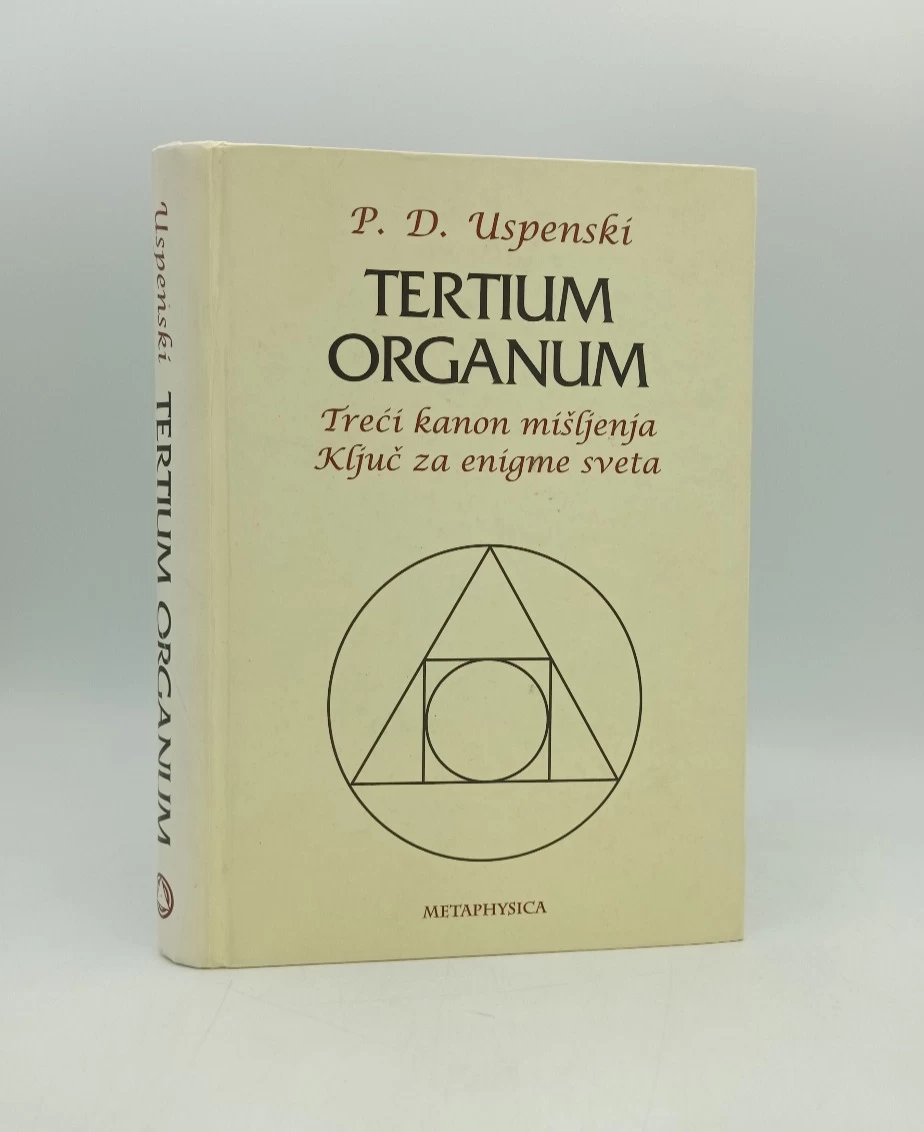
Tertium Organum
Basic information
- Author: Uspenski Pjotr Demjanovič
- Publisher: Metaphysica
- Availability: Available
- Condition: Excellent
- Code: 64969
Shipping options
Payment methods
Explore more
Tertium Organum
Uspenski Pjotr Demjanovič
Summary
Pjotr Demjanovič Uspenski: Tertium Organum
The third canon of thought
The key to the enigmas of the world
The author called this work the third canon of thought, that is, the logic of the future. Namely, he questioned the mysticism of the soul being and the objective world, which is realized through mystical logic. The first canon of thought is Aristotle's Organon, the second is Bacon's Novum organum, and the third is this one - Tertium organum, or organum mysticum. The book contains 23 chapters on many philosophical topics, and is used in most philosophy faculties as a textbook for metaphysics and philosophy. From the contents: The mystery of time and space; Shadows and reality, occultism and love; Mathematics of the infinite; The logic of ecstasy; Mystical Theosophy; Cosmic Awareness; New morality; The birth of superman.
Excerpt from the book - about positivism:
We are too used to "positivist" methods, so we don't notice that they often lead us to absurdity, and if we are looking for an explanation of the meaning of something, they do not lead to the goal at all.
The truth is that positivism is not suitable for explaining meaning. For him, nature is a closed book that he studies from the outside. Positivist methods go very far in studying the effects of nature, as evidenced by all the numerous successes of modern technical sciences, including aviation. But everything in the world has a certain area of activity. Positivism is very good when it seeks an answer to the question of how. But when he tries to answer the question why and wherefore, he becomes comical because he enters foreign territory.
However, more serious positivist thinkers deny any possibility of asking why and why in "positivist research". Positivist philosophy considers the search for meaning and purpose almost absurd. There is certainly some truth in this, because, from the positivist point of view, teleology is indeed nonsense. But the positivist view is not the only possible view. The mistake of positivism is that he sees nothing but himself and believes that everything is possible for him, or that many things that are quite possible, but not for him, are impossible.
Humanity will never stop looking for answers to the questions why and wherefore.
A positivist scientist finds himself in almost the same position in front of nature as a savage in a library full of valuable and rare books. The book is for a savage of a certain size and weight. No matter how much he thinks about what this strange thing can be used for, he will never understand it by its appearance, and the content of the book will remain an unfathomable noumen for him.
But if a person knows about the existence of the content of the book, the noumen, if he knows that behind the visible phenomena there is a hidden meaning, he will eventually grasp the essence of the book.
For such a thing, it is necessary to understand the idea of the content of the book, that is, the meaning of the thing itself.
The scientist who found tablets with hieroglyphs or cuneiforms letters in an unknown language, after a lot of effort he deciphers them and reads them. In order to read them, he needs only one thing: he must be familiar with the fact that the signs represent a letter. While he thinks that it is only an ornament, an external decoration on tiles or a random drawing without any connection with any meaning, until then their meaning and meaning will be completely unavailable to him. As soon as he assumes the existence of meaning, the possibility of understanding is created.
Every code can be read even without a key. But you should know it's a code. This is the first and necessary condition. Without it, nothing can be done.
The idea of the existence of a visible and a hidden side of life has long been known to philosophy. It was recognized that events or occurrences (phenomena) represent only one side of the world, visible, devoid of real existence, and which arises at the moment of our contact with the real world, a side of the world infinitely small compared to the other side. On the other hand, concepts (noumena) were considered to really exist by themselves, but are inaccessible to our perception.
But the biggest mistake is to consider the world divided into phenomena and concepts, to consider that phenomena and concepts are separate from each other, that they exist independently of each other and that gu perceive independently of each other. This complete philosophical ignorance is most clearly manifested in dualistic spiritual theories. The division into phenomena and concepts exists only in our perception. The "illusory world" is only our inaccurate representation of the world.
*The book is underlined in places with an ordinary pencil.
Additional information
- Author: Uspenski Pjotr Demjanovič
- Publisher: Metaphysica
- Year of publication:2007
- Place of publication:Beograd
- Pages:420
- Dimensions:15x21 cm
- Script:Latin script
- Condition:Excellent
- Binding:Hardcover
Reviews
0 reviewsWrite a review
Share your experience and help other readers choose.
This item has no reviews yet. Be the first to share your experience.
More books by Uspenski Pjotr Demjanovič

More books from Metaphysica













You may also like