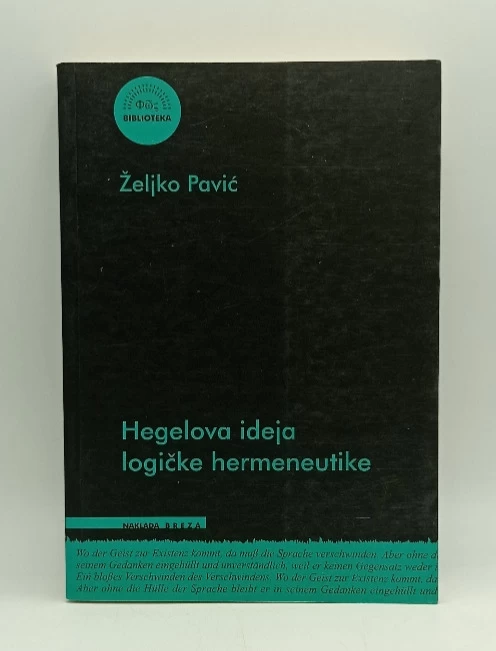

Pavić Željko: Hegelova ideja logičke hermeneutike
€ 9,29
Free delivery in Croatia for orders over EUR 70
Basic information
- Author: Pavić Željko
- Publisher: Breza
- Availability: Available
- Condition: Vrlo dobro
- Code: 52966
Shipping options
GLS Croatia
5€
Delivery
0€
Personal collection at the antique store
0€
GLS parcel machine
3€
Payment methods
Pay on pickup
CorvusPay
By general payment / Virman / Internet banking
Cash on delivery
Hegelova ideja logičke hermeneutike
Pavić Željko
Summary
Željko Pavić: Hegel's idea of logical hermeneutics
Self-learning of the absolute in the visible invisibility of language The phenomenon of language is not observed by Hegel systematically, but essentially phenomenologically. This means that language in Hegel's system does not play any constitutive role, but only appears on the pre-steps of the self-understanding concept. The "monstrous power" of language lies in language as an existential disappearance: it has a "divine nature" to essentially turn it into its opposite. Without this power of language, the self-movement of the spirit as a self-understanding perception would be impossible. In the Phenomenology of Spirit, the phenomenological role of language is much more important than the one assigned to language, for example, in the Encyclopedia of Philosophical Sciences, where language functions as a system of signs, although Hegel is aware of its importance as a native and national language. Despite this, language is an "arbitrary" product of theoretical intelligence and the "first sovereign right" of the mind to separate and differentiate itself from another in order to understand and abolish it as its own. Already in Jena's drafts of the system, language is the "first potency" of consciousness, by which it, before it begins to work, abolishes the otherness of otherness and enables the spirit to establish a relationship with the other in "its" product, in language.
Additional information
- Author: Pavić Željko
- Publisher: Breza
- Year of publication:2004
- Place of publication:Zagreb
- Pages:335
- Dimensions:15x21 cm
- Script:Latinica
- Condition:Vrlo dobro
- Binding:Meki s ovitkom
You may also like




Recently viewed
Biblos Newsletter
For book lovers who enjoy finding the rare
New titles, special copies and quiet recommendations from the antiquarian bookshop.