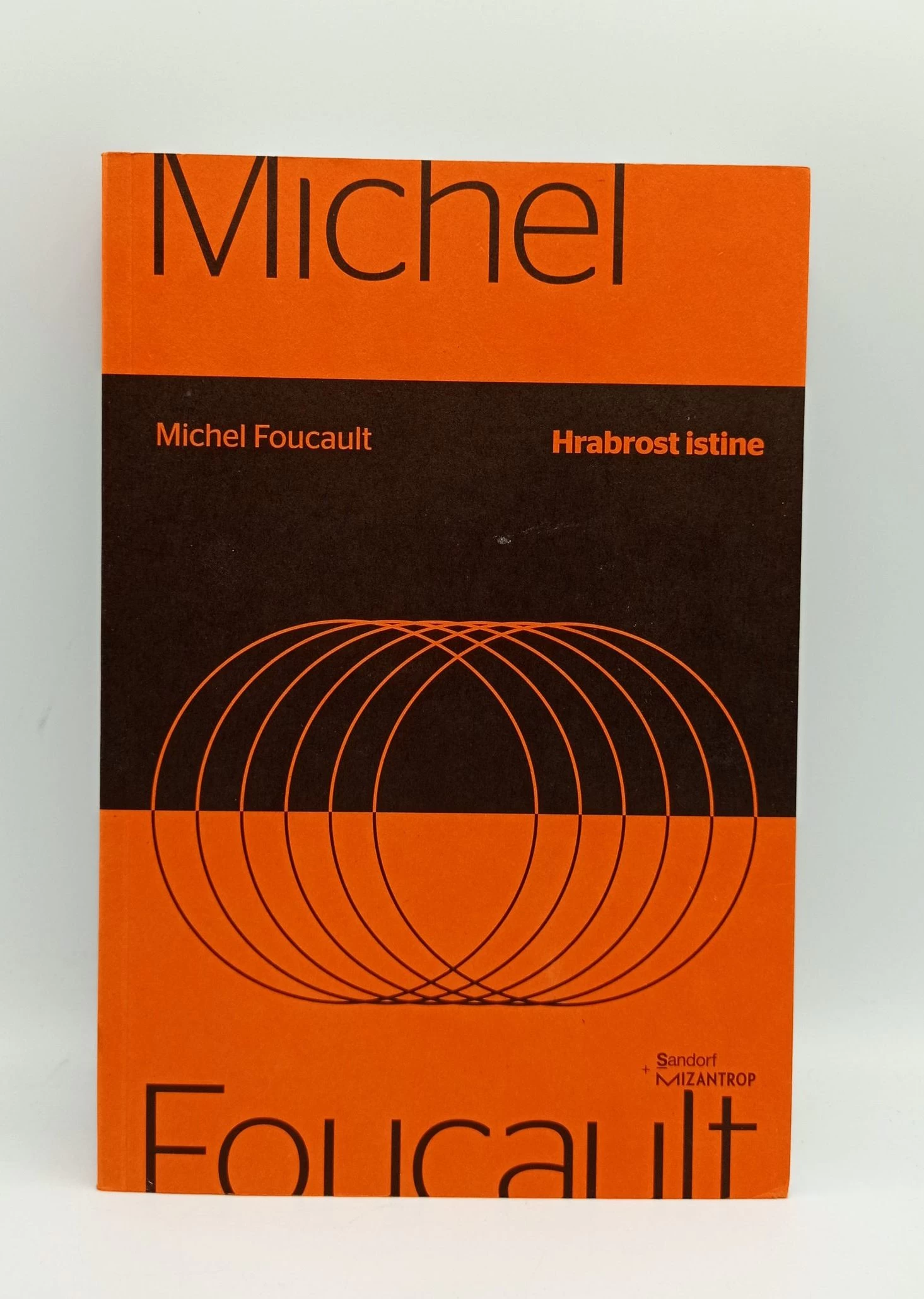

Foucault Michel: Hrabrost istine
€ 17,00
Free delivery in Croatia for orders over EUR 70
Basic information
- Author: Foucault Michel
- Publisher: Sandorf
- Availability: Available
- Condition: Nova knjiga
- Code: 46031
Shipping options
GLS Croatia
5€
Delivery
0€
Personal collection at the antique store
0€
GLS parcel machine
3€
Payment methods
Pay on pickup
CorvusPay
By general payment / Virman / Internet banking
Cash on delivery
Hrabrost istine
Foucault Michel
Summary
Michel Foucault: The Courage of Truth
The Courage of Truth forms a diptych with Governing Self and Others and is a continuation of Foucault's reflections on ancient philosophy and research on action in general, and on the activity of philosophers in particular. The courage of the truth. The lectures at the Collège de France (February and March 1984) are a direct extension and conclusion of a series of presentations on the topic of paresis, around which Foucault's latest research is organized, which he began to discuss in the Hermeneutics of the Subject course (1981). Through the play between stoicism and cynicism, between the intellectual and the difference, the reader, as always with Foucault's works, is encouraged to think and recontextualize in order to see what prevents change from happening in his era, that is, what prevents the flow of power. In The Courage of Truth, in Michel Foucault's last attempt to find in antiquity the possibilities of norms without normative mechanisms, he again shows himself as a thinker who always seeks to undermine the consolidation of power and enable its fluidity. French philosopher, psychologist and political theorist Michel Foucault (1926-1984). He taught at many universities (since 1970 at the College de France). Philosophically, he reflected on the origin of theories and practices of human science. He started from the notion of discourse as a set of assertions, practices, qualification schemes and objects of analysis that, although incompatible and contradictory, share a set of discursive rules that govern them. He opposed the opinion that started from understanding the development of the history of civilization as an uninterrupted history of progress governed by increasing rationality and believes that, on the contrary, the development of humanity was decisively influenced by discontinuity, interruption and randomness, as well as by the arbitrary and irrational. He introduced the concept of government into philosophical analysis and brought it into relation with the science of man, thus presenting the original theory of the system (state).
Additional information
- Author: Foucault Michel
- Publisher: Sandorf
- Year of publication:2015
- Place of publication:Zagreb
- Pages:324
- Dimensions:16x23 cm
- Script:Latinica
- Condition:Nova knjiga
- Binding:Meki
You may also like




Recently viewed



Biblos Newsletter
For book lovers who enjoy finding the rare
New titles, special copies and quiet recommendations from the antiquarian bookshop.