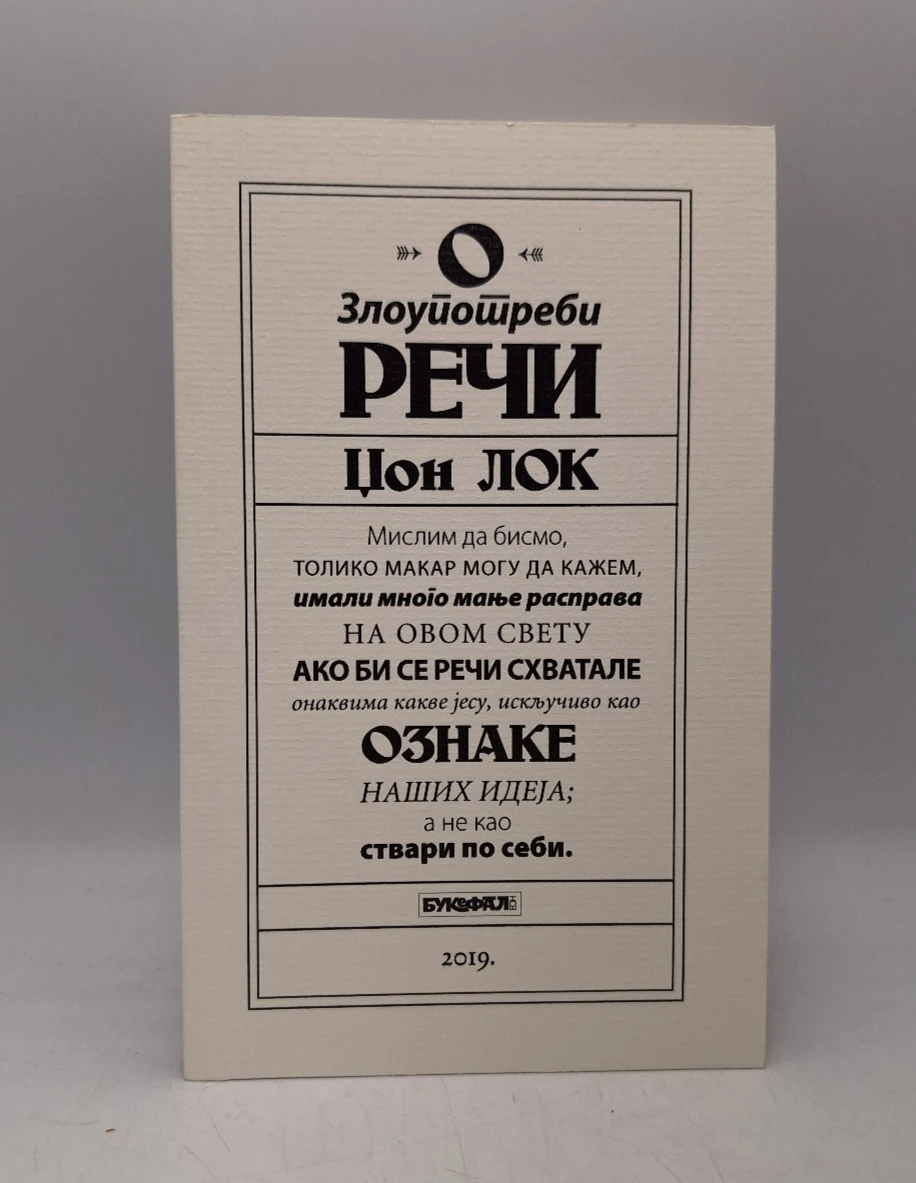

Locke John: O zloupotrebi reči
€ 10,00
Free delivery in Croatia for orders over EUR 70
Basic information
- Author: Locke John
- Publisher: Bukefal
- Availability: Available
- Condition: Nova knjiga
- Code: 81552
Shipping options
GLS Croatia
5€
Delivery
0€
Personal collection at the antique store
0€
GLS parcel machine
3€
Payment methods
Pay on pickup
CorvusPay
By general payment / Virman / Internet banking
Cash on delivery
O zloupotrebi reči
Locke John
Summary
John Locke: On the misuse of words
As one of the most influential English philosophers, and best known for his epistemological and political views, Locke believed that knowledge begins with simple sense observations and their transformation into complex abstract ideas, while as the founder of empiricism, he established a distinction between the primary properties of existence (things that can be evaluated) and secondary properties (color, smell, sound, etc.), perceiving them as the result of the influence of primary properties on a passively observed object, thus determining the essence of empiricism beyond innate ideas - in other words, it is a tabula rasa on which natural experience is engraved.
Additional information
- Author: Locke John
- Publisher: Bukefal
- Year of publication:2019
- Place of publication:Beograd
- Pages:79
- Dimensions:11x18 cm
- Script:Ćirilica
- Condition:Nova knjiga
- Binding:Meki
You may also like



Recently viewed






Biblos Newsletter
For book lovers who enjoy finding the rare
New titles, special copies and quiet recommendations from the antiquarian bookshop.