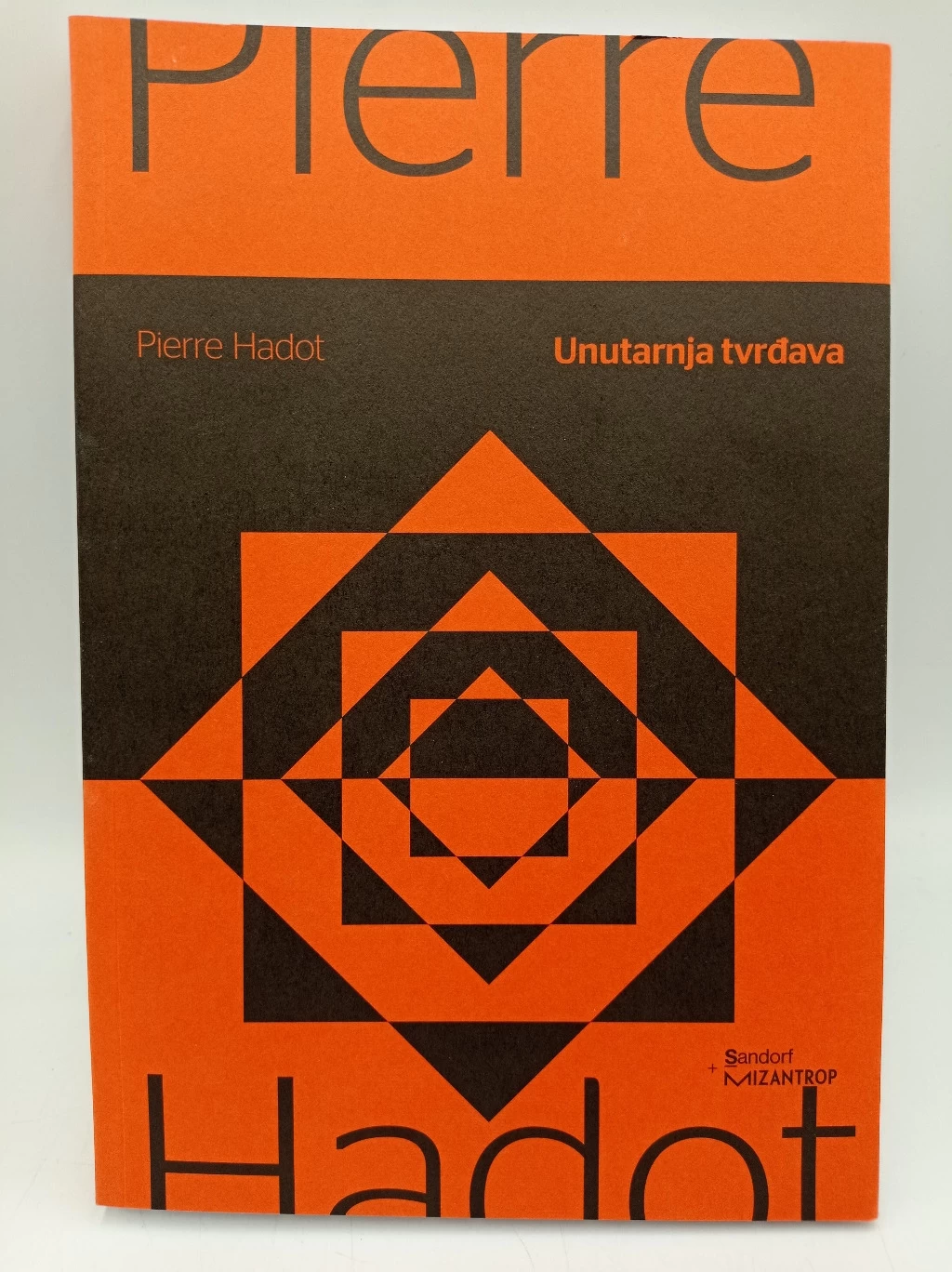

Hadot Pierre: Unutarnja tvrđava
€ 17,00
Free delivery in Croatia for orders over EUR 70
Basic information
- Author: Hadot Pierre
- Publisher: Sandorf
- Availability: Available
- Condition: Nova knjiga
- Code: 52139
Shipping options
GLS Croatia
5€
Delivery
0€
Personal collection at the antique store
0€
GLS parcel machine
3€
Payment methods
Pay on pickup
CorvusPay
By general payment / Virman / Internet banking
Cash on delivery
Unutarnja tvrđava
Hadot Pierre
Summary
Pierre Hadot: The Inner Fortress
Introduction to the "Thoughts" of Marcus Aurelius
Marcus Aurelius was wrong about this. Eighteen centuries have passed (almost two thousand years!), and the Thoughts are still alive. These pages were not intended only for a few aristocrats of spirit, such as Shaftesbury, Friedrich II. or Goethe, rather, over the centuries, they provided, and still provide reasons for life to countless unknown people, who could read them in many translations published around the world.
Today's reader is too often inclined to imagine that there is only one possible translation of the Greek text and will be surprised when, quite often, he comes across significant deviations. But because of that fact, he would have to become aware of the time distance that separates us from the ancients. Our intention, that is to provide the modern reader with an introduction to reading Thoughts,
may not be useless. We will try to discover what Marcus Aurelius wanted to do by writing them, to determine the literary genus to which they belong, and especially to define their relationship to the philosophical system that inspires them, and finally, without writing the emperor's biography, to discover what appears of him as a person in his work.
"I cared about quoting Thoughts abundantly. I hate those monographs that, instead of giving the author a word and staying as close as possible to the text, engage in incomprehensible elucidations that supposedly decode the text and reveal the unspoken of the thinker, without the reader having any idea of what that thinker really "said".
Such a method, unfortunately, allows for all possible distortions, all distortions, all strained "interventions". Our age is seductive for many reasons, but too often we could define it, from a philosophical and literary point of view, as an age of nonsense, if not puns: whatever the occasion was of what!"
-from an interview with Pierre Hadot conducted by Michael Chase
Pierre Hadot (1922-2010) is a French philosopher and historian of philosophy specializing in ancient philosophy, especially Neoplatonism. Hadot was ordained in 1944, but after the encyclical of Pope Pius XII. Humani generis (1950) left the priestly order. He was the director of the École des hautes études en sciences sociales (EHESS) from 1964 to 1986, and in 1982 he was appointed professor at the prestigious Collège de France, where he held the chair of Greek and Roman philosophy. He retired and became emeritus in 1991.
Additional information
- Author: Hadot Pierre
- Publisher: Sandorf
- Year of publication:2016
- Place of publication:Zagreb
- Pages:362
- Dimensions:15x23 cm
- Script:Latinica
- Condition:Nova knjiga
- Binding:Meki
You may also like




Recently viewed





Biblos Newsletter
For book lovers who enjoy finding the rare
New titles, special copies and quiet recommendations from the antiquarian bookshop.