
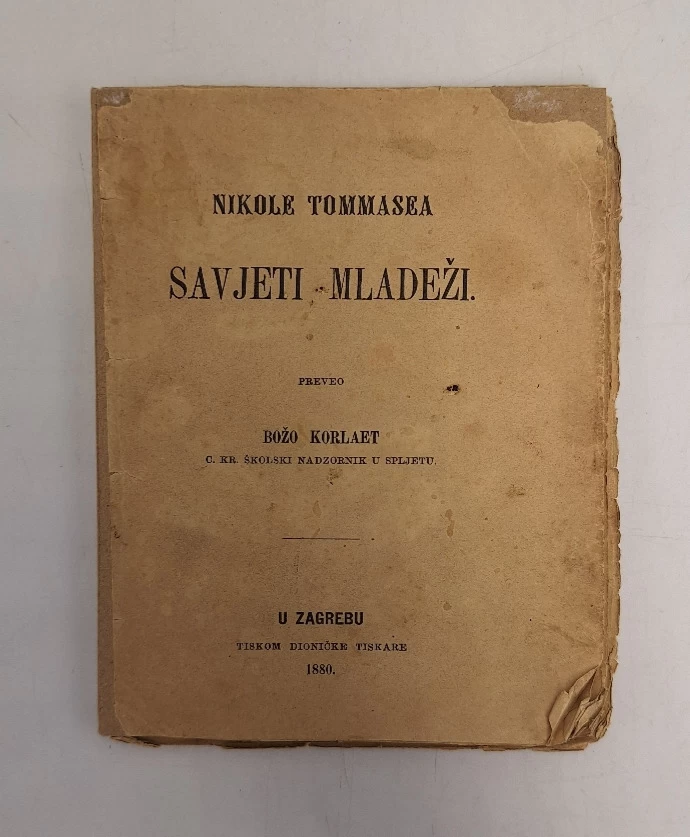
Savjeti mladeži
Basic information
- Author: Tommaseo Nikola
- Publisher: Dionička tiskara
- Availability: Available
- Condition: Very good
- Code: 74807
Shipping options
Payment methods
Explore more
Savjeti mladeži
Tommaseo Nikola
Summary
Nikola Tommaseo: Advice to youth
Tommaseo [tom:azε:'o], Niccolò, Italian writer, linguist and politician (Šibenik, October 9, 1802 – Florence, October 1, 1874). Originally from a merchant family. He was educated at the gymnasium of the Split seminary, then completed his law studies in Padua (1822), where he met the Catholic philosopher A. Rosmini Serbati. He started literary and journalistic activities; he went to Milan, met A. Manzoni and began to collaborate with the liberal circle gathered around the Florentine magazine Antologia, which he continued even after moving to Florence (1827). After publishing a politically undesirable article, he voluntarily went into exile in France (1834). Thanks to the amnesty, he returned to Italy and spent the next decade in Venice, and that was the most fruitful period of his literary and political activity. He visited his homeland several times, but despite his personal charisma, he failed to maintain ties with the Croatian Illyrians because, in the controversy surrounding the unification of Dalmatia with Croatia, he advocated the autonomy of Dalmatia (Dalmatinska question – La questione Dalmatica, 1861). He participated in the revolution of 1848 in Venice, and as the minister of education in the provisional government there, he founded the chair of the "Illyrian" language. After the fall of the Venetian Republic, he was imprisoned and exiled to Corfu (1849). Completely blind, he returned first to Turin (1854), and then settled permanently in Florence (1859), where he remained isolated, insisting on neo-Geulph political ideas and not accepting the unification of Italy. - Erudite and polyglot, he also wrote in Latin, French, Modern Greek and Croatian. As a member of the second generation of Italian romantics, he distinguished himself with a wide range of interests: he worked as a poet and storyteller, philologist, critic and publicist, permanently occupied with issues of family, nature, people, tradition, history and politics. Throughout his life he worked as a lexicographer: New dictionary of synonyms of the Italian language (Nuovo dizionario dei sinonomi della lingua italiana, 1830), Dictionary of the Italian language (Dizionario della lingua italiana, 4 parts, 7 volumes, 1865–79, in collaboration with B. Bellini). His psychological short stories Two kisses (Due baci, 1832) and historical short stories from 1837, The Duke of Athens (Il Duca d'Atene) and The Cup of Lucca (Il sacco di Lucca) are noted. He is the author of numerous discussions, essays, studies and reviews (On education - Dell'educazione, 1834; On Italy - Dell'Italia, 1835; Esthetic dictionary - Dizionario estetico, 1840; Philosophical studies - Studi filosofici, 1840; Rome and the world - Rome et le monde, 1851; The second exile – Il secondo esilio, 1862, etc.). The autobiographical features of the works Poetic Memories and Poems (Memorie poetiche e poesie, 1838), Sparks (Scintille, 1841; in Croatian language 1844), especially the diary prose Intiman dnevnik (Diario intimo, published posthumously in 1938). His most significant prose work is the novel Faith and beauty (Fede e bellezza, 1840), about the stumbling and religious redemption of a young Italian married couple in France, exceptional for its confessional and autobiographical elements. He researched, collected and translated folk poetry and compiled a collection Tuscan, Corsican, Illyrian, Greek folk songs (Canti popolari toscani, corsi, illirici, greci, 1841–42). Since the complete edition of Pjesama (Poesie, 1872) was published, most of his abundant correspondence was also published posthumously. In Croatia, the Italian scholar Mate Zorić is the most deserving of the study of his work.
Additional information
- Author: Tommaseo Nikola
- Publisher: Dionička tiskara
- Year of publication:1880
- Pages:92
- Dimensions:12x15 cm
- Script:Latin script
- Condition:Very good
- Binding:Softcover
Reviews
0 reviewsWrite a review
Share your experience and help other readers choose.
This item has no reviews yet. Be the first to share your experience.
More books by Tommaseo Nikola

More books from Dionička tiskara



You may also like




Recently viewed