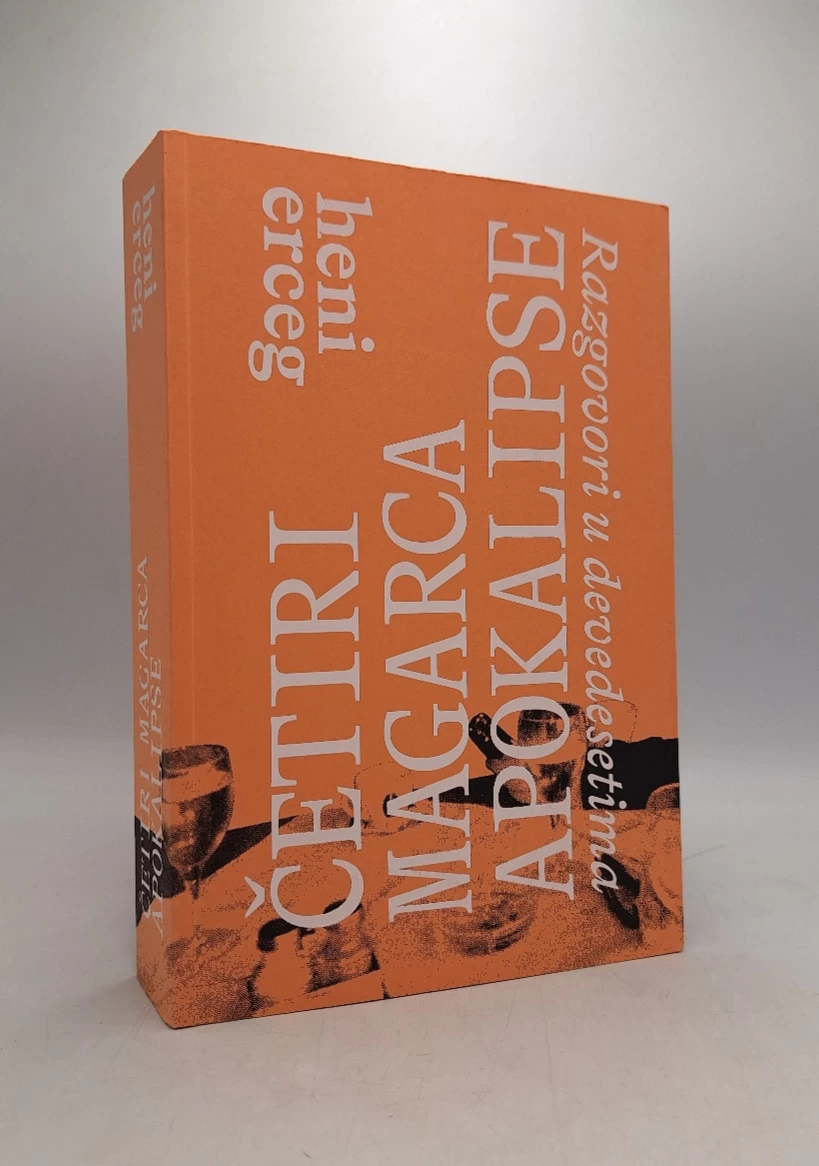

Erceg Heni: Četiri magarca apokalipse: razgovori u devedesetima
€ 28,00
Free delivery in Croatia for orders over EUR 70
Basic information
- Author: Erceg Heni
- Publisher: Ex Libris Rijeka
- Availability: Available
- Condition: Nova knjiga
- Code: 78417
Shipping options
GLS Croatia
5€
Delivery
0€
Personal collection at the antique store
0€
GLS parcel machine
3€
Payment methods
Pay on pickup
CorvusPay
By general payment / Virman / Internet banking
Cash on delivery
Četiri magarca apokalipse: razgovori u devedesetima
Erceg Heni
Summary
Heni Erceg: The Four Donkeys of the Apocalypse: Conversations in the Nineties
The title of this book is a quip by Vesna Parun, one of the greatest Croatian poets, which she used in an interview Heni Erceg conducted with her in January 1996 for the weekly Feral Tribune.
For Parunova, the "Four Donkeys of the Apocalypse" are philosophy, poetry, politics and television, thanks whose combined performance, he says, "free Croatia today is a picture and opportunity of the world in miniature": "Philosophy is in the mouse hole, poetry in the archives of the past, politics in the daily and weekly press, and its deity is television in the marketing dustbin of history." As the temporal cradle of the two central myths of contemporary Croatia - the "homeland war" and the "creation of the state" - the 1990s enjoy a special status in the collective memory today, in such a way that everything is done by the official authorities to make the "glorious period" cosmetically processed in as much detail as possible, cleansed of the unpleasant facts and truths that characterized it. Legends are superior to facts. Romanticism suppressed realism.
Pink was assumed to be dirty gray. The original darkness disappears under powerful retroactive illumination and fireworks that are organized on special dates. Today's official image of Franjo Tuđman and his regime from the era of state-building enthusiasm and flaring nationalistic passions is mainly the result of a monumental, not a historiographical approach to the "theme". This book is something else. She has as much respect for monuments as a burning stick of dynamite. First of all, because the witnesses gathered in it react in vivo - namely: they talk about the nineties in the nineties - and then also because the choice of witness itself, born of Heni Erceg's determination to search for voices of resistance in a time of uniforms and general unanimity, by no means corresponds to the state-making norms of the time, and by God, neither to today's. the donkey forces of the "Father of the State" were sowing the greatest social damage: ideology, culture, political power and media propaganda. The author chose interviews with about sixty intellectuals that she conducted in the period from 1993 to 1997 and published in the then Feral.
Most of her interlocutors belonged to the breed of social outcasts: writers, scientists, actors, directors, painters, musicians... who, because of their disagreement with the prevailing nationalist ideology, were labeled traitors, enemies or suspects, and were dismissed from their jobs. on the social margins, so that their books were not printed, or their films were bunkered, or their plays were banned, like Slobodan Šnajder, Rajko Grlić or Izet Hajdarhodžić, or they were literally exiled from the country by various forms of violence, like Rada Šerbedžija, Mira Furlan or Dubravka Ugrešić.
From the foreword by Viktor Ivančić
Additional information
- Author: Erceg Heni
- Publisher: Ex Libris Rijeka
- Year of publication:2024
- Place of publication:Rijeka
- Pages:622
- Dimensions:15.5x23 cm
- Script:Latinica
- Condition:Nova knjiga
- Binding:Meki
You may also like







Recently viewed



Biblos Newsletter
For book lovers who enjoy finding the rare
New titles, special copies and quiet recommendations from the antiquarian bookshop.