
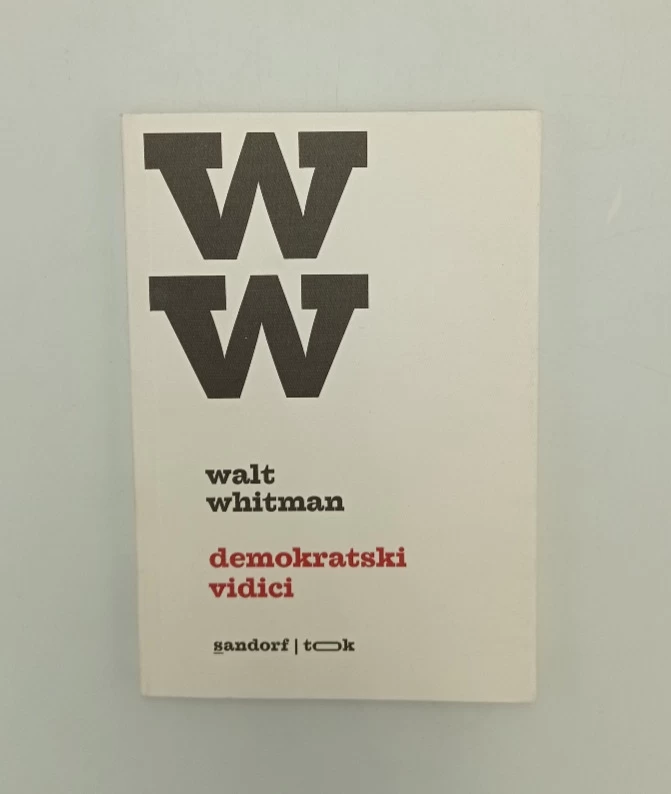
Demokratski vidici
Basic information
- Author: Whitman Walt
- Publisher: Sandorf
- Availability: Available
- Condition: Excellent
- Code: 49268
Shipping options
Payment methods
Explore more
Demokratski vidici
Whitman Walt
Summary
Walt Whitman: Democratic Perspectives
Published a few years after the end of the American Civil War, Democratic Perspectives still represents one of the most provocative analyzes of democracy ever written. Pointing out its shortcomings, but also the enormous possibilities it opens up, Whitman sometimes speaks vehemently and sometimes emphatically about the present and future of the United States, sharply criticizing the greed and corruption of the so-called golden age, and condemning the materialism that spread across the country after the civil war. He sees the solution to the moral crisis in literature: "Therefore, I refer to the possibility, if two or three truly original American poets appear [...], towering over the horizon like planets, stars of the first order, that with their excellence, united contributions [...] they would give more strength and more moral identity (today's most needed features) than all their constitutions, legislative and judicial ties and all their political, war and material experiences so far". Demokratski vidiki was originally published in 1871 and this is their first translation into Croatian.
It could be argued [...] that common and general worldly betterment and a wealthy population, equipped with all the material comforts of life, are the main thing, and that is enough. It could be said that our republic in deed and in reality today achieves the greatest art, songs, etc. by taming the wilderness which turns it into fertile fields, as well as in its railroads, ships, machines, etc. And one could ask: is not all this really better for America than all the sayings of even the greatest rhapsodist, artist or man of letters? And I welcome these achievements with pride and joy; then I answer that the soul of man will not be satisfied with that alone—moreover, it will not be satisfied with that at all—finally; but that she needs [...] that which addresses the most sublime, herself.
Walt Whitman (1819-1892), American poet, one of the most significant in the history of American literature. His most important work is the poetry collection Blades of Grass, a kind of American secular Bible, which ecstatically celebrates American individualism, democracy and brotherhood among people. Poet Ezra Pound said that Whitman does not sing about America, but he is America, and critic Harold Bloom said that the roots of American identity are better expressed in Whitman's poetry than in any other text about American identity.
Additional information
- Author: Whitman Walt
- Publisher: Sandorf
- Year of publication:2018
- Place of publication:Zagreb
- Pages:100
- Dimensions:12x17 cm
- Script:Latin script
- Condition:Excellent
- Binding:Softcover
Reviews
0 reviewsWrite a review
Share your experience and help other readers choose.
This item has no reviews yet. Be the first to share your experience.
More books by Whitman Walt




More books from Sandorf











You may also like