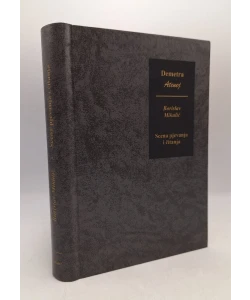


Konstantin (306-337)
Basic information
- Author: Ferjančić Snežana
- Publisher: Službeni glasnik
- Availability: Available
- Condition: New book
- Code: 37459
Shipping options
Payment methods
Explore more
Konstantin (306-337)
Ferjančić Snežana
Summary
Snežana Ferjančić: Constantine (306-337)
Gaj Flavija Valerije Constantine (306-337 AD) is one of the most important rulers of the late Roman Empire. His reign began in 306 in the western provinces ruled by his father Constantius. Over time, as Constantine's position grew stronger, it spread to the entire empire. The path to independent and absolute power began with a conflict with Maxentius (in 312) and ended with a victory over Licinius (in 324). The entire Roman Empire was in Constantine's hands. He became the sole master of this great and powerful state. Constantine's reign was characterized by extensive reforms and a new religious policy. In the 3rd century, after the assassination of the last ruler of the Severus dynasty, the Roman Empire was engulfed by a great crisis, which left deep traces in all spheres of life. It was finished at the end of the 3rd and the beginning of the 4th century, thanks to the measures of Emperor Diocletian (284-305) and his co-rulers. By establishing the tetrarchy and administrative, economic and military reforms, they managed to restore the power and strength of the shaken empire. Their activity was continued and completed by Constantine. Constantine's reign brought significant innovation in terms of religious policy. His predecessors and co-rulers persecuted Christians because Christ's followers, refusing to respect the imperial cult and serve in the Roman army, were undermining the foundations of the Roman state. Constantine abandoned this policy and made sure that Christianity became the official religion of the Roman Empire, equal to the traditional religion.
Additional information
- Author: Ferjančić Snežana
- Publisher: Službeni glasnik
- Year of publication:2013
- Place of publication:Beograd
- Pages:232
- Dimensions:15x23 cm
- Script:Cyrillic script
- Condition:New book
- Binding:Softcover
Reviews
0 reviewsWrite a review
Share your experience and help other readers choose.
This item has no reviews yet. Be the first to share your experience.
More books from Službeni glasnik






You may also like



Recently viewed