Aleksandar Solzhenitsyn: Archipelago Gulag I-III
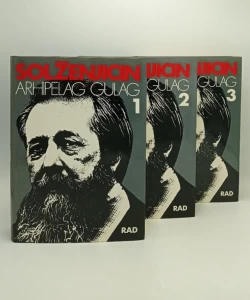
Archipelag Gulag (I-III)
The novel Archipelago GULAG is an artistic and historical work about repression in the Soviet Union in the period from 1918 to 1956, based on the letters, memories and oral accounts of 257 prisoners, as well as on personal the author's experience. Solzhenitsyn wrote this work secretly from 1958 to 1968 (he finished it on June 2, 1968); the first volume was published in Paris in December 1973. Solzhenitsyn himself defined his epoch-making work as a literary research. In a documentary and journalistic way, he presented countless facts of Stalinist repression. Backed up by brutal evidence, they allow every reader to feel like a captive of the GULAG; a captive who is innocently arrested, who is tortured night after night by interrogations and subjected to sophisticated torture until he signs a confession for crimes he did not commit. The atmosphere of total terror on one side and all-consuming fear on the other seems to burn the consciousness and give birth to an internal protest against the inhumane system that cripples the soul of a great nation on both sides of the barbed wire.
The novel Archipelago GULAG had a fateful impact on the author's life. Because of him, Solzhenitsyn was expelled as a traitor, because of him, then, as if nothing had happened, they invited him to return. Regardless of how this work was viewed then, or how it is read now, the writer fulfilled his civic duty. Both before the living and before the dead. The novel Archipelago GULAG must be read, if for no other reason, then so that the human race will never allow something like this lightly again, to be aware at every moment how much freedom is worth to man.
"All literary trends have their peripheries and their centers, that is, peaks. I would call the author of the book Archipelago GULAG a genius of 'socialist realism'. If the Soviet government did not have its Homer, in the person of Solzhenitsyn, it got one. This one the book was written primarily for the Russian reader, but to take it as a reason not to read it would be the same as giving up reading the Iliad because the names of its heroes are difficult to pronounce. The common denominator for these two works is the theme of destruction: in the first case - the city, in the second - the nation. It is possible that in two thousand years reading the Iliad will be as pleasant as reading the Iliad today that much sooner than in two thousand years it will happen that there will be no one to read either."
Josif Brodsky
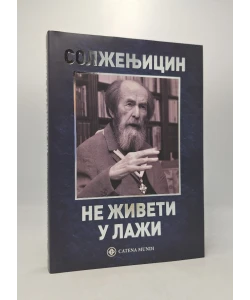
Aleksandar Solzhenitsyn (Russian: Aleksandr Isaevich Solzhenitsyn, December 11, 1918, Kislovodsk - August 3, 2008, Moscow), winner of the Nobel Prize for Literature (1970), is a Soviet and Russian writer, playwright, publicist, poet, social and political worker (USSR, Switzerland, USA, Russia), but also a dissident who for two decades (from sixties to the eighties of the twentieth century) actively spoke out against communist ideas, against the political organization of the USSR and the policies of its authorities. The novel One Day by Ivan Denisovič stirred up the literary public of the entire planet, and he will be remembered for the epochal work Archipelago GULAG. At the end of his writing career, he wrote the two-volume historical-publicist monograph Two centuries together, in which he deals with the relations and coexistence of Russians and Jews on the soil of Imperial Russia and the Soviet Union from the end of the 17th to the end of the 20th century.