
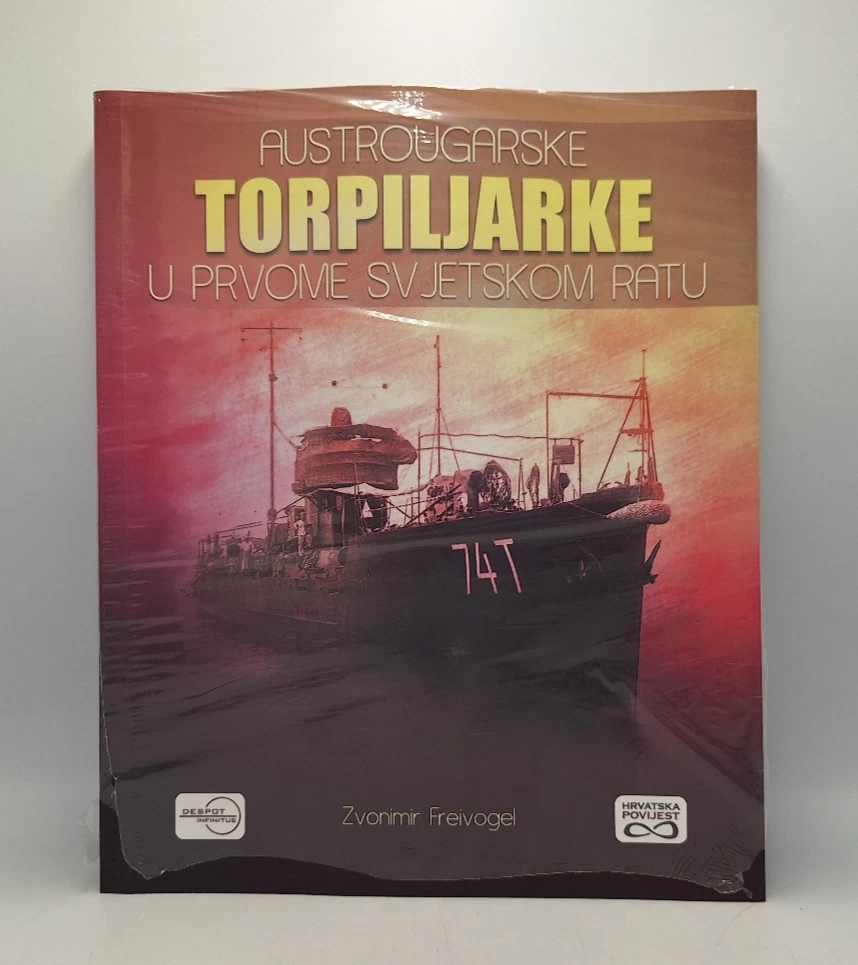
Austrougarske torpiljarke u Prvome svjetskom ratu
Basic information
- Author: Freivogel Zvonimir
- Publisher: Despot Infinitus
- Availability: Available
- Condition: New book
- Code: 79898
Shipping options
Payment methods
Explore more
Austrougarske torpiljarke u Prvome svjetskom ratu
Freivogel Zvonimir
Summary
Zvonimir Freivogel: Austro-Hungarian torpedo boats in the First World War
The torpedo as a revolutionary weapon was invented and built in the then Austro-Hungarian Rijeka. Therefore, it is not surprising that the Austro-Hungarian Imperial and Royal Navy introduced torpedo boats into service relatively soon, fast steamboats that were supposed to defend the coast from the opposing fleet and its own fleet units from attacks by opposing torpedo boats.
From 1875 to 1916, 132 c. and cr. torpedo boats, of which 51 larger ones with 12 coastal during the First World War operated as part of torpedo flotillas or for local defense, and a number of older ones were used for mine clearance or in other auxiliary roles. However, even the "fleet torpedo boats" could not operate in their originally intended role, because the battle fleets of both sides rarely set sail for major operations. So they are c. and cr. torpedo boats together with destroyers and fast cruisers attacked targets on the opposing coast, hunted submarines, supported seaplane attacks or looked for mines.
Out of over 200 torpedoes loaded on 63 operational torpedo boats, only ten were fired in clashes with the enemy, and only five hit the targets! All newer torpedo boats survived the war and were divided among the winners, and some remained in the small fleet of the Kingdom of SHS, the latter of Yugoslavia. In addition to active torpedo boats, their technical data and service, the richly illustrated book also describes a number of unrealized projects of steam and motor torpedo boats.
Additional information
- Author: Freivogel Zvonimir
- Publisher: Despot Infinitus
- Year of publication:2022
- Place of publication:Zagreb
- Pages:156
- Dimensions:23x28 cm
- Script:Latin script
- Condition:New book
- Binding:Softcover
Reviews
0 reviewsWrite a review
Share your experience and help other readers choose.
This item has no reviews yet. Be the first to share your experience.
More books by Freivogel Zvonimir
More books from Despot Infinitus



You may also like