
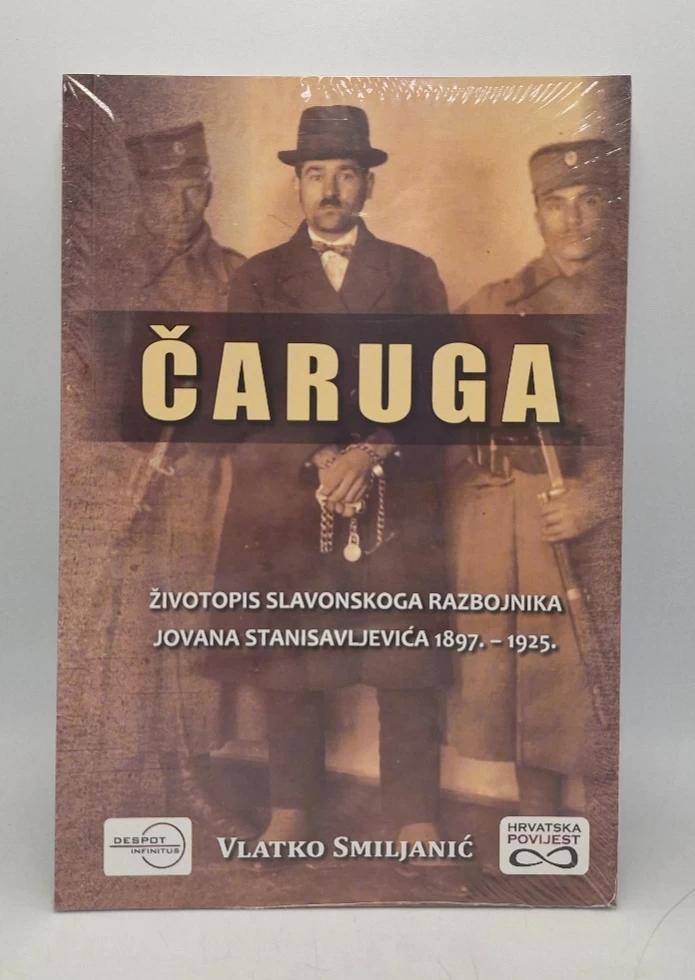
Čaruga
Basic information
- Author: Smiljanić Vlatko
- Publisher: Despot Infinitus
- Availability: Available
- Condition: New book
- Code: 79960
Shipping options
Payment methods
Explore more
Čaruga
Smiljanić Vlatko
Summary
Vlatko Smiljanić: Čaruga
The author uses a modern historiographical approach to shed light on the phenomenon of banditry, including the peculiar personality of the Slavonian bandit Jovan Stanisavljević Čaruga, he described the historical atmosphere and shocking events, especially the geographical environment, the Slavonian world and the microspace of the village of Slavonska Bara. His professional and scientific approach and interpretation of the complex reality of Čaruga's era represents an indisputable contribution to historiography.
He treated the topic with a critical approach, removed stereotypical interpretations, folklore and myths often present in stories and comments about banditry and prominent bandits. The work is multi-layered, but at the same time interdisciplinary. In terms of its structure, methodology and overall content, it represents an indisputable contribution to historical science. The values of the work show that it is an exceptionally talented text, an issue treated with scientific and professional methodology, a book supported by archival, newspaper and book sources. The author, on the one hand, summarized the previous data, findings and interpretations, while, on the other hand, he took a significant step forward and presented Čaruga as a special case study in a modern historiographical context. Cultural anthropology belongs to the author's assertion that Čaruga is a character that always returns to myth. With this, the Slavonian bandit - despite all the differences - was still included in the constellation of European "bandits" and "primitive rebels" in the 19th century. and the 20th century, about which the English historian Eric J. Hobsbawm put forward his interesting theses. prof. Ph.D. Miroslav Bertoša, professor emeritus
Additional information
- Author: Smiljanić Vlatko
- Publisher: Despot Infinitus
- Year of publication:2020
- Place of publication:Zagreb
- Pages:175
- Dimensions:16x24 cm
- Script:Latin script
- Condition:New book
- Binding:Softcover
Reviews
0 reviewsWrite a review
Share your experience and help other readers choose.
This item has no reviews yet. Be the first to share your experience.
More books from Despot Infinitus

You may also like



Recently viewed