
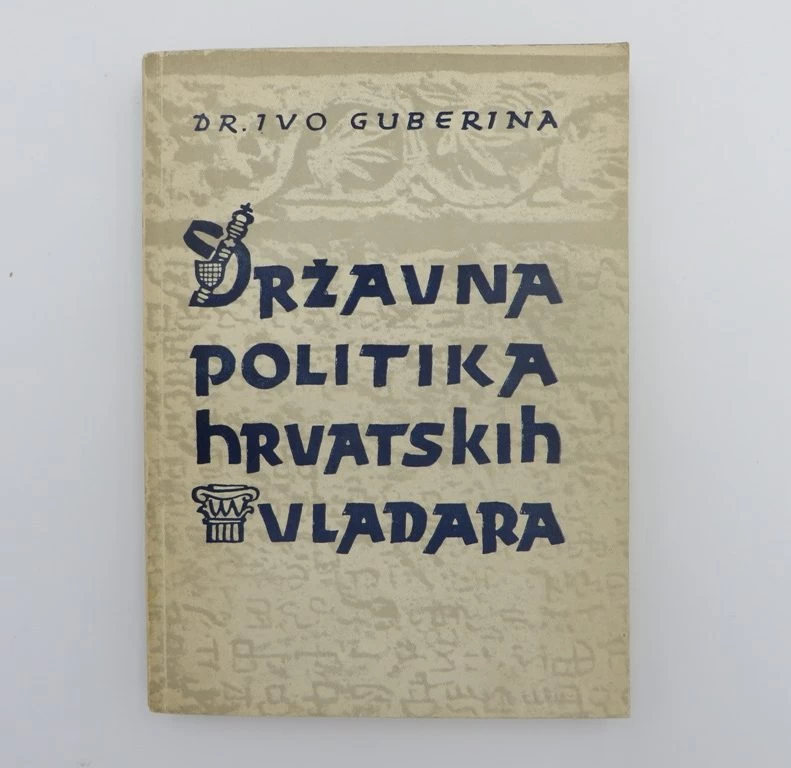
Državna politika hrvatskih vladara II
Basic information
- Author: Guberina Ivo
- Publisher: Tiskara Milana Šufflaya
- Availability: Available
- Condition: Very good
- Code: 39832
Shipping options
Payment methods
Explore more
Državna politika hrvatskih vladara II
Guberina Ivo
Summary
Ivo Guberina: State policy of Croatian rulers ii
From Krešimir III to Zvonimir.
GUBERINA, Ivo (Augustin), religious writer and publicist (Šibenik, 14. XI. 1897 — Zagreb, 30. VI. 1945). He attended the classical high school in Sinj, joined the Franciscan Order in 1915 and studied philosophy in Zaostrogo in 1916–18. and theology in Makarska 1918–21. He was ordained a priest in 1921. After his young Mass, the elders sent him to Rome, where in 1923 he received his doctorate at the Oriental Institute, defending his thesis Doctrina s. Theodori Studitae de visibili unitate Ecclesiae. After returning to his homeland, he taught theology for a short time in Makarska, then served in the Makarska district as a pastor in Veliko Brdo in 1924–26. and Drvenik 1927–36. Year In 1936, he became a diocesan priest and served in the Šibenik diocese as parish administrator in Betina na Murter, and in 1939 he became a parish assistant in Šibenik Dolac parish. This is where he begins to act more intensely politically; because of his political beliefs, he was arrested in 1936 and 1940. When he found himself in danger, he left Šibenik at the end of 1940 and went to Italy. He returned to the country in the spring of 1941 and made himself available to the authorities of the newly established NDH. Soon, he was appointed Ustaše nurse and moved to Zagreb. Year In 1941, he was assigned to work at the Croatian Encyclopedia to examine manuscripts with regard to their moral and political value. In October 1943, he was appointed head of the Ustaše movement's correspondence department, engaged at the University, and was also a guest lecturer at the Home Guard Ensign School. Handed over to the partisans near Bleiburg, convicted and executed. — G. wrote a lot, initially being interested in philosophical and theological problems. From half In the 1930s, he increasingly turned to political and historical nonfiction, but a lack of expertise was felt in his historical works, which was also noticed by his contemporaries, for whom he was a "historian and politician" (S. Osterman). He is like "rarely (...) a historian who was so scrupulous when it comes to monuments, and so daring when it comes to connecting events when the monument fails" (D. Žanko). Pišč's main preoccupation consisted in considering Croatian history as a separate and independent entity, and not as a part of the general Slavic, especially not Yugoslav, past. He participated in the discussion on the ethnogenesis of the Croats and proved their non-Slavic origin. In addition to the books and booklets he wrote, he collaborated in periodicals: Nova revija (1924–29), Bogoslovska smotra (1925–31), Sacerdos Christi (1927), Vrhbosna (1927–28, 1934), Katolički tjednik (1929–30, 1932, 1938), Misao (1929), Nedjelja (1930, 1937–38), For faith and home (1930), Hrvatska smotra (1939–40, 1942–44), Hrvatski glasnik (1939), Croatian people (1939–40, 1943–45), Hrvatska gruda (1940), Croatian review (1940–41, 1943), Ustaška youth (1941–42), Sarajevski novi list (1942), Readiness (1942–43, 1945), Ustaški yearbook (1942), Croazia sacra (1943), Osvit (1943), Za dom (1943) and Croatian yearbook (1944). He also signed himself with the pseudonym Non quis sed quid.
Additional information
- Author: Guberina Ivo
- Publisher: Tiskara Milana Šufflaya
- Year of publication:1945
- Place of publication:Zagreb
- Pages:212
- Dimensions:24x21 cm
- Script:Latin script
- Condition:Very good
- Binding:Softcover
Reviews
0 reviewsWrite a review
Share your experience and help other readers choose.
This item has no reviews yet. Be the first to share your experience.
More books from Tiskara Milana Šufflaya
You may also like