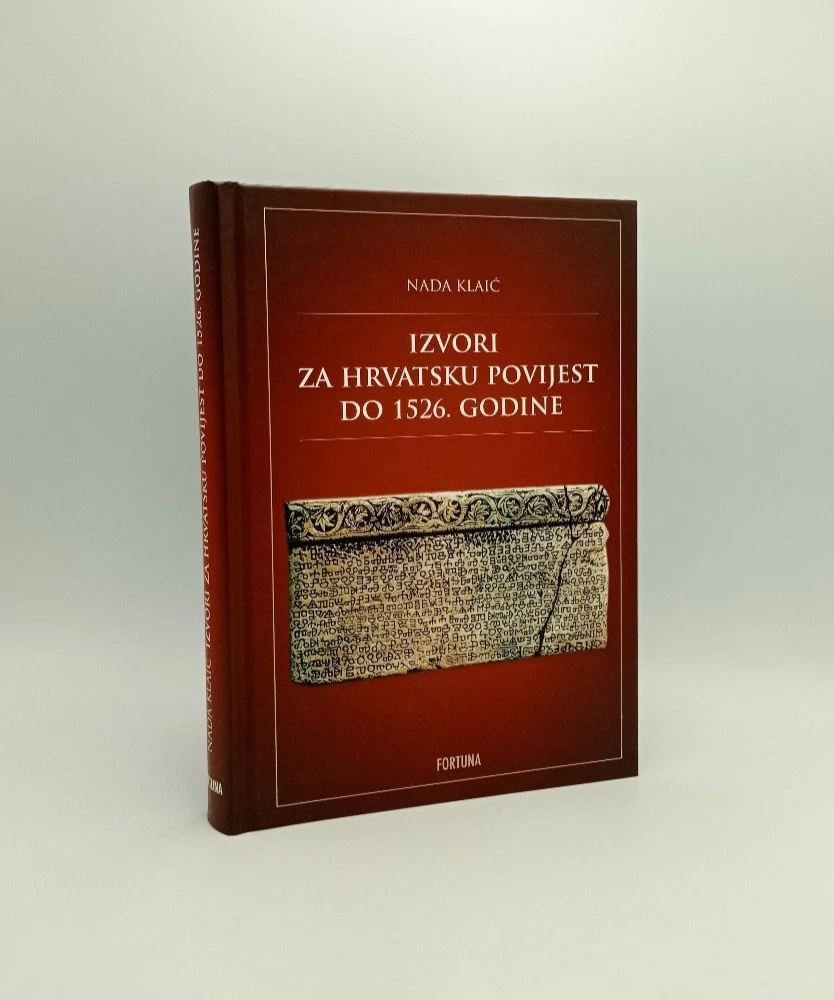
Izvori za hrvatsku povijest do 1526. godine
Basic information
- Author: Klaić Nada
- Publisher: Fortuna
- Availability: Available
- Condition: New book
- Code: 49770
Shipping options
Payment methods
Explore more
Izvori za hrvatsku povijest do 1526. godine
Klaić Nada
Summary
Nada Klaić: Sources for Croatian history until 1526.
With her impressive bibliography of over 200 titles, Nada Klaić (1920–1988) is one of the few historians who researched and marked Croatian media studies and the entire historiography of the 20th century. She began her scientific career in 1944 as an assistant at the Faculty of Philosophy in Zagreb. At the same Faculty, she received her doctorate with the topic Political and Social Organization of Slavonia for Arpadović (1946). She became an assistant professor in 1955, an associate professor in 1961, and a full professor in 1969. Her wide range of geographical interests included medieval Croatia, Dalmatia, Slavonia, Kvarner and the islands, as well as Bosnia and Serbia, and her work covered numerous historiographical topics from the early Middle Ages to the 19th century. From the rich oeuvre of Nada Klaić, the crowning synthetic works should be singled out: History of Croats in the Early Middle Ages (1971), History of Croats in the Developed Middle Ages (1976). and the posthumously published History of Croatians in the Middle Ages (1990) On the other hand, "Aunt Nada" gained great popularity among the student population, which she knew how to charm with her energetic and interesting presentations, and especially with her characteristic "myth busting". During her lectures, the halls were usually overcrowded, so it can truly be said that she fulfilled the medieval university ideal with her teaching engagement, as pointed out by Ivo Goldstein. An integral element of her overall activity was her insistence on a critical approach to the research of the past and a "return" to the sources, as well as a constant review of other people's, as well as her own, scientific results. It was her specific criticism of Croatian early medieval sources that caused the biggest controversies within the historiographical profession and the general public. Namely, due to the chronic lack of sources, the Croatian early Middle Ages has always represented an extremely sensitive research area with a number of problematic topos. Moreover, that period had, and still has, an important ideological, not to say mythical, function in the Croatian historical discourse. Therefore, it is not surprising that Nada Klaić's conclusion - that almost all preserved documents between the 9th and 12th centuries are of more than questionable authenticity due to their later origin - was met with great resistance. Today it is completely acceptable to say that these, as well as early medieval sources in general, are truly questionable in a diplomatic sense, but the way in which Nada Klaić expressed and presented her results in public forty years ago earned her a negative reception from several quarters. Despite this, as Radoslav Katičić writes, she "enjoyed rebelling against authority".[1] In contrast to the polemics at the time of the publication of her works, it can be asserted that recent historiographical reviews of Nada Klaić's work mainly valorize the quantitative component of her oeuvre, and few of the new readers and critics took the path of merit, that is, "criticism of critical historiography" as Nenad Ivić expressed it. Bearing in mind the temperamental and unyielding nature of Nada Klaić, she would by no means have liked the relative silence that reigns over her work thirty years after her death.
There is no doubt that Nada Klaić at one time opened up many new questions and posed fresh, sometimes radical and intriguing theses, thereby contributing to the modernization and popularization of domestic historiography. But, on the other hand, she was also remembered for the fact that she did not show too much enthusiasm for broader theoretical and historiographical developments, then primarily embodied in the French "Annal school", especially from the mid-70s of the 20th century, when she entered a kind of self-isolation from the contemporary st early and domestic literature - as observed by Neven Budak. Nevertheless, we can agree with Franjo Šanjek's phrase that Nada Klaić is an "integral historian" whose oeuvre, whether they like it or not, must be encountered by all contemporary and future researchers of the Croatian Middle Ages. Although a certain part of her results have been historiographically overcome or revised, her approach to historiographical problems and her charisma as a professor still attract attention today.
At this point we have mentioned only the main features of Nada Klaić's character and works, while more detailed critical reviews of individual parts of her vast oeuvre still await more invited historians. Among the more systematic and comprehensive critical analyzes of her work, especially with regard to medieval Bosnia, Mladen Ančić's texts should be highlighted, especially the book Path of the Pendulum. The Hungarian-Croatian Kingdom and Bosnia in the XIV. century from 1997.
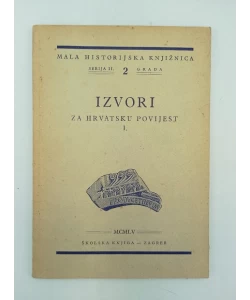
From her scientific beginnings, Nada Klaić paid the greatest attention to archival material as a basis for knowledge of the past, historical sources, their meticulous diplomatic interpretation and systematic and sharp criticism. Her half-century of work on the sources yielded ecstatic results in the form of numerous published and interpreted documents. As part of the work on the disclosure and analysis of the springs, the book Sources for Croatian History until 1526 (Zagreb: School Book, 1972), the reprint of which you are holding in your hands, is certainly the best-known, most used, and probably the most important contribution of Nada Klaić. Primarily, it is a university textbook intended for students who are starting to become more thoroughly familiar with the Croatian Middle Ages, but also for history teachers at all levels. In this sense, the publication of this reprint follows the author's basic motive - the dispersion and difficult availability of published sources, including the first edition of this book.
It is a collection that was created on the basis of many years of work, collection, interpretation and translation of medieval documents important for Croatian history. Based on some parts of Jaroslav Šidak's Historical Reader's Book for Croatian History I (1952), Nada Klaić prepared four booklets of sources for Croatian history from the early Middle Ages to 1848 from 1955 to 1958. She supplemented and refined the contents of the first two volumes during the 1960s and published them in 1972 as a complete collection of sources for Croatian history, from the first news about the migration of the Slavs at the dawn of the 7th century to the report on the defeat and collapse of the Hungarian-Croatian state on the Field of Mohács in 1526. In the introduction to the book, the author explained the content and structure of the work, the method of citing published and unpublished sources, and also provided basic information about the translations and translators of individual documents. Although she followed the chronological sequence of political history, the author included in this collection a large number of sources that bear witness to social and economic issues (riots and uprisings, agrarian relations, trade, etc.). The collection has 241 units of sources, some of which are fully or partially translated documents, and some consist of several thematically unified individual sources. Each unit is accompanied by a register, the author's comment, basic data on the content of the source and a reference to previous publications. Therefore, it is a handbook that, with the scope and variety of selected sources, still meets the needs of students, young historians and teachers after 45 years. On the other hand, contemporary historiographical approaches to the Croatian Middle Ages pose new questions and seek new answers. This is probably why Nada Klaić, despite her auctoritas which can seem discouraging, would advise today's readers to compare the published sources and interpretations presented in the comments with more recent historiographical (and theoretical) literature and ultimately make their own critically based judgments.
Additional information
- Author: Klaić Nada
- Publisher: Fortuna
- Year of publication:2019
- Place of publication:Zagreb
- Pages:386
- Dimensions:17x24 cm
- Script:Latin script
- Condition:New book
- Binding:Hardcover
Reviews
0 reviewsWrite a review
Share your experience and help other readers choose.
This item has no reviews yet. Be the first to share your experience.
More books by Klaić Nada


More books from Fortuna






You may also like