

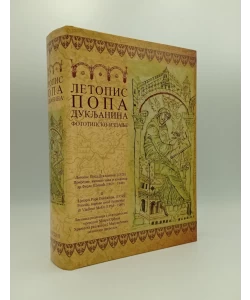
Letopis Popa Dukljanina
Basic information
- Author: Šišić Ferdo
- Publisher: Zaklada tiskare Narodnih novina
- Availability: Available
- Condition: Very good
- Code: 12357
Shipping options
Payment methods
Explore more
Letopis Popa Dukljanina
Šišić Ferdo
Summary
Ferdo Šišić: Chronicle of Popa Dukljanin
Special editions
book 67
Philosophical and philological writings
book 18
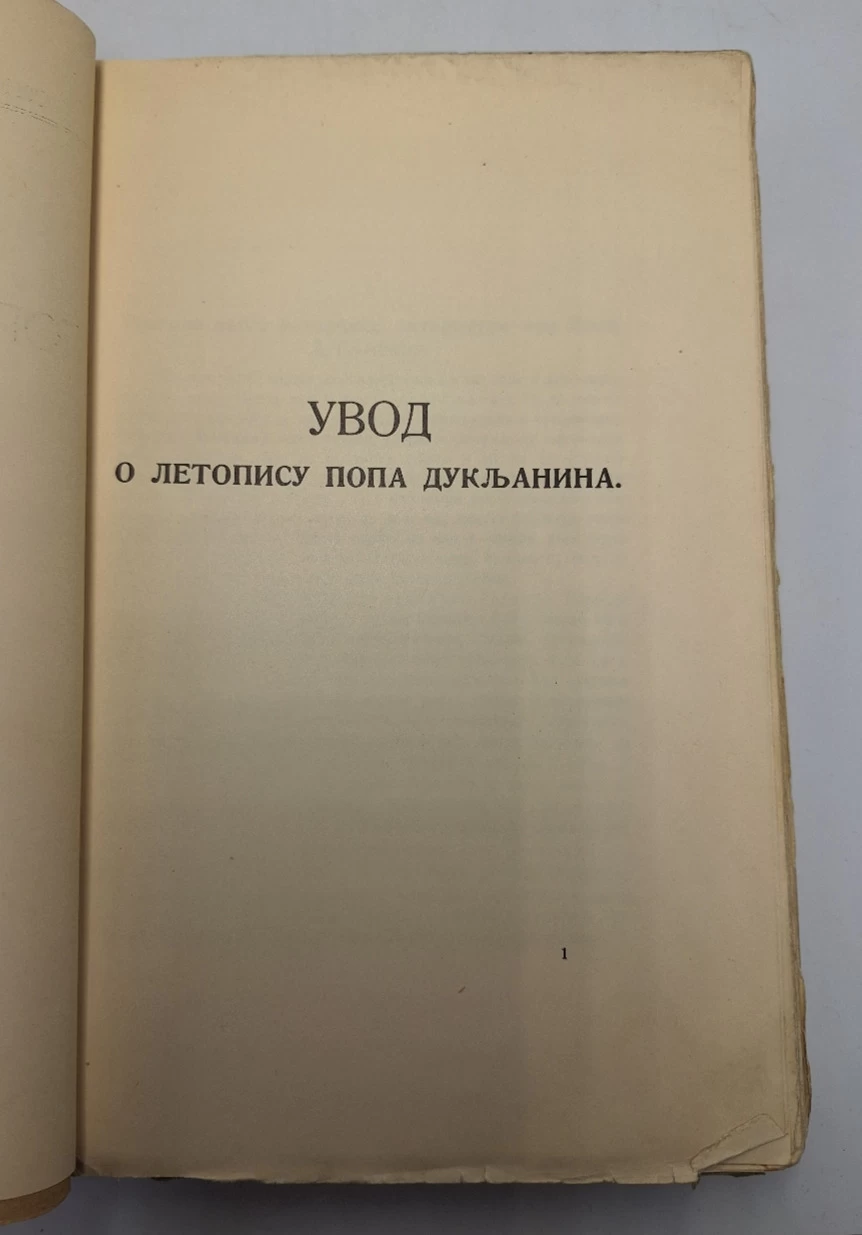
Chronicle of Popa Dukljanin (Barski genealogy, Kingdom of the Slavs), narrative source from XII. paragraph. The name "yearbook" does not correspond to the content because it does not mention years. The anonymous author, a priest of the church in Bar, who is usually called Pop Dukljanin, claims that he translated the work, which he calls Kingdom of the Slavs (Sclavorum Regnum), from Slavic to Latin, and wrote what he read or heard from the elders. The work is actually a compilation of many sources. It was not preserved in the earliest, Slavic form (if such existed at all), and the Latin text was preserved only in a copy from the period around 1650. This copy was probably taken by R. Levaković from an older model in Kotor, and published by I. Lučić as a contribution to the work On the Kingdom of Dalmatia and Croatia in six books (De Regno Dalmatiae et Croatiae libri sex, 1666). The Chronicle was also published in 1601 in an Italian translation by M. Orbini in the book Kingdom of the Slavs (Il regno degli Slavi), with some additions that the Latin version does not have. Orbini used a different, probably older template than Lučić. The so-called The Croatian editorial office of Jjetopisa was found by D. Papalić, a patrician from Split, in the Makarska coast at the beginning of the 16th century. This, a revision of the work written in Croatian and Cyrillic, which differs in content from the Latin version, circulated in copies until it was published in 1851 by I. Kukuljević Sakcinski. Papalic's manuscript was translated into Latin by M. Marulić, and it was also published by I. Lučić as an appendix to the work from 1666. There is a rich literature on Jjetopis that deals with questions of authorship, time of origin, structure, purpose, tradition and individual data mentioned in the work. Among the editions with commentary, those by F. Šišić (1928) and V. Mošin (1950) stand out, and the last is a monographic treatment by E. Peričić (1991). While the prevailing opinion was that the work was created gradually and that it was a compilation of the work of two or three authors, today it is generally considered to be the work of one writer. The author used various works, among other saints' biographies (St. Benedict, St. Cyril and Methodius, St. Vladimir), the Slavic translation of the nomocanon (which the author calls Methodos), the legend of the founding of Dubrovnik, probably the Trebinje genealogy from the 10th century, the archives of the Bar church, etc. He obviously adapted and interpreted some sources in order to get a picture of the past of the imagined kingdom of the Slavs. He described how the Goths conquered Dalmatia and Prevalitana during the reign of Emperor Anastasius, and that one of their rulers settled in the land of the Slavs, and then the Bulgarians came and occupied the areas east of the Gothic-Slavic kingdom. After a series of pagan and bad Gothic rulers, Christian-friendly kings came to power. The central place in the work is dedicated to King Svatopluk (Svetopelek), who was baptized by Cyril (Constantine) and who held a council on the Dalmi field (plainities Dalmae), where he founded the kingdom and was crowned by the emissaries of the Byzantine emperor. The following is a description of his successors, without any relation to historical events (except for some vague reminiscences). Something more related to real events can be found in the depiction of the life of St. Vladimir. Chronicle can serve as a historical source of significant credibility only in that part where the history of the Dukljan dynasty is described until the middle of the 12th century. It contains the history of the rulers of Duklja from the legendary beginnings of the dynasty to the rebellion against King Radoslav in 1148/49.
The Croatian edition differs from the Latin version in that there is no introduction, and from chapters 24 to 28 it contains its own text without a real historical basis (in chapter 27 it contains the story of the alleged murder of King Zvonimir). In addition, he changes the term "Slavic" to "Croatian", and the name of King Svatopluk to Budimir. Its origin is mostly given ra in XIV. century (according to some authors even later, up to the 16th century).
There are assumptions that Dukljanin's work was already in use in the 13th/14th centuries. century in Croatia (Toma Arhiđakon, Attribution to the Supetar Cartulary), and also abroad (Andrija Dandolo). In the Renaissance and Baroque era, it was important for the spread of Slavophile ideas among Croatian intellectuals.
Some data provided by Pop Dukljanin caused extensive discussions in Croatian historiography. The identification of Goths and Slavs was used for the so-called the Gothic theory about the origin of the Croats. The most attention was paid to the assembly on the Dalmi field, for which the older historiography tried to prove that it took place on the Duvanjsko polje, and the newer places it near the Montenegrin Podgorica or refrains from any location of that event, and that under the name of Svatopluka, or Budimir, is hidden by Tomislav or some other Croatian ruler (Branimir, Petar Krešimir IV), while the legendary significance of that story is highlighted in recent historiography. The memory of Red Croatia, the area from the center of Svatopluk's kingdom to Durrës, has also caused different interpretations, but today it is considered to be the territory of Duklja, which was inhabited by a group of Croats, assimilated in later centuries. The story about Zvonimir's murder in the Croatian newsroom was used as one of the arguments in the strongly defended thesis about Zvonimir's violent death. The work, which was probably created due to the conflict between the churches of Bar and Dubrovnik, is also important for understanding church history. The Kingdom of the Slavs is studied not only as a historical source, but also as an early work of the South Slavic, i.e. Croatian literature.
Additional information
- Author: Šišić Ferdo
- Publisher: Zaklada tiskare Narodnih novin...
- Year of publication:1928
- Place of publication:Beograd
- Pages:480
- Dimensions:16.5x24 cm
- Script:Cyrillic script
- Condition:Very good
- Binding:Softcover
Reviews
0 reviewsWrite a review
Share your experience and help other readers choose.
This item has no reviews yet. Be the first to share your experience.
More books by Šišić Ferdo





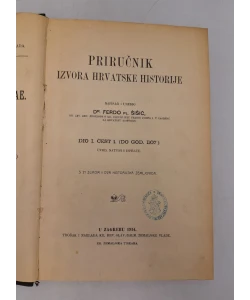


More books from Zaklada tiskare Narodnih novina


You may also like







Recently viewed