
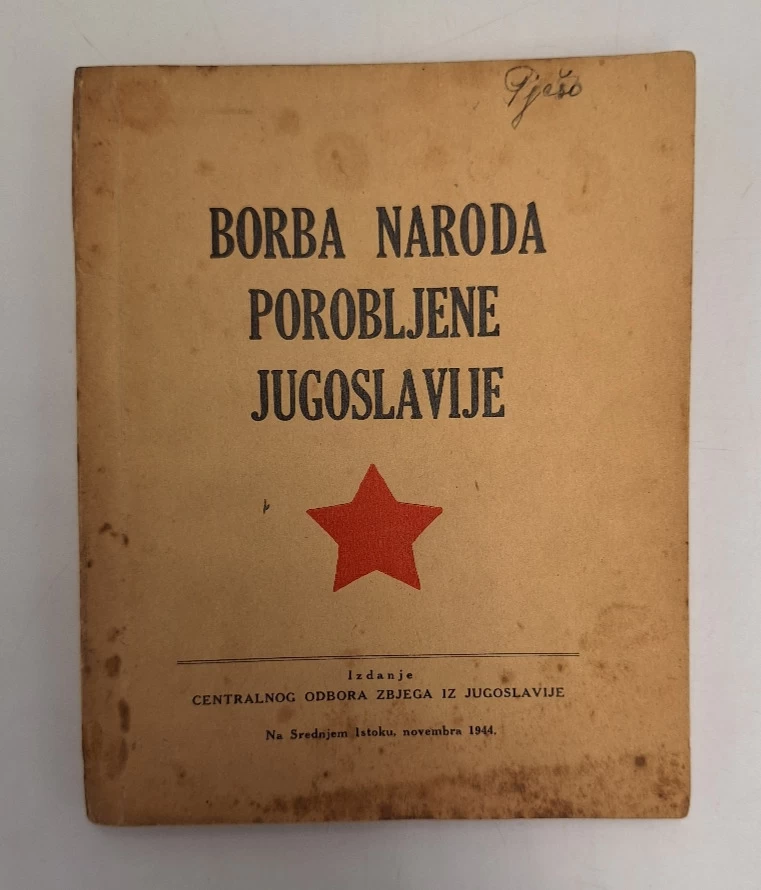
Borba naroda porobljene Jugoslavije
Basic information
- Publisher: Centralni odbor zbjega iz Jugoslavije
- Availability: Available
- Condition: Very good
- Code: 73594
Shipping options
Payment methods
Explore more
Borba naroda porobljene Jugoslavije
Summary
Struggle of the people of enslaved Yugoslavia
Very rare edition from El Shatt.
El Shatt is a complex of refugee camps in the desert on the Sinai peninsula in Egypt, where since February 1944 until March 1946 the evacuated population of the Dalmatian islands, coast and href="https://hr.wikipedia.org/wiki/Zagora">Zagore.
Fleeing the German offensive at the end of 1943 and the beginning of 1944, when the whole of Dalmatia was occupied, a large number of civilians are afraid of reprisals sheltered on the island Vis. As the Main Headquarters of the partisan army and the allied British army were already located on Vis, there was no possibility of receiving and feeding such a large number of people. Therefore, it was decided to evacuate the non-combatant population of the island and the refugees to Southern Italy, first to Bari and then to Taranto. There were almost 40,000 people on the run, mostly from Makar (about 5,800), then from Korčula (4,500), from Brač and Šoltan (4,300), from Vodič (4,000), from Višan (3,800), from Hvar (3,000), from Trogir (2,000), from Šibenik (2,000), as well as thousands from other places in Dalmatia. About 80% of the refugees were Croats, and 7% were Serbs, along with some Slovenes, Jews and others. Since Italy was still the scene of heavy fighting between the Allied forces and the Germans, it was decided to transfer the escaped population to the safer Egypt, then under the administration of the British.
Egypt, according to some, was not chosen by chance. King Petar II was the formal ruler of Yugoslavia there. Karađorđević, part of the ministries of his government in exile, parts of the royal army. Among that army was a battalion of Croats and Slovenes who served in the Italian army, and were captured by the British. These Croats and Slovenes rebelled shortly before the refugees came, and they wore a five-pointed star on their caps. They were the first to come to the aid of the newcomers and set up their first tents in the middle of the bare desert.
The camp was formed on an area of 260 km2 near the Suez Canal, and divided into five smaller subcamps. Families and settlements in the camp were grouped so that they had the same arrangement as in the old area. On average, there were one to two families in each tent. Although far from their homeland and in bad conditions, they tried to preserve the semblance of a normal life. Schools, various workshops, communal laundries were founded, newspapers were published, and a church was arranged in one tent. People from Dalmatia had a hard time adapting to desert conditions, especially children who suffered from intestinal diseases. A large number of them died of measles in the El Khatadba camp. The British administration maintained a strict regime, allowing people to leave the complex only with passes.
More than 30,000 people spent eighteen or more months in the refugee camp. 475 children were born in the camp. Some of the children were born in relationships between Englishmen and Croats, but only a part of these relationships were legalized. The trace of Croats staying in El Shatto is also in personal names. Some of the children were given names such as Nila, Sinai, Sinajka, Elšatka, Sueska, Suez, Nilka, Zbjegan, etc.
Near the camp there was an aviation training ground of the Royal Army, so bombs fell on the camp, allegedly by accident, five times, killing several people - the last time in early 1945.
With the calming of the situation in Yugoslavia and strengthening Tito authorities, in March 1945 a commission for repatriation was formed. In May 1945, the fugitives slowly returned home. The return was delayed due to an alleged lack of ships and several months of delays due to strained political relations between Yugoslavia and its allies. The last convoy left El Shatta 24. March 1946. According to lists from the three camps, a cemetery with 715 dead remains at the refugee site.
Persons who were refugees in El Shatt or were born there: Ranko Marinković, Vjekoslav Kaleb, Savka Dabčević-Kučar, Josip Hatze href="https://hr.wikipedia.org/wiki/Estera_Paunovi%C4%87">Estera Paunović, Roko Dobra, Gojko Borić, Tomislav Zuppa (he transferred civilians via Lecce to El Shatt), Jakša Miličić, Rudolf Gerhart Bunk,[ Ivica Hlevnjak, Miroslav Feldman, Želimir Pašalić (professor of economics), Sinaj Juraj Bulimbašić (awarded olive grower), Živko Kljaković (academic painter), Zvonimir Barišić (versatile sports worker),[Šime Mišetić (football worker),[Stjepan Vladimir Letinić (agronomist, poet and journalist). Famous people whose parents were on the run in El Shatto: Izvor Oreb ("his mother was at Moses' spring"), Željko Vukmirica, Stipe Božić.
Additional information
- Publisher: Centralni odbor zbjega iz Jugo...
- Year of publication:1944
- Place of publication:Kasr El-Aini
- Pages:156
- Dimensions:14x17 cm
- Script:Latin script
- Condition:Very good
- Binding:Softcover
Reviews
0 reviewsWrite a review
Share your experience and help other readers choose.
This item has no reviews yet. Be the first to share your experience.
You may also like






Recently viewed