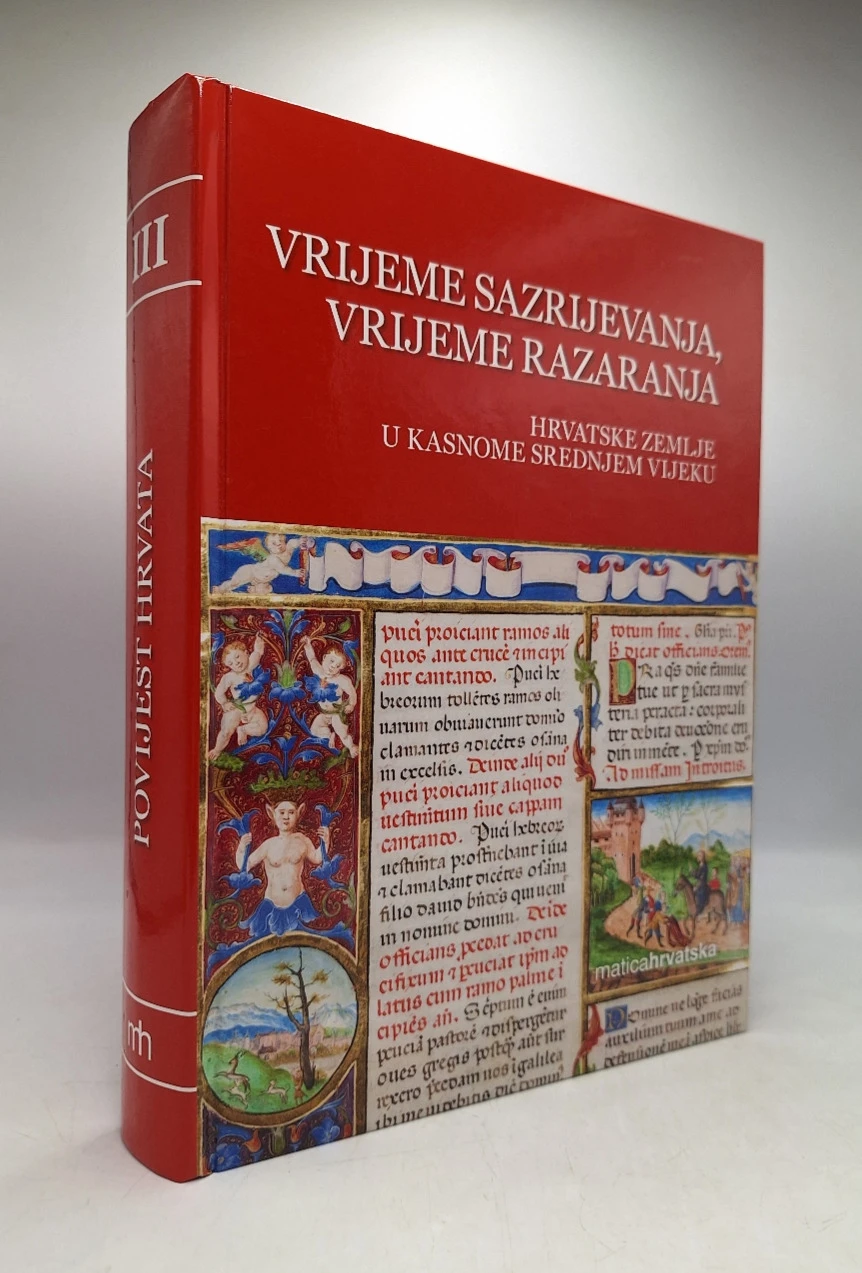

Karbić Marija: Povijest Hrvata III - Vrijeme sazrijevanja, vrijeme razaranja: hrvatske zemlje u kasnome srednjem vijeku
€ 32,00
Free delivery in Croatia for orders over EUR 70
Basic information
- Author: Karbić Marija
- Publisher: Matica hrvatska
- Availability: Available
- Condition: Odlično
- Code: 84374
Shipping options
GLS Croatia
5€
Delivery
0€
Personal collection at the antique store
0€
GLS parcel machine
3€
Payment methods
Pay on pickup
CorvusPay
By general payment / Virman / Internet banking
Cash on delivery
Povijest Hrvata III - Vrijeme sazrijevanja, vrijeme razaranja: hrvatske zemlje u kasnome srednjem vijeku
Karbić Marija
Summary
History of Croats III - Time of maturing, time of destruction: Croatian lands in the late Middle Ages
Editor: Marija Karbić
»The Late Middle Ages period was marked by contrasts and turbulent events, the simultaneous action of forces of integration and disintegration. It is a period in which significant changes occur on the political level, but also in other aspects of life, a period that significantly determined the subsequent development of Croatian society. Dalmatia comes under the rule of the Republic of Venice and becomes part of the Venetian Stato da mar, which determined its separate development for several centuries. Until the end of the Middle Ages, large parts of the Croatian territory fell under the rule of the Ottomans and were thus also separated from the rest of the Croatian lands. Although they were only a distant threat at the beginning of the late Middle Ages, the Ottomans soon became a factor that significantly influenced the fate of the Croatian people in that period. In addition to the loss of territory, the wars with the Ottomans also lead to heavy devastation and directly and indirectly caused considerable damage to the economy, and the financial strength of the state was weakened by high defense costs. The consequence of the Ottoman actions were large migrations of the population both within the country and outside its borders. These migrations also led to the spread of the Croatian name to the area of medieval Slavonia and the merging of the Croatian and Slavonic nobility, which created the basis for the future integration of the Croatian area.
The Hungarian-Croatian Kingdom in that period was also faced with battles for the crown between different pretenders on several occasions. They also led to significant destruction, but also to the weakening of the king's position in relation to the barons, i.e. members of the highest layer of the nobility and holders of the most important state duties, as well as to changes in the way the nobility perceived itself and the emergence of the idea of the nobility as the bearer of sovereignty. The late Middle Ages is also the period in which a series of reforms in the judiciary, administration, and tax system took place, as well as the development of culture and the emergence of the renaissance of art and humanistic thought in these areas.
(...) The contributors to this volume are mostly members of the middle generation of historians, and they come from various institutions throughout Croatia. Although their approaches to the creation of texts, as well as the evaluations of certain events, persons and situations they bring, differ to a certain extent, which is a consequence of respecting the freedom of each researcher, all authors have a common effort to provide the reader with an overview of the current state of research on certain topics and the level of knowledge reached, while citing the results of their latest research. In addition, it should be noted that the desire to create as complete a picture of the past as possible directed the authors towards new methodological approaches and hitherto neglected sources, using the results not only of historiography but also of other scientific disciplines, such as archaeology, art history, philology and literary history. Simply put, the authors wanted to show how far we have come in our knowledge of the Croatian late Middle Ages, while at the same time giving impetus to new research" (Marija Karbić)
Additional information
- Author: Karbić Marija
- Publisher: Matica hrvatska
- Year of publication:2019
- Place of publication:Zagreb
- Pages:637
- Dimensions:21x28.5 cm
- Script:Latinica
- Condition:Odlično
- Binding:Tvrdi
You may also like


Biblos Newsletter
For book lovers who enjoy finding the rare
New titles, special copies and quiet recommendations from the antiquarian bookshop.