
O ribama i školjkašima dubrovačkog kraja
Basic information
- Author: Balabanić Josip | Grmek Dražen Mirko
- Publisher: Dom i svijet
- Availability: Available
- Condition: Excellent
- Code: 22771
Shipping options
Payment methods
Explore more
O ribama i školjkašima dubrovačkog kraja
Balabanić Josip | Grmek Dražen Mirko
Summary
Mirko Dražen Grmek, Josip Balabanić: About the fish and shellfish of the Dubrovnik region
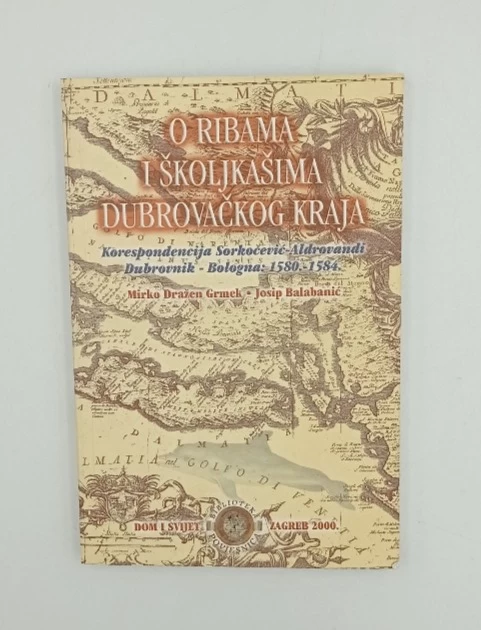
The book "About the fish and shellfish of the Dubrovnik region" by Mirko Dražen Grmek and Josip Balabanić was published in the "Povjesnica" library of the publisher "Dom i svijet" from Zagreb in 2000.
It contains the correspondence of the lord of Dubrovnik Jakov Lovrov Sorkočević and Ulisse Aldrovandi from Bologna during the four-year period 1580-1584. It is a manuscript legacy of the famous Italian naturalist, professor of the famous University of Bologna, Ulisse Aldrovandi (1522-1605), founder of the natural history museum in Bologna. As a pragmatic scientist, he advocated a scientific approach that entailed going out into the field, observing and collecting natural resources from different regions. For this, Aldrovandi connected with many collaborators. The authors refer to Aldrovandi's connection with Dubrovnik, with the Dubrovnik pharmacist Federik Ogeri, the chancellor of the Republic of Dubrovnik, Guglielmo Dondin, and especially with the Dubrovnik lord Jakov Sorkočević Lovrov, a naturalist amateur. stayed in Ston and its surroundings. Unlike his other class comrades, for whom going to Ston meant a sea of punishment (partly justified, because the life in the Ston swamp was quite unhealthy), Sorkočević, as a nature lover, used this stay to deepen his knowledge of the fauna of the Maloston subsea, which, no doubt, attracted him in an unusual way.
Sorkočević's inclination towards natural history was known in Dubrovnik, and even beyond the borders of the Republic of Dubrovnik. Professor Aldrovandi, namely, through his secretary Antonio Gigante, who was at one time the secretary of the theologian Ludovico Beccadelli, and at one time the archbishop of Dubrovnik, had good knowledge of the Dubrovnik intellectual environment, because Beccadelli gathered in his summer court, within a kind of academy, a select society that led scientific and literary nobles and discussions. Therefore, it can be assumed that Gigante directed Professor Aldrovandi to cooperate with Sorkočević, which took place through intensive and productive correspondence during the mentioned period. It is about 25 letters from Aldrovandi's correspondence, accompanied by very meticulously made pictures of animals and fish and their Dubrovnik names, which Aldrovandi, according to Jakov Sorkočević's precise descriptions, had made in the watercolor technique.
In addition to letters with descriptions and his own observations, Sorkočević sent the Italian scientist fish shells, bones, and even live fish, and other similar material that he obtained from must, which he assumed could be useful to a scientist. Based on his knowledge of the fish and other animal life of the Maloston Bay and its surroundings, he reports in detail, argumentatively and analytically to the famous Bolognese about their characteristics, the way they reproduce, their appearance and anatomy, and their behavior. Sorkočević's descriptions are realistic and vivid, like Hektorović's literary enthusiasm in "Fishing and Fisherman's Complaining", and they testify to the breadth of his education. Under Sorkočević's influence, Aldrovandija changed his opinion in several instances, based on late-medieval authors, leaning towards Sorkočević's opinion confirmed by independent observation of these natural phenomena. Sorkočević was well aware of the diverse and abundant world of fish in the area, which he observed and caught himself, but also exchanged knowledge with local fishermen. Therefore, as an amateur naturalist, he did not hesitate at all to express his own opinion in front of a scientific authority such as Professor Aliprandi, even when it was completely contrary to the position of a prominent scientist from Bologna.
Sorkočević's experience in growing oysters and mussels in the Maloston Bay, where these shells were grown in the coves of Sutvid, Bjejevica, in front of Hodilje, in front of Mal, is also precious for us. im Ston, and especially in Bistrina, in the wave-rich submarine springs of fresh water and the sandy and clear seabed, protected from strong waves, and with moderate temperature and salinity. Although the Maloston Bay was known in ancient times for oysters and mussels, as a natural site from which these two economically most important shellfish were harvested, the need for human nutrition for shellfish of various types led to the early development of their cultivation. Sorkočević is the first to report on the cultivation of these shells and the way it is done in the Maloston Bay. Although Juraj Šižgorić had already described the main sea products in his work "De situ Illyriae et civitate Sibenici" from 1487 (Građa za povijest knjiživnosti hrvatska Zagreb 8, 1899) and mentioned oysters as a very nutritious and tasty food, the first known record of growing oysters in the Maloston Bay was written almost two hundred years later than Sorkočević, and its author was Grisogono de Trau, who in 1775 presented how families from that region lay oak branches on which oysters are caught, which grow for three years, so that after that period they are ripe for consumption and economically profitable.
By publishing the transcription and translation of the letters of Professor Aldrovandi and his associates from Dubrovnik, the authors Mirko Dražen Grmek and Josip Balabanić snatched a valuable cultural and scientific content from historical oblivion. By confirming the participation of Dubrovnik's intellectual forces in laying the foundations of modern zoology, they shed new light on the Croatian cultural past of the 16th century. The publication of the correspondence between the lord of Dubrovnik and the scientist from Bologna from the manuscript legacy of professor Ulisse Aldrovandi confirms once again the cultural and intellectual connection between the two sides of the Adriatic, which has been maintained for many centuries.
Additional information
- Author: Balabanić Josip | Grmek Dražen...
- Publisher: Dom i svijet
- Year of publication:2000
- Place of publication:Zagreb
- Pages:193
- Dimensions:14.5x21.5 cm
- Script:Latin script
- Condition:Excellent
- Binding:Softcover
Reviews
0 reviewsWrite a review
Share your experience and help other readers choose.
This item has no reviews yet. Be the first to share your experience.
More books from Dom i svijet




You may also like










Recently viewed