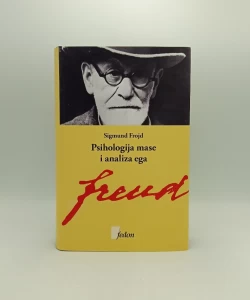
Sigmund Freud: Psychoanalytic Thoughts
Ppsychoanalysis confirms Plato's old thought that the good are only satisfied with dreaming about what the bad do in reality.
Only the poor are embarrassed to receive a gift, but never the rich.
We must also call human religions the madness of the masses.
Of course, madness is not seen by the one who participates himself. in him.
Ethics is the limitation of instincts.
The idea of a peaceful old age seems to be as much a legend as that of a happy youth.
Sigmund Freud (born in Freiberg, today's Příbor, Czech Republic, on May 6, 1856, and died in London on September 23, 1939) was an Austrian neurologist and the founder of psychoanalysis. Freud can rightly be considered one of the most influential intellectuals of his time, and not only for his extensive and numerous works, but also for voluminous letters, to which, without the help of a personal secretary, he answered diligently and regularly. It is estimated that he wrote about 30,000 letters during his life. He adhered to the self-imposed rule of answering every letter he received within one day.
Psychoanalysis, which he founded, is at the same time a theory about the human psyche, a therapy for its treatment and a point of view through which Freud interprets civilization and society. Psychoanalysis is a kind of "Copernican turn" that affects man's narcissistic belief in the supremacy and sublimity of the thinking Self. Freud's theory about the psychological structure of man into the Id (id), I (ego) and Superego (superego) has become one of the most comprehensive and scientifically confirmed theories of personality. Freud unequivocally showed that man is ruled by drives that arise from the unconscious (id). He is known to the wider public for a series of twenty-eight lectures published in the collection Introduction to Psychoanalysis. Although perhaps the most famous, that work is not the most important. In his magnum opus The Interpretation of Dreams, he showed that dreams are the libido's safety valve.
The second most important work, Three Treatises on Sexuality, ranks him among the pioneers of sexology. In it, he expanded the concept of sexuality beyond its conventional usage to include a multitude of erotic impulses from earliest childhood onwards. Distinguishing sexual goals (blind and indiscriminate drives) from sexual objects (persons we are attracted to), he developed a repertoire of sexual behavior, concluding that sexuality is the main driver of most human behavior.
Freud's success in psychoanalysis partly stems from his ability to self-analyze and self-criticize. Throughout his life, Freud strove to "be himself", which for him meant facing himself and the world without embellishment and self-deception. He was able to put himself in the role of the patient and see himself as if it were someone else. This is how he used to say about himself: »the problem is that I am not ambitious enough. I know I'm somebody without being told that," or: "I spent 14 francs on a suit, but that's why I made a good impression." He never attributed his success to talent or genius, but to hard work and self-discipline. He tirelessly pointed out: "I'm not particularly gifted. All my ability to work probably stems from my character and the absence of distinct intellectual weaknesses.'' Namely, through the drive for life Eros and the drive for death Thanatos, Freud ontologically closed the being, and showed pleasure as the essence of being. This discovery contradicted Freud's fundamentally bourgeois view of the world. Namely, Freud showed that civilization rests on renunciation of instincts and postponement of gratification, which, according to psychoanalysis, causes neurotic illness. That is, Freud sees the development of civilization as analogous to the development of personality.
How much Freud's theory determined not only psychology as a science but also ourselves, is also shown by the fact that all
today we self-evidently use "Freudian language". So we talk without hesitation about the Oedipus and Electra complex, sibling rivalry, narcissism, libido and sexual perversions. A collection of these wise thoughts will surely expand the reader's Freudian vocabulary.