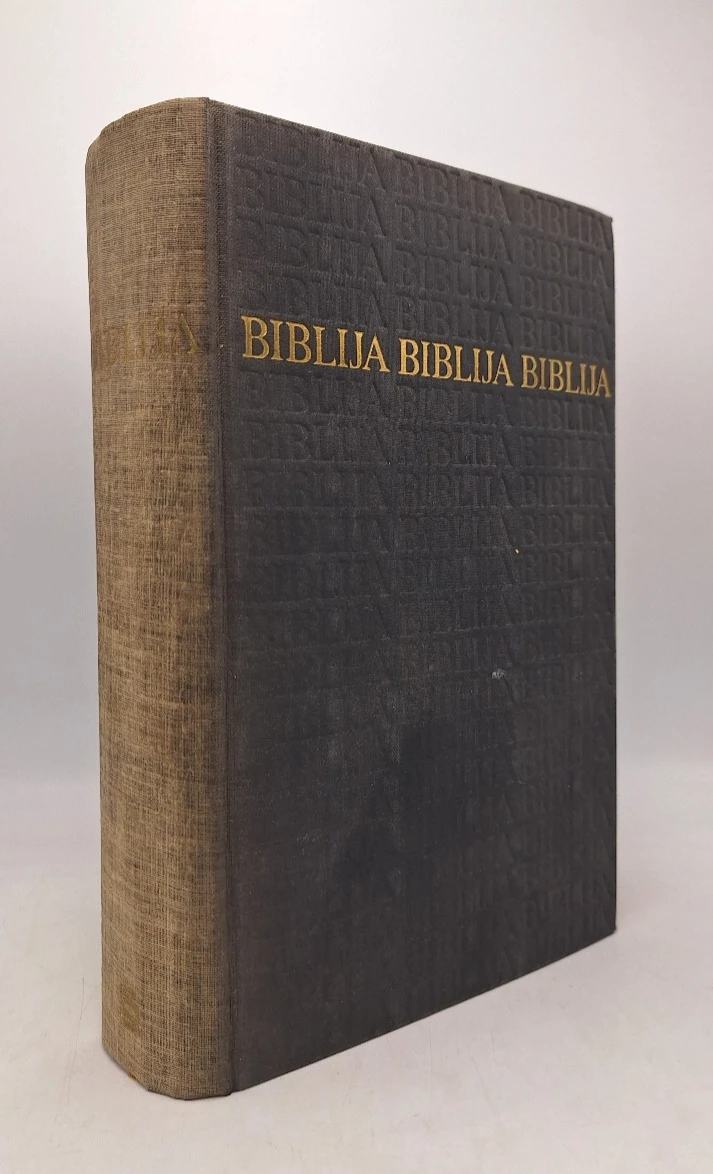

/: Biblija - Stari i Novi zavjet
€ 40,00
Free delivery in Croatia for orders over EUR 70
Shipping options
GLS Croatia
5€
Delivery
0€
Personal collection at the antique store
0€
GLS parcel machine
3€
Payment methods
Pay on pickup
CorvusPay
By general payment / Virman / Internet banking
Cash on delivery
Biblija - Stari i Novi zavjet
/
Summary
Bible - Old and New Testament
First edition
The Zagreb Bible The Zagreb Bible from 1968 appears as the fourth complete translation of the Bible into the Croatian language, and the first printed in Croatia and in Zagreb. A public publisher in the then communist system published a Croatian translation of the Bible made from the original, based on the model of the Jerusalem Bible (La Bible de Jérusalem). The Second Vatican Council, which closed the gates of the Vatican Basilica in 1965, is a call to return to the sources, the Holy Scriptures and the Church tradition. And in our country there is no Bible, as they say, not even for medicine. Thoughts to get there are hopeless. And then a miracle happens, called the Zagreb Bible. It is a miracle that in 1968, when the time was full of left-wing, faith-averse beliefs, when the government ruled in our country that systematically suppresses religion, occasionally loosening the reins, the Bible was published in Zagreb, in Croatia. And that at the instigation of the so-called social or state publisher of Reality. That, so to speak, no one could have thought even in their dreams. At the end of 1966 and at the beginning of 1967, reality invited the biblical scholars of the Catholic Faculty of Theology to prepare a translation of the Bible, that faculty which fifteen years ago was de facto, not de iure, excluded from the University of Zagreb. It is significant that precisely on the Epiphany of January 6, 1967, the key person in the whole thing, on whose blessing the entry of Catholic biblical scholars into the venture depends, Archbishop and Cardinal Franjo Šeper of Zagreb accepts the gauntlet thrown down in a conversation with biblical scholars Bonaventure Duda and Ivon Ćuk and gives his consent to prepare a translation of the Croatian Bible in cooperation with Catholic biblical scholars and the publisher of Reality. In ten days, on January 17, at the headquarters of the publishing house Tstvalnost, the biblical scholar Bonaventura Duda proposes that writers be involved in the work on the Croatian translation of the Bible. This surprised and pleased the interlocutors, the writer Jura Kaštelan and the director of Reality, Ivan Košutić. Kaštelan will suggest that literary classics are not invited to the circle of collaborators, because they will work slowly, but budding young writers. And the selection did not go according to the key of religious suitability, but only according to expertise, so that the ranks of literary collaborators included believers as well as experts who are not believers. The editorial board was formed: the main editors are university professor Jure Kaštelan, writer, member of the Publishing Council of Reality, and university professor Bonaventura Duda, biblical scholar, from the Catholic Faculty of Theology. The editors are Josip Tabak, writer, and Jerko Fućak, biblical scholar. Literary collaborators were gathered: Branko Brusar, Olinko Delorko, Filibert Gass, Marko Grčić, Stjepan Hosu, Jure Kaštelan, Božo Kukolja, Tomislav Ladan, Nikola Milićević, Zvonimir Mrkonjić and Ante Sekulić. Nikola Šop and Ton Smerdel were also there. The circle of biblical collaborators consisted of Bonaventura Duda, Jerko Fućak, Ivan Golub, Ante Kresina, Janko Oberški, Ljudevit Rupčić and Celestin Tomić. Ivan Golub, sticking to his point of view - when a person is in a position, the young should be promoted and the old should be rewarded - suggested to the editors of Zagrebačka Biblia in the beginning that the aspiring biblical scholar Adalbert Rebić, who at the time was finishing his study of biblical sciences in Rome at the Pontifical Biblical Institute, was accepted by the editor-in-chief Bonaventura Duda. Linguistic collaborators were Marko Grčić, Jure Kaštelan, Zvonimir Mrkonjić and Josip Tabak, who was entrusted with the general proofreading of the entire Bible with an insight into the Hebrew original. The highly conscientious and tireless Stjepan Hosu (once Golub's high school teacher) will be the proofreader of the Bible translation. On May 1, 1967, work began on the translation of the Zagreb Bible. Significantly, on the church holiday of Joseph the Worker, secular labor day, the work on the Bible begins, the collaborative work of clerics and laymen, writers and biblical scholars. The beginning of the work is known - the terminus a quo. Is the end of the work determined or at least predicted - terminus ad quem? It is. Tomislav Ladan said regarding the deadline for the preparation of the Bible: »Not in a few years ina, but in one year, but start work not tomorrow, but today. Otherwise, the first work will be done only in the last (one) year. So we're doing it now this year." And the work itself? Manuscript translations were adopted as a starting point. The basis is the manuscript translation of the late professor of biblical studies at the Catholic Theological Faculty of the University of Zagreb, Antun Sovic, with the exception of the Pentateuch of Moses by Silvio Grubišić and the Psalms of Filiberto Gass. From the printed translations, the translation of the Song of Songs by the writer Nikola Milićević and the New Testament by the biblical scholar Ljudevit Rupčić were taken. What did the collaboration between writers and biblical scholars look like? As a biblical associate of the Zagreb Bible, Ivan Golub mentions a few memories: "My biblical section was the Old Testament books of Ezra and Tobias and all the biblical books dedicated to women: Ruth, Judith and Esther, the book about gentle Ruth, about brave Judith and about the witty Esther. I am proud of that. The literary associate on the same section was Olinko Delorko, with the exception of the Book of Ezra, which was literary edited by Ante Sekulić. The basis was Sovicić In terms of language and literature, it was processed by a linguist-literate. It should be noted that Sovic's translation is exemplary in terms of fidelity to the original, but in the end it was not accepted in terms of the Croatian language into which it was translated sloboda, the poetic license, did not fail to be faithful to the original. Smerdel published his version of Lamentations. Since the Hebrew language, into which it is translated, is full of homonyms, the writer's contribution was always faithful the original and in the spirit of the language into which it is translated - in the spirit of Croatian. It was devoid of tediousness, monotony, repetition of one and the same word for one meaning." The complex and centuries-old question of the name covenant and/or covenant was resolved with i-i. The Bible is called the Old and New Testaments, and the term covenant is used in the Bible itself. God's name, in the original Hebrew four letters - the tetragrammaton YHWH, in the Bible it is spelled Yahweh. Personal names are mostly written according to the Hebrew original, and some according to the Vulgate. The Latin translation, the Vulgate, does not have the š sound, which the Hebrew original has. According to the Vulgate, the names of the great prophets are Isaiah, Jeremiah, not Hebrew (Yirmijahu - Jeremiah), and the minor prophets also appear in the Hebrew form as Hosea. The name of David's father in the Bible appears in the Hebrew form Jesse, not in the Vulgate Latin Jesse. Kajetan Vičić's poem Jesseides libri XII (Prague, 1700) is called by some Jishajids, relying on the Zagreb Bible, by others Jeseida, relying on the Vulgate. Faced with terminological decisions, the Zagreb Bible, with the exception of the covenant, went for compromise solutions between the Hebrew original and the Latin Vulgate. Compromise solutions, but not compromising.
You may also like








Recently viewed

Biblos Newsletter
For book lovers who enjoy finding the rare
New titles, special copies and quiet recommendations from the antiquarian bookshop.