

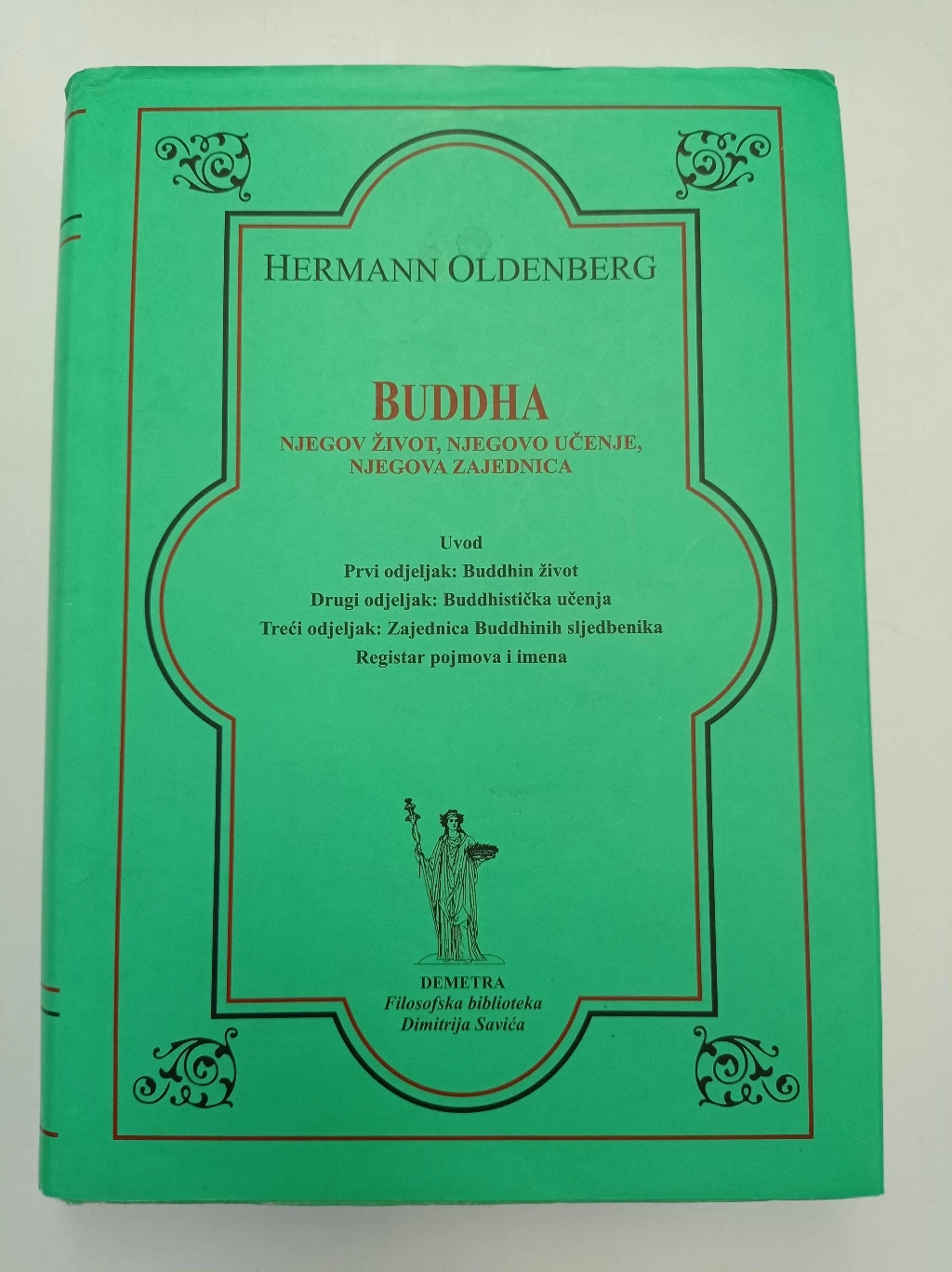
Buddha
Basic information
- Author: Oldenberg Hermann
- Publisher: Demetra
- Availability: Available
- Condition: Excellent
- Code: 46647
Shipping options
Payment methods
Explore more
Buddha
Oldenberg Hermann
Summary
Hermann Oldenberg: Buddha
His Life, His Teaching, His Community
The life work of Hermann Oldenberg (1854 - 1920) was devoted above all to researching the older history of Indian religion. In addition to publishing texts and translations, he advanced it decisively through his main four parts, which, although not written according to a premeditated plan, encompass the entire picture from the middle of the second to the middle of the first millennium BC.
Oldenberg began his Buddhist works with the publication of texts and translations: Dîpavansa in 1879, Vinaya Pitaka in five volumes in 1879 - 83; Theragâthâ 1883. Along with this came an English translation of the Vinaya Pitaka (three volumes, 1881-85) in the Sacred Books of the East series. In the midst of this strictly philological study of texts, the book Buddha was created, which made him famous even outside the narrow circle of experts in one fell swoop. In the field of Buddhology, this work gained a kind of counterpart only with the volume of the translation Reden des Buddha ["Buddha Speaks"] (1922), published from his estate after his death.
The meaning belonging to Oldenberg's "Buddha" in the history of Indology can hardly be assessed today, because most of what was new at the time of its appearance has now, precisely through this work, already become a generally recognized secure possession. Older Western Indology drew its knowledge mainly from Sanskrit texts that depicted the Buddha as a superhuman being surrounded by a tangle of legends. Then attention was increasingly focused on the Pali tradition, and in the oldest writings of the Tipitaka (Buddhist canon from Ceylon and Eastern India), texts appeared in which the tradition about the Buddha's life and science, which is closer to the historical reality, appeared. Together with Georg Turnour, Viggo Fausböll and the married couple Rhys Davids who founded the Pâli Text Society in 1882, Oldenberg belongs to the pioneers of Pali philology.
{H. V. Glasenapp, from the afterword}
Oldenberg's research and interpretations of deep connections between the early Buddhist model of asceticism and pre-Buddhist "circles of thought" (especially Brahmanical) give this monograph a special value. they give us an insight into the reality of the development of the Indian spiritual tradition through the structure - forms of thought, forms of existence and social connections with which they appear - rather than only through the content of ideas, beyond dichotomous oppositions according to the model of the orthodox - heretical which was transferred from the Indian past itself to the history of ideas and its interpreters, both Indian and Western.
But the objectivity of the structural historical approach, in which the usual speculation about the absolute is presented as a form and intersection of the specific context, as a concrete form of life of local human communities, is not free from the price of paradox: the objectivity of the analysis on the Indian ground was achieved at the price of outdated and today certainly backward Eurocentric observations about the "soft essence" and "dark fantasy" of the Indian in contrast to the "firmness and determination", "brightness of spirit", "clarity and definiteness of thought" of the Greeks and Germans. Indeed, the nonsense about the exotic "Oriental", turned inward, is itself exotic today; they bear witness to the deeply ideological nature of the Eurocentric attitude of a large number of European humanities actors from the end of the colonial era (including one Husserl). However, in the case of such a meritorious philologist and historian as Oldenberg, these ideological limitations are fascinating precisely in view of the cognitive scope of his research in the history of Indian literature, philosophical and religious ideas. To that extent, they represent an unusual curiosity and challenge for the contemporary reader, especially the younger one, who today is sometimes explicitly and programmatically educated for global political correctness in humanist academic disciplines, who is encouraged to study Eastern traditions even when he does not become an Orientalist.
[B. Mikulić, from the preface]
*
Additional information
- Author: Oldenberg Hermann
- Publisher: Demetra
- Year of publication:2007
- Place of publication:Zagreb
- Pages:432
- Dimensions:18x25 cm
- Script:Latin script
- Condition:Excellent
- Binding:Hardcover with dust jacket
Reviews
0 reviewsWrite a review
Share your experience and help other readers choose.
This item has no reviews yet. Be the first to share your experience.
More books from Demetra

You may also like








Recently viewed