
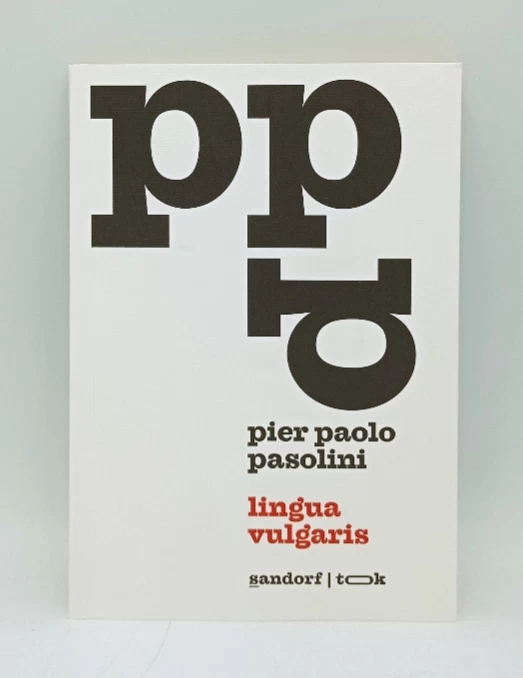
Lingua vulgaris
Basic information
- Author: Pasolini Pier Paolo
- Publisher: Sandorf
- Availability: Available
- Condition: Excellent
- Code: 66409
Shipping options
Payment methods
Explore more
Lingua vulgaris
Pasolini Pier Paolo
Summary
Pier Paolo Pasolini: Lingua vulgaris
Unlike his previous interviews and the numerous articles he wrote in the last years of his life, this is a unique document - a retranscription of the entire debate that Pasolini was an animator of. It can be read as a piece of his "theater of words", in which each character embodies the questions dear to Pasolini. Thus, among the protagonists we find an "Albanian" who advocates the same theses as Pasolini, but ten years ago, a progressive who accuses him of being a reactionary and gets carried away by the myth of a happy past that never existed, a Gramscian who calls for the emancipation of the masses, professors from the north of Italy and professors from the south of Italy with their hopes and fears, young students and their revolutionary lyricism, as well as the voices that rise from the audience.
Although he does not agree with any of them. of them, Pasolini addresses each one in his gentle and disarming voice. His tone is never polemical, although reading the debate can sometimes give that impression. On the contrary, he tries to find a foothold in each interlocutor that would allow him to get out of the dead end he deliberately led everyone into, which is a struggle "between a culture we don't accept and a dead culture". Everyone asks him for guidance in their own way. But he insists that he is not a guide, that he does not know what to do, that he is not a prophet, nor does he want to be one. And yet, today more than ever, Pasolini is spoken of as a prophet. No, Pasolini does not read the future. He sees the present, but with rare lucidity.
-from the Afterword by Michele Bee
Pier Paolo Pasolini, Italian writer and film director, was born in Bologna in 1922 and died in Rome in 1975. He graduated in literature in Bologna, and studied Romance philology, especially the Friulian dialect, in which he expressed his delicate and fantastic poetic world in his first published poems. He joined the Italian Communist Party in 1947, but was expelled due to accusations of seducing a minor and lost his job as a teacher. He is the author of several novels and theoretical discussions, especially on stylistic freedom and criticism of contemporary capitalist society. In addition to dialectal poetry, he also wrote poetry in the Italian language. He started working in film in 1954 as a collaborator on screenplays (Fellini and Bolognini), and in the later phase, original interpretations of historically and culturally key texts stand out, as well as peculiar evocations of the past and adaptations of classic literary works. Films such as The Decameron (1971), The Canterbury Tales (1972) and The Flower of 1001 Nights (1974) celebrate sexuality, and films with contemporary social and political themes also attracted attention. Pasolini's unexplained violent death contributed to the creation of the myth of his consistent non-conformism in life and art. His provocative and complex work combined Marxism and Christian spirituality, nostalgia for the pre-capitalist values of the rural world, condemnation of the lack of values of Italian civil society and the violence of social structures against the individual.
Additional information
- Author: Pasolini Pier Paolo
- Publisher: Sandorf
- Year of publication:2022
- Place of publication:Zagreb
- Pages:60
- Dimensions:12x17 cm
- Script:Latin script
- Condition:Excellent
- Binding:Softcover
Reviews
0 reviewsWrite a review
Share your experience and help other readers choose.
This item has no reviews yet. Be the first to share your experience.
More books from Sandorf

You may also like