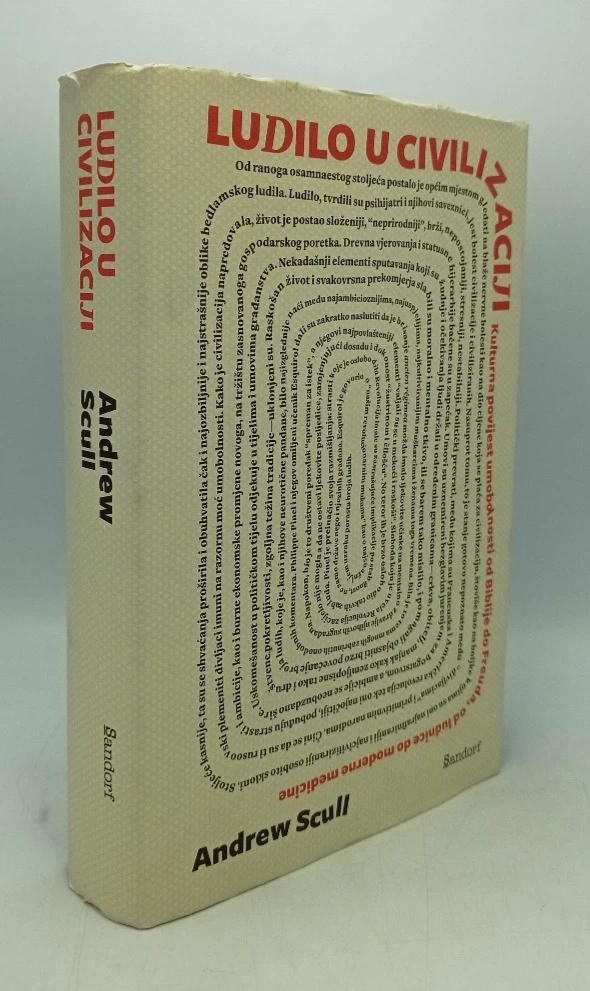

Scull Andrew: Ludilo u civilizaciji
€ 22,00
Free delivery in Croatia for orders over EUR 70
Basic information
- Author: Scull Andrew
- Publisher: Sandorf
- Availability: Available
- Condition: Nova knjiga
- Code: 46165
Shipping options
GLS Croatia
5€
Delivery
0€
Personal collection at the antique store
0€
GLS parcel machine
3€
Payment methods
Pay on pickup
CorvusPay
By general payment / Virman / Internet banking
Cash on delivery
Ludilo u civilizaciji
Scull Andrew
Summary
Andrew Scull: Madness in Civilization
Today, mental disorders are most often viewed through the lens of medicine, but societies have also tried to find meaning in them through religion and the supernatural, or by creating psychological or social explanations in an effort to rein in the demons of madness. Madness in Civilization traces the long and complex history of this affliction and our attempts to cure it.
Andrew Scull takes the reader from ancient times to the present day, sketching a vivid and often harrowing portrait of the different ways in which cultures around the world have interpreted the seemingly irrational, psychotic, and crazy. From the Bible to Sigmund Freud, from exorcism to mesmerism, from Bedlam to Victorian asylums, from humoral theory to modern pharmacology, the book explores the manifestations and meanings of madness, its challenges and consequences, and our varied responses to it. The book also explores how madness has haunted the imagination of artists and describes the profound influence it has had on the arts, from drama, opera and novels to painting and sculpture.
Extensively and richly illustrated and written in a highly readable narrative style from the pen of a leading scientist hailed as "one of the foremost contemporary historians of psychiatry", Madness in Civilization will quickly be recognized as essential reading, an exceptional and masterful panoramic history of the subject from of deep significance for all of us.
Paradoxically, madness does not exist only in opposition to civilization, or exclusively on its edges. On the contrary, it is one of the central themes for artists, for playwrights, novelists, composers, theologians, for doctors and scientists, not to mention how closely it concerns almost all of us - either through our own encounters with disorders of the mind and feelings, or through those of family members and friends. Madness is, therefore, in important ways an indelible part of civilization, it is not located outside of it. It is a problem that persistently haunts our consciousness and our daily life. It is therefore marginal at the same time and more than marginal.
Madness is a disturbing subject, a subject whose secrets still baffle us. The loss of reason, the sense of alienation from the common-sense world that the rest of us imagine we continue in, the devastating emotional turmoil that grips some of us and won't let go: this is part of our common human experience throughout the ages, in all cultures. Madness haunts the human imagination. It fascinates and frightens at the same time. Few are immune to its horrors. It constantly reminds us how fragile our power over reality can sometimes be. It defies our sense of the very limits of what it means to be human.
Andrew Scull is a professor of sociology and science studies at the University of California, San Diego. He previously taught at the University of Pennsylvania and Princeton. His numerous publications include Museums of Madness; Social Order/Mental Disorder; The Most Solitary of Afflictions: Madness and Society in Britain, 1700-1900; Masters of Bedlam; Madhouse: A Tragic Tale of Megalomania and Modern Medicine and Madness: A very short introduction. He has also published numerous articles and reviews in leading journals including TLS, Lancet and Brain. He was the recipient of a scholarship from the Guggenheim Foundation and the American Council of Learned Societies, and in 1992-1993 was the president of the Society for the Social History of Medicine.
Additional information
- Author: Scull Andrew
- Publisher: Sandorf
- Year of publication:2018
- Place of publication:Zagreb
- Pages:480
- Dimensions:16x24 cm
- Script:Latinica
- Condition:Nova knjiga
- Binding:Tvrdi s ovitkom
You may also like












Biblos Newsletter
For book lovers who enjoy finding the rare
New titles, special copies and quiet recommendations from the antiquarian bookshop.