

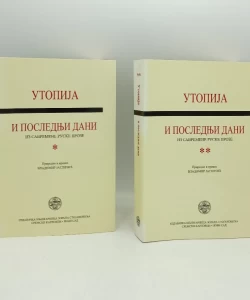
Antologija ruske poezije XX veka I-II
Basic information
- Author: Jagličić Vladimir
- Publisher: Izdavačka knjižarnica Zorana Stojanovića
- Availability: Available
- Condition: New book
- Code: 43471
Shipping options
Payment methods
Explore more
Antologija ruske poezije XX veka I-II
Jagličić Vladimir
Summary
Vladimir Jagličić: Anthology of Russian Poetry of the 20th Century I-II
The Silver Age
For the first quarter of the twentieth century, when it comes to Russian poetry, the term "Silver Age" took root in literature. The Silver Age should be the "child" of the golden, nineteenth century in Russian poetry, which began with the "Pushkin constellation" (after the great personalities Lomonosov and Derzhavin), and ended with the maturity of Tyutchev, Fet, Solovyov and Sluchevski, who announced the rise of Russian symbolism. That's how it looks to us today, scientifically polished, so it seems that the Silver Age is some kind of group shot in which they are smiling like-minded people. Of course, in the so-called reality, not everything was so smooth. There were different aspirations, searches (for themselves and others), conflicts, reconciliations, renewed quarrels, poetic and life separations, even duels between seemingly kindred spirits. Blok, Beli and Brjusov, Vyacheslav Ivanov and Vološin, Vološin and Gumiljov, Gumiljov and Blok, Gumiljov and Akhmatova - like many of their companions, went through different, both literary and poetic, as well as non-literary life phases. The excessive rapprochement of this extremely individual personality cost - it is not an exaggeration to say - almost his life. They mixed, dangerously, worlds in order to search for and find themselves again in their confusion and unclear fog, or definitely get lost in them. We are not contemporaries who follow their (common poetic) rise, not knowing how it will end, but someone who looks back, keeping in mind the entire life and creative path - both of the poet and the era to which they belonged. Therefore, it is necessary to distinguish the initial fellowship of young poets from the later, individual development of certain personalities. If we add the names of such diverse creators as Baljmont, Sologub, Kuzmin, Hipiyusova, Khodasevich, Anjensky, Klyujev, Khlebnikov to these mentioned names - let's just stick to them - it will become clear, even without detailed explanation, why this period stands out in Russian poetry, not only as a part of Russian, but also world culture, but also why it is not reducible to the scarcity of belonging to poetic trends and schools. These poets surpassed them, even when they belonged to them orthodoxy.
Additional information
- Author: Jagličić Vladimir
- Publisher: Izdavačka knjižarnica Zorana S...
- Year of publication:2015
- Place of publication:Sremski Karlovci
- Pages:684 684
- Dimensions:15x23 cm
- Script:Cyrillic script
- Condition:New book
- Binding:Hardcover
Reviews
0 reviewsWrite a review
Share your experience and help other readers choose.
This item has no reviews yet. Be the first to share your experience.
More books by Jagličić Vladimir
More books from Izdavačka knjižarnica Zorana Stojanovića