
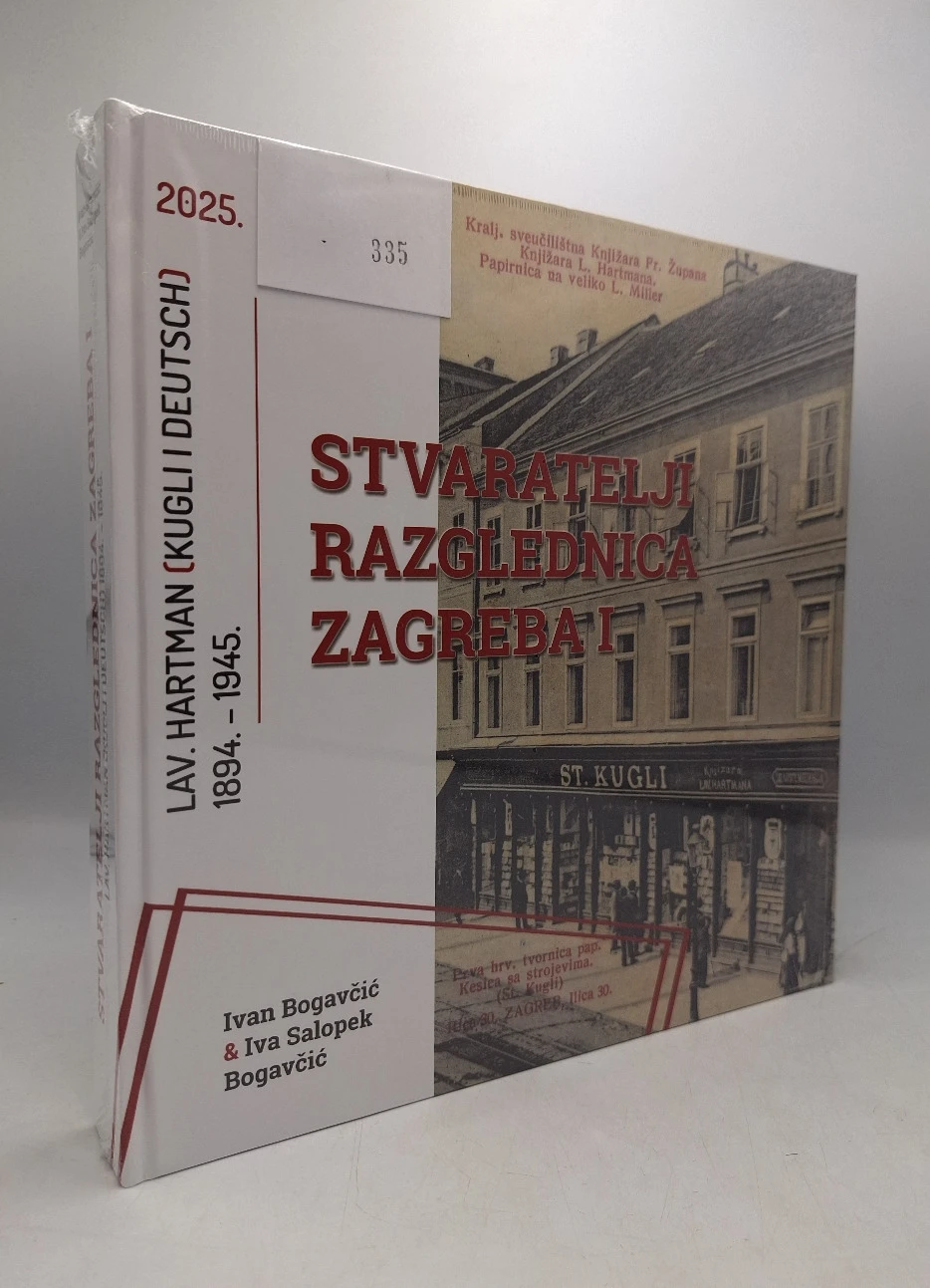
Stvaratelji razglednica Zagreba I
Basic information
- Author: Bogavčić Ivan | Bogavčić Salopek Iva
- Publisher: Institut za vrednovanje i obradu razglednica
- Availability: Available
- Condition: New book
- Code: 83001
Shipping options
Payment methods
Explore more
Stvaratelji razglednica Zagreba I
Bogavčić Ivan | Bogavčić Salopek Iva
Summary
Ivan Bogavčić, Iva Salopek Bogavčić: Creators of Zagreb postcards I
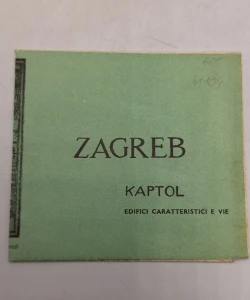
The book presents the work of the printing and publishing house Lav in a comprehensive and cataloged manner. Hartman (Kugli and Deutsch) in the postcard segment. The book uses a chronological-problematic approach to examine the postcards of Zagreb that were printed by the aforementioned bookstore from 1894 to 1945. In the opening chapters of the book, the terms and terminology used in connection with the printing, publishing, collection, distribution, collection and preservation of postcards are discussed, the printers and publishers of Zagreb postcards until 1900, the appearance of the first postcards in Croatia, as well as the appearance of the first found Zagreb postcard that was used for postage in 1893. Then there are ten chapters about the activities of the bookshop Lav itself. Hartman and series of postcards produced by that company. The first lithographic postcards of the bookshop Lav. Hartman as an established Zagreb printer and publisher published in the period 1894-1897. As early as 1898, a series of postcards of Zagreb and Zagreb motifs was published by the bookshop Lav using the autotype technique. Hartman based on the photographic templates of Ivan Standl, Leo Vetter and Eduardo Kastian. These are postcards that were printed from part of the clichés that were made in 1891 for the tourist guide of Zagreb, i.e. Zagreb and its surroundings: a signpost for natives and foreigners. In the same year, 1898, a series of postcards depicting Zagreb's business entities was printed, attributed to the bookshop Lav.Hartman. It is assumed that the bookstore is Lav. Hartman was the printer and publisher of that series of postcards, while the publishers were probably the economic entities shown on the postcards. The postcards show typologically different types of economic entities from craft shops, banks, inns, hotels to factories that were located in the center of Zagreb. Bookstore Lav. Around 1904, Hartman published a leporello booklet with thirteen Zagreb motifs from photographs by the company Stengel & Co. in the light printing technique. Not long after that, Knjižara prints motif-identical postcards based on the same photographs by Stengel. In the period from 1906 to 1918, the motifs of postcards were mostly still oriented towards the narrower area of the city center of Zagreb. A new series of at least seventeen postcards was printed in 1916 using the attractive technique of lithographically colored autotype, and in the same year, a series of five postcards with new motifs reproducing the artworks of Nasta Rojc, Menci K. Crnčić and Branko Šenoa was printed using multi-colored autotype in cooperation with the Viennese company POSTKARTENVERLAG BRÜDER KOHN, WIEN. During 1929/30. Stjepan Kugli publishes a large series of about seventy postcards that were made in new ways in accordance with the trends of the time, such as silver bromide photography, toned silver bromide photography, copperplate printing or rotogravure. The book ends with a chapter on collecting postcards in Zagreb, which can be more seriously traced from 1895, when the first texts on postcards appear about how collectors are looking for "revanche", i.e. a return ticket or ansichtskarten for their collection, and the first postcards as part of the collection are found in albums from 1897. Based on the preserved postcard albums, it can be seen that mostly postcards were collected by women, namely teachers, noblewomen or clerks following the then European fashion of collecting postcards from many tourist destinations.
Additional information
- Author: Bogavčić Ivan | Bogavčić Salop...
- Publisher: Institut za vrednovanje i obra...
- Year of publication:2025
- Place of publication:Zagreb
- Pages:380
- Dimensions:24x24 cm
- Script:Latin script
- Condition:New book
- Binding:Hardcover
Reviews
0 reviewsWrite a review
Share your experience and help other readers choose.
This item has no reviews yet. Be the first to share your experience.
You may also like





Recently viewed