


In the organization of Biblos antiquarian and its owner, Daniel Glavan - after more than half a millennium, a copy of De institutione bene vivendi per exempla sanctorum from 1506 arrived in Croatia - - Marko Marulić's most translated work and surely, along with Judita - his most famous!
Marulić gained fame as a European humanist with his numerous Latin works - among which De institutione bene vivendi per exempla sanctorum, a work he wrote at the end of the 15th century, occupies a special place. st.

The greatness of Marulić's overall creativity is also conveyed by the fact that Thomas More read Marulić's Evangelist from in 1516 in the dungeon immediately before his execution (1535) and that Franjo Saleški always carried with him a copy of just such De institutione bene vivendifrom 1506.
In this work, as a Christian moralist and theological writer, he puts man in the center of attention, who in his vision is an ethical being. Man receives all his value, meaning and determination from God, without whom everything would be in vain and without whom there would be nothing. The thought of original sin and Christ's saving role are the fundamental starting points of Marulić's ethical and theological thought and the main goal of his worldview. Man is weak and sinful, but with faith in God and personal dedication, he can live virtuously and thus gain eternal life. institutione bene vivendi Marulić drew mostly from the Holy Scriptures, then from the lives and works of church fathers and teachers (Jerome, Eusebius of Caesarea, Gregory the Great, etc.). This morally instructive work is written in a chosen style and is divided into six books with 71 chapters, and in each of them one virtue is considered.
De institutione bene vivendi, that kind of "bestseller" of the 16th century, was first printed in 1506 in Venice - just like the copy that arrived at the Biblos antiquarian.
The work soon became very popular and saw around 60 editions with translations into the most important European languages - Italian (Venice, 1563), German (Cologne, 1563), Portuguese (Lisbon, 1579), French (Douai, 1585), Czech (Prague, 1621), and in 1924, Milan Pavelić translated the 4th chapter of II. books in the Croatian language. Branimir Glavičić translated it in its entirety only in 1986, preparing a comparative Croatian-Latin edition.

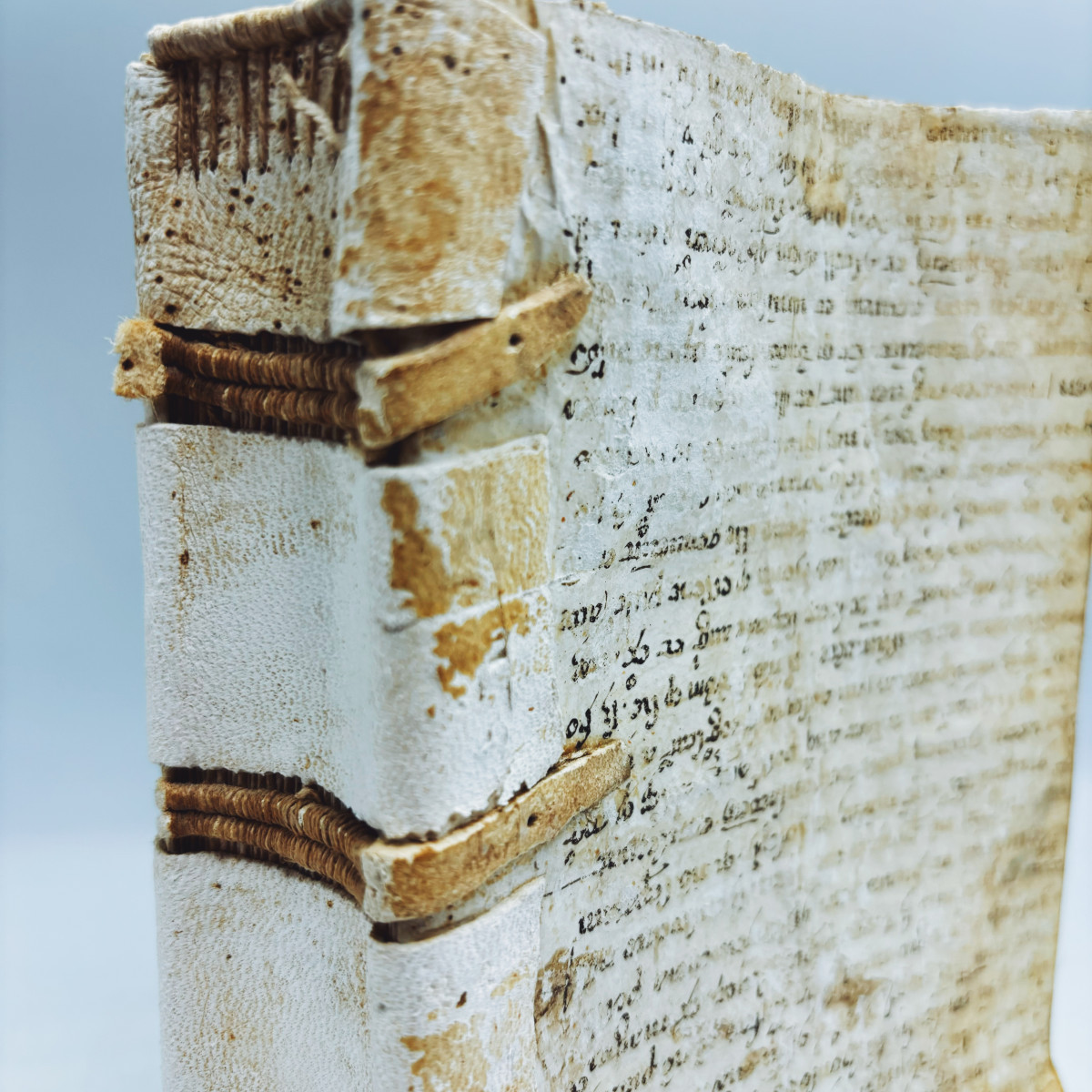
A rare example De institutione bene vivendi, which arrived in Croatia 500 years after its creation, is an original and rare copy printed on solid paper with minimal darkening. The excellent preservation of this book is due to its superb craftsmanship - the pages are stitched and attached to a leather strap with cords across the spine. The strips of fine goatskin are wrapped around the spine and overlap with the end leaves (manuscript pages).
Find out more about this work of the father of Croatian literature and explore the possibility of assuming the role of guardian of the national cultural and intellectual heritage:
Biblos Newsletter New titles, special copies and quiet recommendations from the antiquarian bookshop.For book lovers who enjoy finding the rare