
George Orwell a rebel with a cause
George Orwell was born under the name Eric Arthur Blair in 1903 in India in the sahibi class (the name by which Europeans were addressed in the colonial era).
His father was a British official in the Indian civil service, and his mother, a French woman, was the daughter of an unsuccessful teak trader in Burma.
His family was part of the upper middle class, and Orwell himself later referred to this class as "landless nobility", i.e. people whose pretensions to social status do not match their income. The writer was thus brought up in a somewhat snobbish atmosphere.
He spent the first years of his life relatively carefree in India, until at the age of four he was sent to study in England.
There, both because of poverty and because of his brilliant mind he stood out from the rest of his peers.
His family counted on George, because of his intelligence, to "make it in life" and help them regain their lost wealth.
Orwell stated that he was lonely as a child and was not popular at school because of his inappropriate behavior. He grew up to be a grumpy, withdrawn and eccentric young man.
"Like any lonely child I was in the habit of making up stories and holding conversations with fictional people, and I think that my literary ambitions were mixed with a feeling of isolation and underestimation from the very beginning."
George Orwell
The struggle against the beginning imperialism
Instead of graduating from college, Orwell decided to follow the family tradition, so in 1922 he went to Burma where he worked as an assistant superintendent in the Indian Imperial Police.
He soon realized how much the British imposed their will on the Burmese and became increasingly ashamed of his position as a colonial policeman.
He left Burma, and upon returning to Europe, to redeemed and lessened his sense of guilt, he began to live the life of poor and outcast people.
He wore shabby clothes and stayed in cheap lodgings in London together with workers and beggars, and he also spent some time in the slums of Paris where he worked as a dishwasher in hotels and restaurants.
Orwell's aversion to imperialism led him not only to a personal rejection of the bourgeois way of life, but also to a political reorientation.
Immediately after returning from Burma, he began to call himself an anarchist, and later, during the 1930s, he considered himself a socialist.
Literary beginnings and literary style
Literary George Orwell's journey began during his stay on the Asian continent. The writer's experiences in Burma exposed the cruelty of colonialism and then he began to write his first essays in which he denounced the differences between the British ruling class and the local population.
All this was a announcement of strong social and political criticism that would become a trademark of his works. He later collected his thoughts from that period in the book "Burmanski dani". href="https://www.antikvarijat-biblos.hr/knjige/knjizevnost/kataloniji-u-cast-eCVWXVb6E">"In honor of Catalonia".
In Spain, he witnessed power struggles, war propaganda and persecution of dissidents. These themes will become central in his later masterpieces
George Orwell's writing style is usually short and clear. The writer deliberately avoids the use of figurative language and unnecessary words.
In the essay entitled "Politics and the English Language", Orwell offers six rules by which the author can improve his writing.
6 Orwell's rules for writing a text:
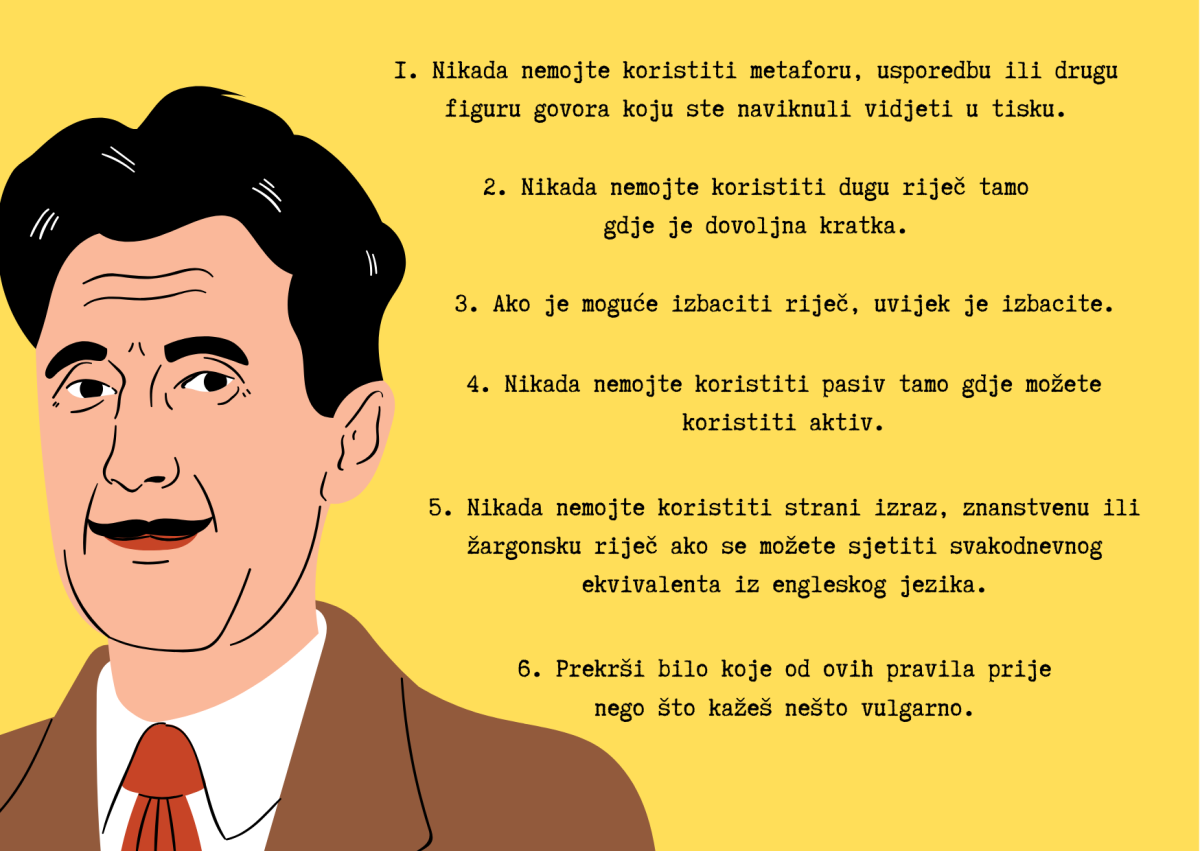
Photo: Antikvarijat Biblos
Private life
George Orwell was married twice.
In one of her letters, Orwell's first wife, Eileen O'Shaughnessy, complained to a friend saying: "I didn't call earlier because we were constantly and very violently arguing."
Later she continued in a similar tone: "I thought to save time and write everyone just one letter after the murder or separation."
George didn't talk much differently about his marriage either. Namely, in the letter he sent to his ex-lover, he admits that he is sometimes unfaithful to Eileen, and among other things he says: "I treated her badly too. And I think she treated me badly at times, but it was a real marriage because we went through terrible struggles together and she understood everything about my work."
Together they adopted a son, Richard Horatio Blair, and Eileen tragically died during an operation at the age of 39.
In the autumn of 1949, shortly before his death, he married Sonia Brownell.
Orwell died at the age of 47 from tuberculosis. He was buried under his real name Eric Arthur Blair.
George Orwell's works

Photograph: Antikvarijat Biblos
1984
It is about a dystopian novel that represented George Orwell's terrifying vision of the future.
The author is modeled the imagined totalitarian state on the model of the Soviet Union during the time of Stalin, as well as Nazi Germany during the time of Hitler.
The main character, Winston Smith, is an employee of the Ministry of Truth in which he does what the ruling regime asks him to do. Nevertheless, despite the manipulations and mortal danger, he tries to resist and think for himself.
The book belongs to one of the most provocative and important works of world literature, and today the topics it deals with are probably more relevant than ever.
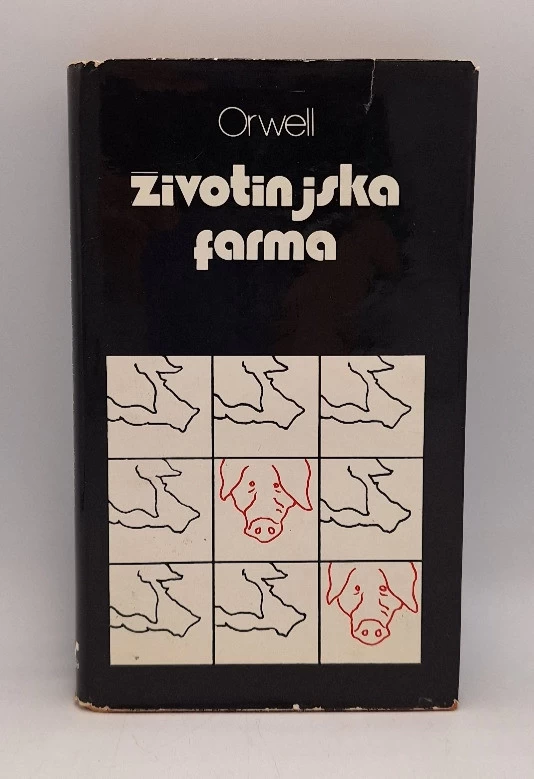
Zivotinjska farm
Animal Farm is a satirical novel that makes fun of Stalin and Soviet totalitarian communism. The book deals with a group of barnyard animals who overthrow and expel their exploitative human masters and establish their own egalitarian society.
In the end, the intelligent and powerful animal leaders, the pigs, undermined the revolution. Concluding that “all animals are equal, but some animals are more equal than others”, the pigs create a dictatorship even more oppressive and heartless than the one established by humans.
In the preface to Animal Farm, Orwell also criticized the situation in Great Britain, but it was censored.
In honor of Catalonia
George Orwell writes about his experiences and observations while fighting in the Spanish Civil War.
The author narrates about the Catalan revolution his ardor, his boredom on the battlefield, the bullet in his neck that he received while on the front line, and his escape to France. days
George Orwell's first novel takes place in Burma at the time when that country was ruled by Great Britain.
In the five years he spent in the police service in Burma, Orwell got to know the people, country and culture there, learned Burmese and Hindustani, and weaved his experience into the book Burmese Days.
There he became even better acquainted with the dark side of colonial rule, the imposed superiority and arrogance of his race and class, so he quit his job in disappointment in order not to sever all ties, as he later wrote, "not only with imperialism but also with every form of power of man over man".
The work represents one of the sharpest criticisms of colonialism in literature.
Don't give up, aspidistro
A social novel interwoven with humorous notes is the story of poor, unsuccessful and disappointed Gordon Comstock, a thirty-year-old salesman in a bookstore who would like to make a living from writing.
Aspidistra from the title is a resistant potted plant once very popular in England. Burdened by a chronic lack of money, Gordon sees aspidistra in all the windows of households where members of the lower middle class live, from which he himself, to his own regret, does not manage to rise.
It is difficult to make ends meet, but he does not accept help from a rich friend; torn and divided between pride and prejudice, reason and feeling, necessity and freedom, duty and art, Gordon simply does not know what to do.
Biblos Newsletter
For book lovers who enjoy finding the rare
New titles, special copies and quiet recommendations from the antiquarian bookshop.