
Croatian encyclopedia - a significant project by Mate Ujević

Who was Mate Ujević?
Mate Ujević was born on July 13, 1901 in the village of Krivodol near Imotski. He finished primary school in his native village, while he attended high school in Sinj and Split.
From an early age he showed a great interest in literature, so he very quickly began writing travelogues, poems and literary criticismwhich were published in various magazines.
He studied comparative literature, French, South Slavic literature, Old Slavic and history. After graduating from college, Mate Ujević got a job at the Archbishop's Classical Gymnasium in Zagreb, where he worked as a teacher of Croatian and French.
He married Marija Juras, a professor of mathematics, physics and chemistry, and together they had seven children.
"Dad gave us the basic coordinates of behavior and movements in life. We children had to do everything ourselves. There were really a lot of children in the family, so there was no time for father to devote He wouldn't have time to do anything else, and he worked a lot."
Sculptor Marija Ujević about her father Mati Ujević
Fighter against dictatorial regimes
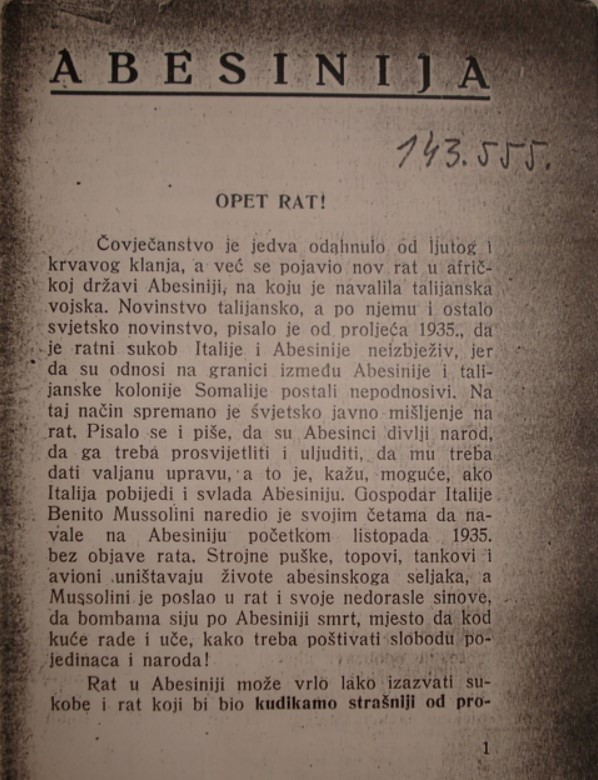
Photo: Internet, Abyssinia brochure
Mate Ujević is described by his contemporaries as moral a man who was opposed to all forms of dictatorial rule, both fascism and communism. For example, in 1935, under the pseudonym Josip Sučević, he published the brochure Abyssinia in which he wrote against Mussolini's occupation of Ethiopia.
A few years later, on April 26, 1941, the Gestapo arrested him in Zagreb because he had written against fascism before the war. According to some sources, the reason for his arrest was the accusation that he financed the Croatian encyclopedia, which we will talk about later, with "Jewish money". communism Ujević had no peace. Namely, although he personally did not support the ideas of totalitarianism, because he worked in a state institution during the NDH, the communist authorities banned him from work for almost five years.
"Whoever saves just one life, has saved the whole world"
Bonaventura Duda about Mata Ujević:
"God wants and He wants his pious man to be righteous. He is a righteous man who cultivates the same religiosity: a lover of God and a lover of humanity. Kudos to him!"
During the NDH, Mate Ujević worked at the Croatian Publishing Bibliographic Institute. During that period, using his status and acquaintances with prominent people, he tried to help Jews and other intellectuals who were being persecuted by the Ustasha government at the time.
Namely, his neighbor Manko Berman worked as an administrator at the Institute. Berman was arrested in 1942 and sent to Jasenovac.
Ujević wrote pleas to the authorities to release him for months because, he stressed, well, the Institute cannot function without such a good worker.
The pleas bore fruit and Berman was released.
Since he assumed that the document by which his colleague was freed would not be valid for long, Mate risked his life by obtaining the necessary documents and money that enabled the Berman family to travel safely to Israel.

Photo: Internet, Yad Vashem Museum
For this reason, the State of Israel posthumously awarded him the Righteous Among the Nations award in 1994.
This is an award given to non-Jews who helped save them during the Holocaust.
In the Holocaust Memorial Museum, Yad Vashem, Mate Ujević has a memorial plaque.
The idea of the origin Croatian encyclopedias

Photograph: Biblos, Croatian encyclopedia
The project of creating a general and national encyclopedia called the Croatian encyclopedia was launched in the late 1930s in Zagreb.
Ujević believed that it was an extremely important project. for Croatian cultural identity.
The goal was to provide readers with information about Croatia from the past and present.
The project was called"megalomaniac", and after the creation of the Banovina Hrvatska, it received the support of the authorities and the Catholic Church.
The articles were written by numerous scientists from the University of Zagreb and other scientific institutions of the Kingdom of Yugoslavia.
The encyclopedia was conceived in 12 volumes, and the printing of the first volume was completed on February 10, 1941, a little less than two months before the attack of the Axis Powers on Yugoslavia.
The publication of the encyclopedia was continued by the Croatian Publishing (Bibliographic) Institute, which operated in the NDH.
The fifth volume, concluding with the term "Electricity", was published at the beginning of 1945.
After the entry of partisan troops into Zagreb, almost the entire print run of the fifth volume of the Croatian Encyclopedia was destroyed. Therefore, unlike the first four volumes, the fifth volume is extremely rare today, which makes its value increasing every day.
Condemnation of the publishing project of the Croatian Encyclopedia
After the end of the Second World War, and during the establishment of communist rule in Croatia, the publishing project of the Croatian Encyclopedia was condemned and labeled as an "Ustasha project".
Such an approach did not make much sense, with given that in the article Man of the Croatian Encyclopedia, volume IV. In 1942, a very clear and detailed condemnation of racist theories as unscientific and baseless was given.
In the aforementioned article, it is pointed out that despite (meaningless) attempts to prove the superiority of a pure race, in fact "it can often be established that prominent people are of mixed race."
In the Independent State of Croatia, which itself accepted racist laws, for example, "Croats as Aryans" rasa", publishing opposing views was quite brave.
HIBZ was not covered by the then censorship regulations until the end of 1944.
Importance of the Fifth Volume Croatians encyclopedias

Photo: Biblos, Croatian encyclopedia V. volume
The fifth volume of the Croatian encyclopedia is the most requested and the Croatian book of all time. Namely, due to the great interest of the public at the time, the first four volumes, which were published in the period from 1940-1944, were printed in large editions.
The fourth volume was reprinted in 1944, while the fifth came out on May 2, 1945, just six days before the collapse of the NDH.
Partisans, after entering Zagreb on May 8, 1945, destroyed almost all copies of the fifth volume. Allegedly, only 157 copies of the encyclopedia have been preserved.
The fifth volume is also the last, out of the originally planned 12, because the project was discontinued. Later, many collaborators, including the editor-in-chief of the Croatian Encyclopedia, Mate Ujević, participated in the creation of the JLZ General Encyclopedia and other editions of the FNRJ Lexicographic Institute, which was founded in 1950 at the instigation of Miroslav Krleža.
Today it is called the Lexicographic Institute "Miroslav Krleža" and, among other things, has been publishing the new Croatian Encyclopedia since 1999.
Prepared by: Marijana Matijević
Biblos Newsletter
For book lovers who enjoy finding the rare
New titles, special copies and quiet recommendations from the antiquarian bookshop.