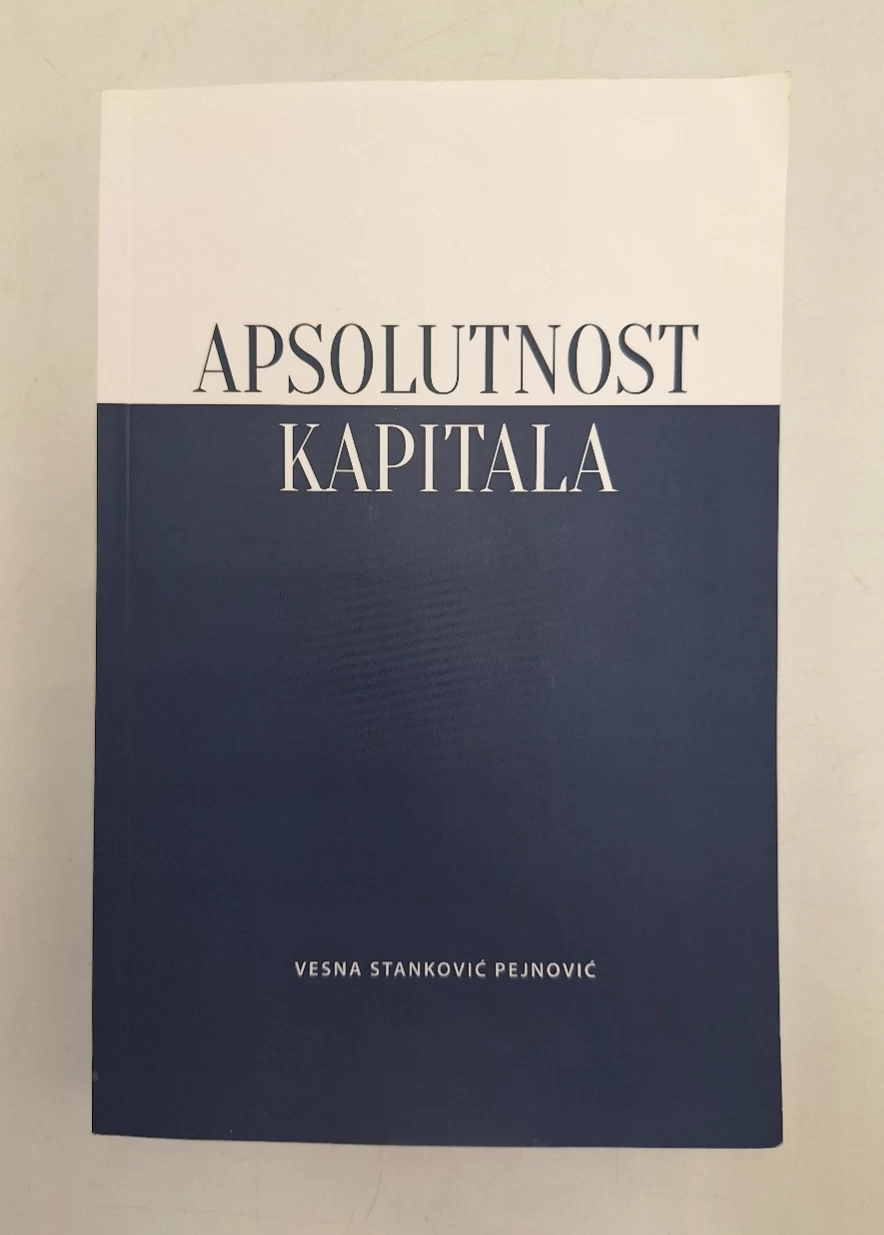

Stanković Pejnović Vesna: Apsolutnost kapitala
€ 30,00
Free delivery in Croatia for orders over EUR 70
Basic information
- Author: Stanković Pejnović Vesna
- Publisher: Metaphysica
- Availability: Available
- Condition: Excellent
- Code: 74618
Shipping options
GLS Croatia
5€
Delivery
0€
Personal collection at the antique store
0€
GLS parcel machine
3€
Payment methods
Pay on pickup
CorvusPay
By general payment / Virman / Internet banking
Cash on delivery
Apsolutnost kapitala
Stanković Pejnović Vesna
Summary
Vesna Stanković Pejnović: The absoluteness of capital
Capital is not simply an economic category, but a certain historical way of creating a human community, that is, a regulatory principle of a certain way of life. "Under the assumptions of capital, the economy is not a means for the development of other human activities; on the contrary, all other human activities become a means of its development" (Divjak, 1982: 67). Capital is the power to manage labor and its products. (Horvat, 1969: 134) The absoluteness of capital should be understood as the unlimited occupation of the world and life in an intensive and comprehensive way. This cycle begins with the form of commodities as the core of capitalist society, which expands and fills every environment and finds its peak in turning man into a commodity by exploiting labor power. This is why the very essence of democracy is a political form of capital's rule over people, and life itself is capitalist terror and totalitarian power because we live in a consumer society where everything is subordinated to the circulation of capital. The higher humanity is at a higher level of development, the greater the chances of its collapse because capital rules all social spheres. Instead of an enlightened aspiration for self-knowledge, every form of life and action is an object of society's control. A new, hidden form of totalitarianism wants to impose the thesis that the imaginary freedom of a "fluid society" (Bauman) is "obtained".
Additional information
- Author: Stanković Pejnović Vesna
- Publisher: Metaphysica
- Year of publication:2022
- Place of publication:Beograd
- Pages:334
- Dimensions:15x23 cm
- Script:Latin script
- Condition:Excellent
- Binding:Softcover
You may also like











Biblos Newsletter
For book lovers who enjoy finding the rare
New titles, special copies and quiet recommendations from the antiquarian bookshop.