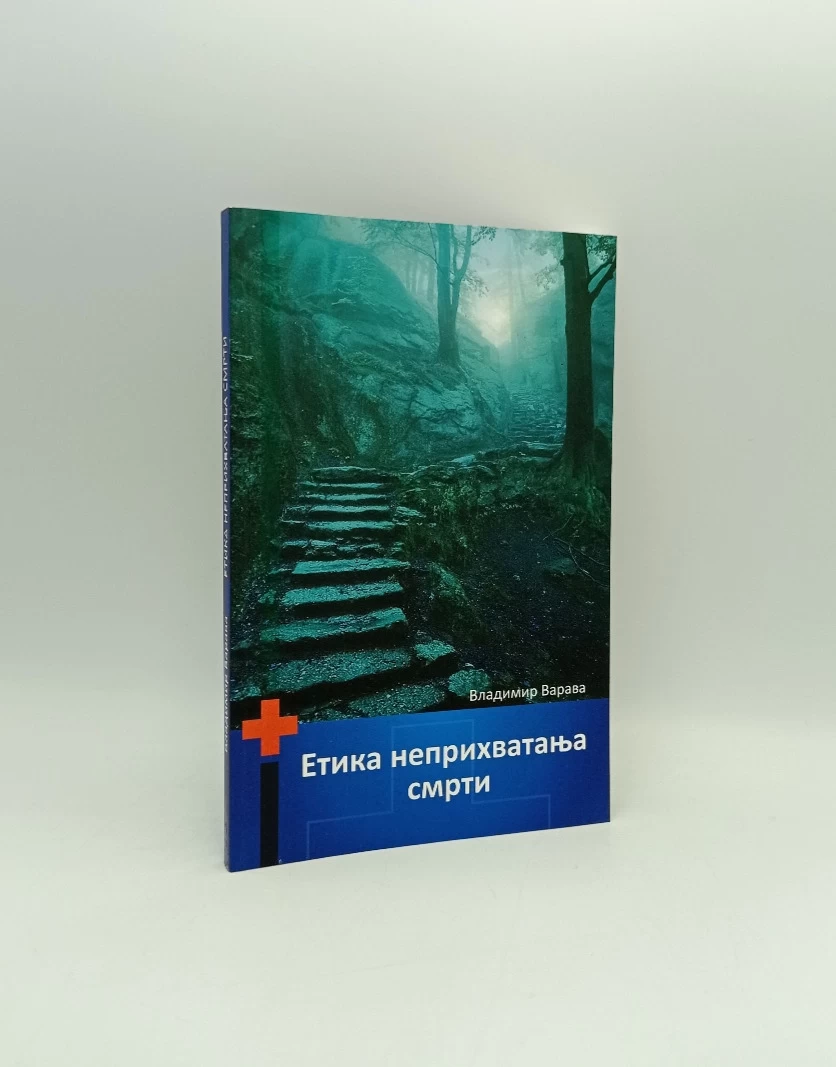

Varava Vladimir: Etika neprihvatanja smrti
€ 8,00
Free delivery in Croatia for orders over EUR 70
Basic information
- Author: Varava Vladimir
- Publisher: Logos Beograd
- Availability: Available
- Condition: New book
- Code: 43657
Shipping options
GLS Croatia
Delivery time: 1-2 working days (RH)
Delivery is made via the GLS delivery service.
5,00 €
Delivery
Delivery time: 3-21 working days
We send the delivery price via email within 24 hours.
Price on request
Personal collection at the antique store
Palmotićeva 28, 10000 Zagreb
Free
GLS parcel machine
Delivery time: 1-2 working days
Delivery is made to the selected GLS package machine.
3,00 €
Payment methods
Pay on pickup
CorvusPay
By general payment / Virman / Internet banking
Cash on delivery
Etika neprihvatanja smrti
Varava Vladimir
Summary
Vladimir Varava: The ethics of not accepting death
As paradoxical as it may be, even unbearable and incomprehensible to some, it is still a true statement that a person cannot do without death, or more precisely, without accepting death as the most important and not the last event of life. And there is no joke with the most important thing: you have to surrender all the forces of your soul to him.
If a man ignores death and, therefore, does not touch it either with his heart or with his mind, then his life dissolves in a flood of senseless creation and loses all meaning and value. And when the hedonists with a stunned look ask the philosopher why he wastes time "in vain" worrying about death so painfully, he answers them like this: "I philosophize in order to live, and you live in order to die". To deny death is to deny life. Man gets the chance to defeat death only when he stares into the abyss of its icy horror.
If we set ourselves the goal of looking at death through the eyes of philosophy, then we must not lose sight of the following questions: "What is death for man?", "What is the moral (therefore, exclusively human) meaning of death?"
Anticipating some conclusions, we can say that a moral understanding of death helps man to get closer to life precisely because death is essentially connected to man's being, even though it radically alienates him from himself. This connection is antinomian and tragic: that is why it can never be rationally understood.
Man, according to Heidegger, is "a beholder of Nothing". And without going into the explanation of this thought, we can, in the words of Dostoevsky, say that "being exists only when it is threatened by non-being". This means that the non-being layer is so important to man that life acquires its perhaps only, i.e. moral meaning, only when the spiritual influence of non-being on life is understood. As the potter grasps, above all, "the elusive void", so man "captures" death in a certain sense. Death is an event that affects man only through the supernatural sense of tragedy, and not through the ordinary law of nature itself. If death is a law, then neither philosophy nor man himself have anything to look for in the world, as a break in life on the way to the realization of every positive goal and every value, death points to some inexorable and "inevitable strangeness of the world". As much as positivist science tries to appease man by referring to the fact that death is a legitimate and natural phenomenon in the universal natural order of things, without suspecting that it destroys the very basis of the human being and reduces it, in essence, to absolutely nothing, philosophy always manages to resist all (even the most "accurate") myths of science itself by pointing to the fundamental incomprehensibility beings, to the impossibility of finding an unequivocal, uncontradictory and ultimate truth about the world and man's destiny. Philosophy thus breaks through to the understanding that there is a secret in the battle, which science always tries so madly to hide. And if the secret battle exists, then it means that the world is not a hostage to immutable natural laws, and then what is beyond life and death, that is, hope - the only possibility of mortal existence - emerges in man.
normal and natural, that it undermines and destroys a person's life both physically and - what is most terrible - spiritually. If death is really a complete end, then there is no life as such, nor was it. Any justification of mortal life by appealing to the lofty memory of descendants, to the merits that humanity will respect, to the development of culture and the rest, is absurd, even if it does not remove the essential evil of existence - the catastrophe of personal destruction in death.
Additional information
- Author: Varava Vladimir
- Publisher: Logos Beograd
- Year of publication:2010
- Place of publication:Beograd
- Pages:174
- Dimensions:13x20 cm
- Script:Cyrillic script
- Condition:New book
- Binding:Softcover
Reviews
This item has no reviews yet. Be the first to share your experience.
Write a review
You may also like



Recently viewed



Biblos Newsletter
For book lovers who enjoy finding the rare
New titles, special copies and quiet recommendations from the antiquarian bookshop.