

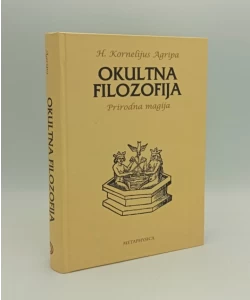
Okultna filozofija - ceremonijalna magija
Basic information
- Author: Agrippa Heinrich Cornelius
- Publisher: Metaphysica
- Availability: Available
- Condition: New book
- Code: 55724
Shipping options
Payment methods
Explore more
Okultna filozofija - ceremonijalna magija
Agrippa Heinrich Cornelius
Summary
Heinrich Cornelius Agrippa von Nettesheim: Occult Philosophy - Ceremonial Magic
The Occult Philosophy of Heinrich Cornelius Agrippa is one of the most significant works of the Renaissance era that deals with ritual magic and its relationship to religion. The first book was printed in Paris, Cologne, and Antwerp in 1531, and the entire tripartite work was published in Cologne in 1533.
In the first book, Agrippa explains what he calls natural magic, and there he discusses the four elements (earth, air, water, and fire), as well as divination, the planets, and their Hermetic correspondents. The second book deals with celestial magic that includes gematria, numbers, Kabbalah, pentagrams, geomantic shapes, angelic writing, astrology, talismans, magic squares, and planetary seals. The third book is devoted to ritual or divine magic, which includes Platonism, cabalistics, evil spirits and demons, divine names and spiritual seals.
This work is in the spirit of other works of hermetic philosophy of the Renaissance era, as well as the previous ones. Namely, Agrippa's interpretation of magic is similar to the interpretations of Marsilio Ficino, Pico della Mirandola and Johann Reuchlin - in terms of the synthesis of magic and religion, with special attention devoted to the study of nature.
As already mentioned, the sum of occult and magical thinking is the most significant work of Agrippa, which solves the problem of skepticism in knowing the highest truth. In short, Agrippa advocates a synthetic approach to magic that merges nature with the heavenly and divine through Neoplatonic philosophy, whereby the common application of natural magic is somehow affirmed through a form of supernatural magic, whose origin is in God. According to Agrippa, all epistemological problems, which culminate in skepticism, are solved by this position.
Occult philosophy exerted a huge influence on later thinkers of this direction, such as Giordano Bruno and John Dee, but, with the rise of scientific thought, it was denounced at the end of the so-called epoch of the occult renaissance.
Additional information
- Author: Agrippa Heinrich Cornelius
- Publisher: Metaphysica
- Year of publication:2020
- Place of publication:Beograd
- Pages:496
- Dimensions:15x21 cm
- Script:Latin script
- Condition:New book
- Binding:Hardcover
Reviews
0 reviewsWrite a review
Share your experience and help other readers choose.
This item has no reviews yet. Be the first to share your experience.
More books by Agrippa Heinrich Cornelius

More books from Metaphysica













You may also like