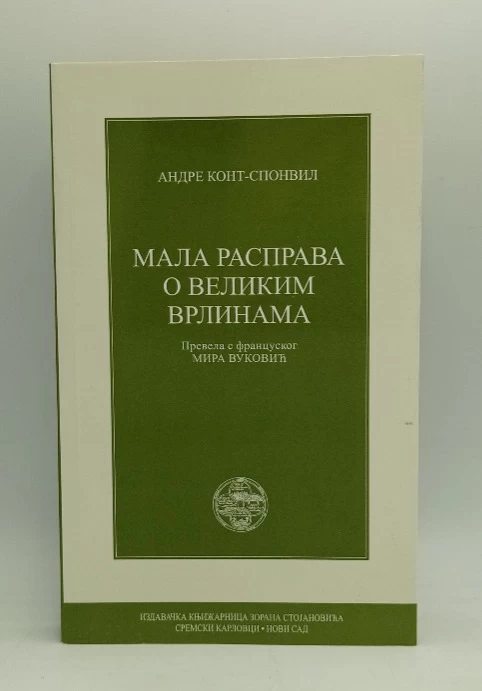

Comte-Sponville Andre: Mala rasprava o velikim vrlinama
€ 21,24
Free delivery in Croatia for orders over EUR 70
Basic information
- Author: Comte-Sponville Andre
- Publisher: Izdavačka knjižarnica Zorana Stojanovića
- Availability: Available
- Condition: Odlično
- Code: 43993
Shipping options
GLS Croatia
5€
Delivery
0€
Personal collection at the antique store
0€
GLS parcel machine
3€
Payment methods
Pay on pickup
CorvusPay
By general payment / Virman / Internet banking
Cash on delivery
Mala rasprava o velikim vrlinama
Comte-Sponville Andre
Summary
Andre Comte-Sponville: A small treatise on the great virtues
If virtue can be taught, as I believe, it can be done by example rather than by books. So what is the use of the discussion about the virtues? That, perhaps, that we would try to understand in it what should be done, or be, or how to live, and thus, at least intellectually, measure the path that separates us from the virtues. The task is modest, insufficient, but necessary. Philosophers are students (only sages are teachers), and students need books: that's why they sometimes write them themselves, when the ones at hand do not satisfy them or are too difficult for them. Is there a more necessary book for each of us than a discussion of morality? And what, in morality, is more worthy of our interest than virtues? Like Spinoza, I do not believe that it is useful to attack vices, evil, sin. Why always accuse, always attack? It is the sad morality of sad people. As for good, it exists only in an irreducible multitude of good deeds, which surpass all books, and good inclinations, which are also many, but certainly fewer, and which tradition designates with the name of virtue, that is, excellence (that is the meaning of the Greek word arete, which the Latins translated as virtus).
Additional information
- Author: Comte-Sponville Andre
- Publisher: Izdavačka knjižarnica Zorana S...
- Year of publication:2014
- Place of publication:Novi Sad
- Pages:356
- Dimensions:14x23 cm
- Script:Ćirilica
- Condition:Odlično
- Binding:Meki s ovitkom
You may also like







Recently viewed








Biblos Newsletter
For book lovers who enjoy finding the rare
New titles, special copies and quiet recommendations from the antiquarian bookshop.