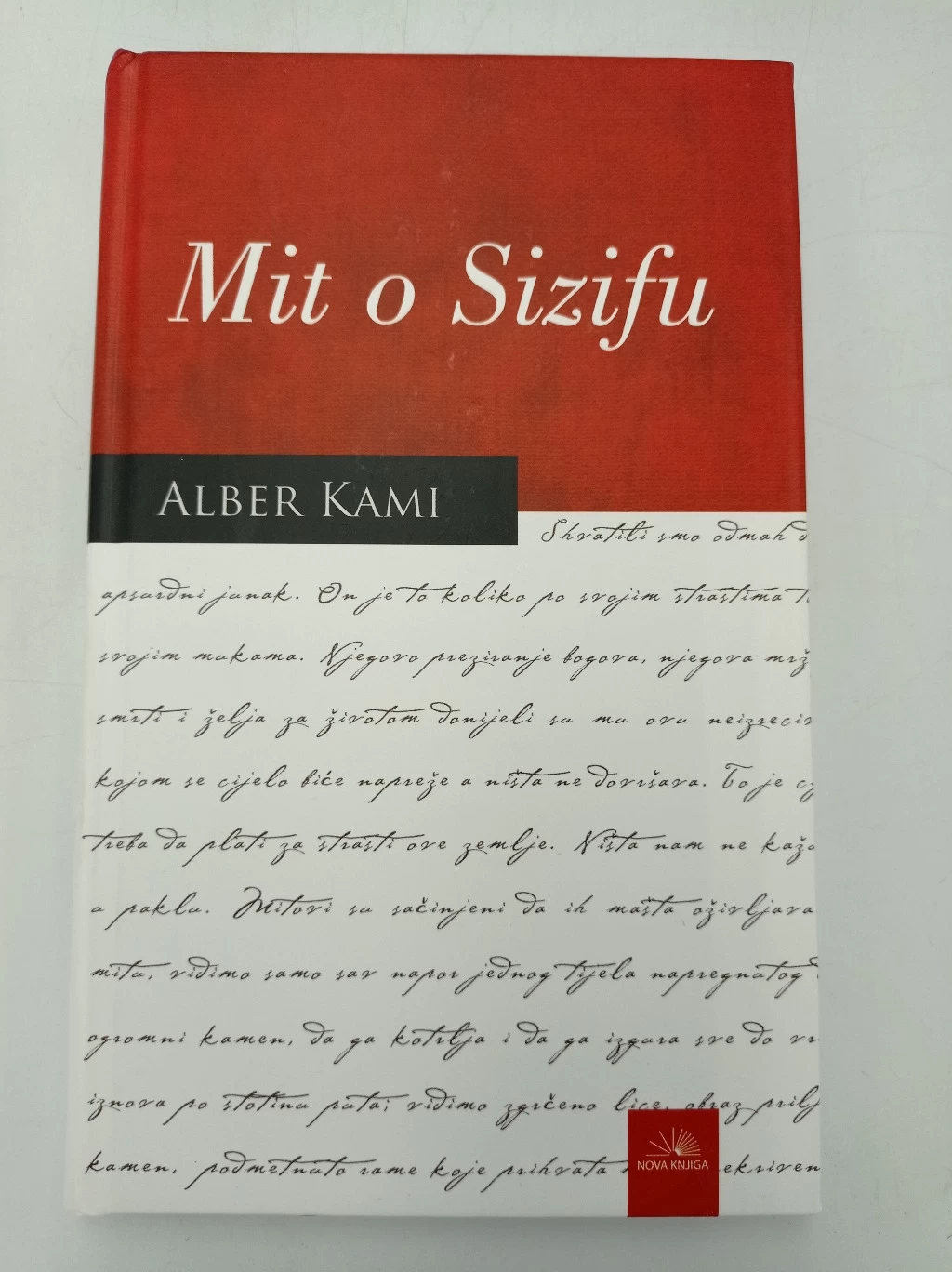

Camus Albert: Mit o Sizifu
€ 9,00
Free delivery in Croatia for orders over EUR 70
Basic information
- Author: Camus Albert
- Publisher: Kosmos - Nova knjiga
- Availability: Available
- Condition: Nova knjiga
- Code: 52247
Shipping options
GLS Croatia
5€
Delivery
0€
Personal collection at the antique store
0€
GLS parcel machine
3€
Payment methods
Pay on pickup
CorvusPay
By general payment / Virman / Internet banking
Cash on delivery
Mit o Sizifu
Camus Albert
Summary
Albert Camus: The Myth of Sisyphus
There is only one really serious philosophical problem: that is suicide.
With that killer sentence, which seems to emerge from the entire philosophical thought, a young man who is not even thirty years old begins his analysis of an absurd feeling. He describes the "disease of the spirit" from which our time suffers: Absurdity is born from this confrontation of human aspirations and the unreasonable silence of the world.
Camus asks a fundamental question: is life worth living? If human existence has no meaning, what can save us from suicide? If there is no God who gives meaning to our lives, people must take on that role themselves. This is our absurd task - like Sisyphus to forever roll his stone uphill, while the inevitability of death constantly overshadows us. Written during the darkest days of the Second World War, "The Myth of Sisyphus" advocates the acceptance of a reality that includes rebellion, passion and, above all, freedom.
In a world that has lost meaning, intersected by absurd walls, man remains a stranger, a modern Sisyphus who rolls the stone of his existence in vain.
Albert Camus, French writer, essayist, playwright, journalist, participant in the Resistance Movement, theater champion and athlete, winner of the French Nobel Prize prize for literature, originator of the idea of European integration and one of the leading intellectuals of the 20th century, with his magnificent work he had a profound influence on his contemporaries and future generations. His diverse works are characterized by a constant search for positive values - at a time when many value strongholds are disappearing.
This edition contains the supplement Hope and Absurdity in Franz Kafka's work. When he talks about Kafka, Camus is writing about himself. He considers himself a small writer, so he quoted someone who claims that the greatest misfortune is to think of yourself as a great writer. An absurd work in its principles can be a joke for him - about a madman fishing in a bathtub.
Additional information
- Author: Camus Albert
- Publisher: Kosmos - Nova knjiga
- Year of publication:2013
- Place of publication:Podgorica
- Pages:168
- Dimensions:13x20 cm
- Script:Latinica
- Condition:Nova knjiga
- Binding:Tvrdi
You may also like



Recently viewed


Biblos Newsletter
For book lovers who enjoy finding the rare
New titles, special copies and quiet recommendations from the antiquarian bookshop.