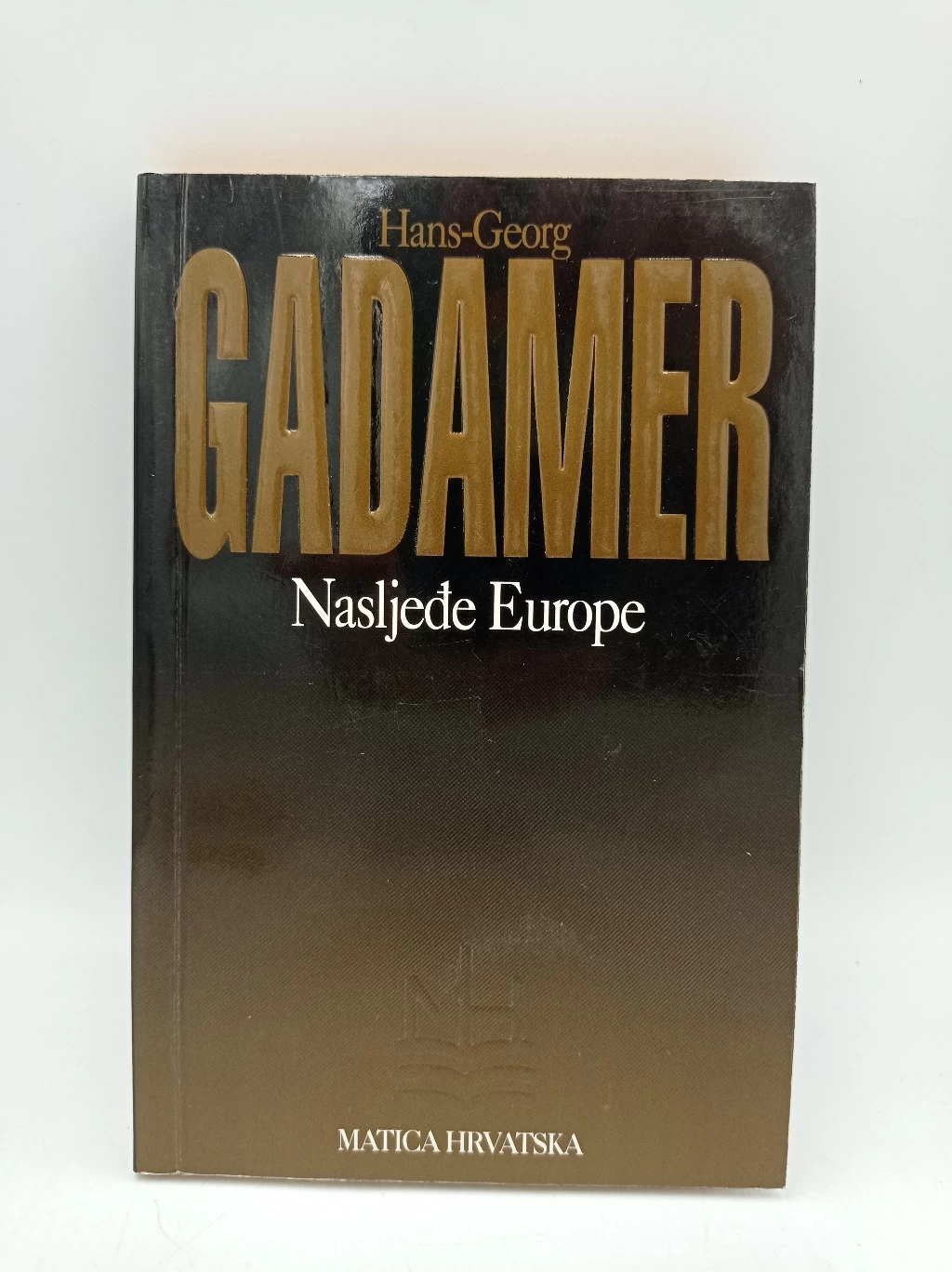

Gadamer Hans Georg: Nasljeđe Europe
€ 5,00
Free delivery in Croatia for orders over EUR 70
Basic information
- Author: Gadamer Hans Georg
- Publisher: Matica hrvatska
- Availability: Available
- Condition: Vrlo dobro
- Code: 37326
Shipping options
GLS Croatia
5€
Delivery
0€
Personal collection at the antique store
0€
GLS parcel machine
3€
Payment methods
Pay on pickup
CorvusPay
By general payment / Virman / Internet banking
Cash on delivery
Nasljeđe Europe
Gadamer Hans Georg
Summary
Hans-Georg Gadamer: The Inheritance of Europe
Translated by Kiril Miladinov, edited by Damir Barbarić
"(...) The pluralistic entanglement of Europe and humanity, interpretable only from a constant turning to the European and world past, is a task that is set before the spiritual sciences that "sharpen their gaze for the persistent forces of lived life" and which are always in a certain sense turned to the past, but only in order to reminded the present of the tasks of modernity. To understand the spiritual unity of Europe both as a reality and as a task, which has grown out of the diversity of Europe, is what should stand before any political formation of Europe. Therefore, Gadamer's speech about the past and future of spiritual sciences can tell us a lot about the future of Europe..."
Hrvoje Jurić, Vijenac
Why globalization has no alternative and why philosophy must turn to practice, why spiritual sciences and art will not disappeared, why did empirical sciences reshape our world, why is the role of science and experts growing in today's world, who shaped Gadamer's opinion?...
Can the previous questions even be connected to the title of the book? They can, because nine discussions published mostly between 1983 and 1987 connect the motif of philosophical self-reflection and European philosophy as a component of European spiritual heritage. And by asking such questions and offering possible answers to them, Gadamer, according to the interpretation of Zvonko Šundov, tries to show that the European spiritual heritage is not an incidental museum fact, but a life-long, decisive history of the spirit for modern times.
Hans-Georg Gadamer (1900-2002), German philosopher, one of the most influential thinkers of the last century, especially in the field of philosophical hermeneutics and philosophy of language.
Additional information
- Author: Gadamer Hans Georg
- Publisher: Matica hrvatska
- Year of publication:1997
- Place of publication:Zagreb
- Pages:152
- Dimensions:11.5x17 cm
- Script:Latinica
- Condition:Vrlo dobro
- Binding:Meki
You may also like




Recently viewed







Biblos Newsletter
For book lovers who enjoy finding the rare
New titles, special copies and quiet recommendations from the antiquarian bookshop.