
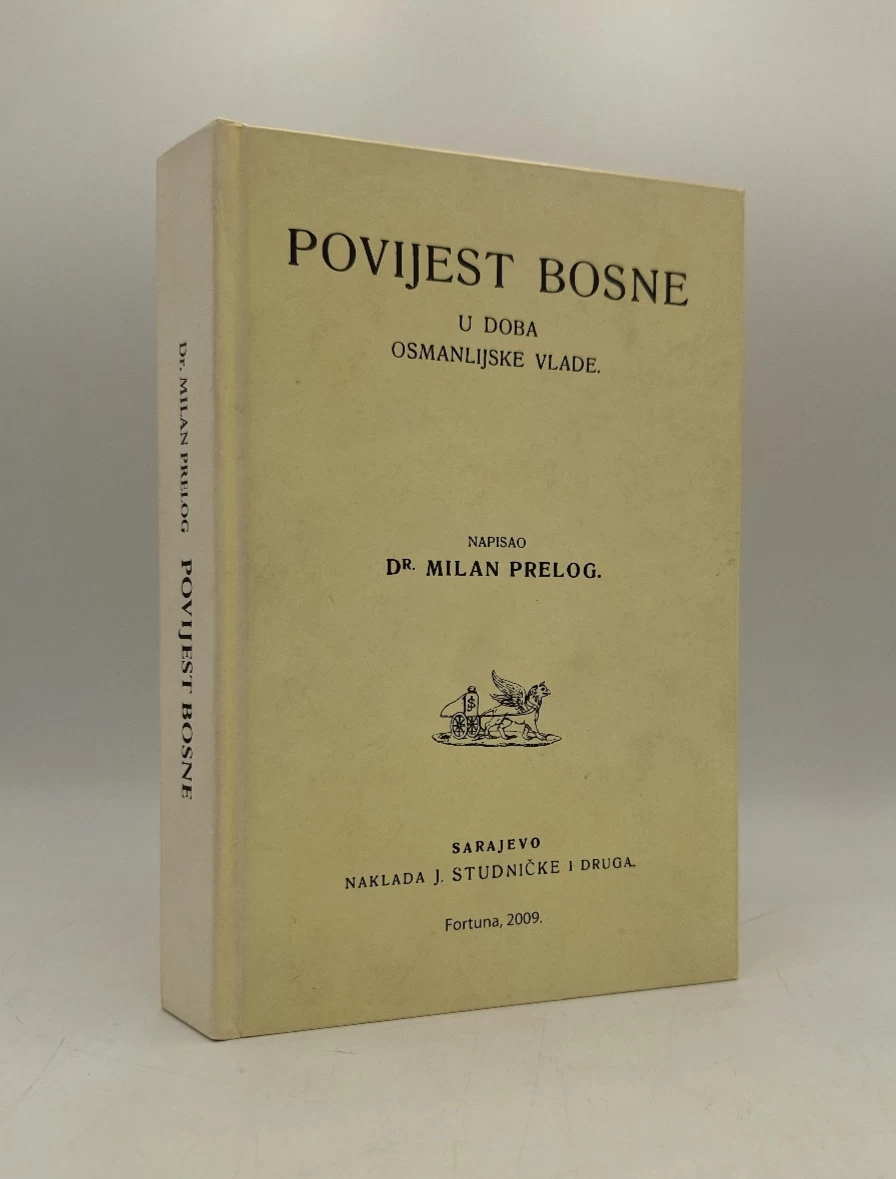
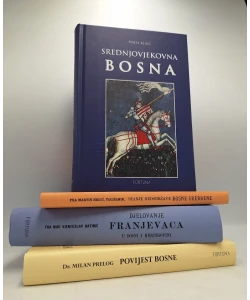
Povijest Bosne u doba osmanlijske vlade I.-II. dio
Basic information
- Author: Prelog Milan
- Publisher: Fortuna
- Availability: Available
- Condition: Excellent
- Code: 13056
Shipping options
Payment methods
Explore more
Povijest Bosne u doba osmanlijske vlade I.-II. dio
Prelog Milan
Summary
Milan Prelog: History of Bosnia during the Ottoman rule I-II. part
Reprint of the first edition from 1913
Bosnia without history
The name of Milan Prelog (1879-1931) is one of those names that we always associate with other names, and not by chance. Namely, one of the most famous Croatian art historians of the 20th century also bears the same first and last name, but with the mention of Milan Prelog, the name of his son Vladimir, the Croatian winner of the Nobel Prize in Chemistry (1975), is inevitably associated.
Prelog, like many of his compatriots, arrived from the Czech Republic to serve in Bosnia and Herzegovina during the Austrian occupation. What French or German are today, in addition to English as the most widely used language in the European Union, Slavic languages represented in the Austro-Hungarian Monarchy. The occupying administration of Bosnia and Herzegovina needed as many personnel as possible who speak the lingua franca of various regions of the large Central European empire. And Bosnia, traditionally, has always welcomed newcomers with open arms, even in the most difficult times. As for the very act of occupation in 1878, for the Muslim population of the Bosnian vilayet it certainly represented the most difficult moment in the entire Bosnian history. That history, so torn by different interpretations – national, religious, civilizational, administrative, ideological – found very few worthy chroniclers. Even though he arrived in Bosnia after that turning point in 1878, Milan Prelog, just like the native Bosnian Safvet-beg Bašagić, the author of the Short Guide to the Past of Bosnia and Herzegovina (1463-1850), considered that year a turning point, perhaps it is even better to say a crossroads, of historical currents that, by a play of fate, crossed right on the soil of Bosnia and Herzegovina.
The 'return' of Western civilization in Bosnia meant a mental, but also a concrete, political-legal turn in the way of managing the country (although here it might be more appropriate to say 'province', but Bosnia, even when they deny it, still represents a country, even if it is a virtual one). In addition to the shortcomings of the Austrian administration in Bosnia and Herzegovina, which with its rigid, bureaucratic apparatus wanted to colonize the Balkans in the way that the world powers did with the most remote corners of the planet, that administration created many preconditions for the peaceful development of civil society. The theory of belated colonialism is supported by the attitude of the Austrian administration towards the three peoples and confessions in BiH: it has always very carefully distanced itself from any form of protectionism on religious or national grounds. Because of this, especially Croatian intellectuals and priests, both in BiH and in Croatia (then Croatia and Slavonia under Hungary and Dalmatia under Austria), felt hurt and, in a way, betrayed by their king and emperor, who did not want to show any more respect to the Catholics in Bosnia than he courteously, in the name of expanding the empire, did to the Orthodox and Muslims. The Catholics, who were under constant surveillance as a real threat to the Ottoman Empire, expected that the arrival of the "West" would bring them satisfaction at least in the form of social, property-legal and other compensations for the losses suffered during more than four hundred years of supreme authority from the Bosphorus. The cause of such an Austrian attitude is also the well-known German realpolitik, according to which it was certainly not necessary to encourage the already agitated and fairly complete Croatian national awareness within the old borders of the Empire. Therefore, although Croat-Catholics in BiH were already considered part of the Croatian national body, in the political-legal, and even economic and traffic sense, they could, theoretically, live in the Land of Francis Joseph, close to the Arctic.
Just as with the Bosnian Muslims, the occupation, and later the annexation, resulted in a turn towards the 'bright' eras, let's call it pax Ottomanica (as in Short instructions to the past of Bosnia and Herzegovina in which Safvet-beg Bašagić ends that history with the year 1850), that's how those two are
the events produced a very understandable feeling of distance, that is, a forced distance from the same West that they have longed for and desired for so long among Bosnian Catholics.
Only the Serbian, that is, the Orthodox entity in Bosnia and Herzegovina has never experienced its history emotionally. The national consciousness of the Serbs in the modern political sense happened earlier than that of the other South Slavic peoples, so there was no need for historical-legal maneuvers at the time of the Austrian occupation. It should be borne in mind that at that moment the magnet of young Serbian democracy attracted other non-Slavic peoples, not only Serbs, and the idea of unification with Serbia among these peoples (Croats, Slovenes, but also Czechs and Slovaks) was considered, to say the least, a harmless political program. (originally printed in two parts, and here, because there is no reason to the contrary, we present it in one book) remains the only correct Bosnian historical synthesis, without pseudo-historical insinuations on the one hand, without hidden theses or, perhaps most importantly, without an attempt to predict the consequences of the four-century rule that the book deals with. Published in the modest edition of the Sarajevo bookseller J. Studnička, who also has Czech roots, this book can without exaggeration be placed alongside the best achievements of Croatian historiography of the time by Vjekoslav Klaić, Ferda Šišić, Ivo Pilar and others who founded the objective science of history in our micro-regional framework.
The true wealth of the book is the footnotes, which let us know that Prelog used Bosnian, Serbian, Croatian, and German equally. (Austrian), Hungarian and Italian (Venetian) historical sources.
Although Bosnia was once and still is the subject of every salon discussion in the Balkan tavern, very few historians from the 19th century until today decided to write a historiographically based work on its history. Although we could very easily list here literally all the more serious works on the history of Bosnia and Herzegovina (in South Slavic languages), suffice it to say that in just over one hundred and fifty years, so many have been collected that you can count them on the fingers of both hands.
For us, that was enough of a recommendation to reprint this valuable book, and for you, I hope, a recommendation to read it.
In Zagreb, April 19, 2009
Ivan Hornet
Additional information
- Author: Prelog Milan
- Publisher: Fortuna
- Year of publication:2009
- Place of publication:Zagreb
- Pages:181+193
- Dimensions:13.5x20.5 cm
- Script:Latin script
- Condition:Excellent
- Binding:Hardcover
Reviews
0 reviewsWrite a review
Share your experience and help other readers choose.
This item has no reviews yet. Be the first to share your experience.
More books by Prelog Milan



More books from Fortuna










You may also like