
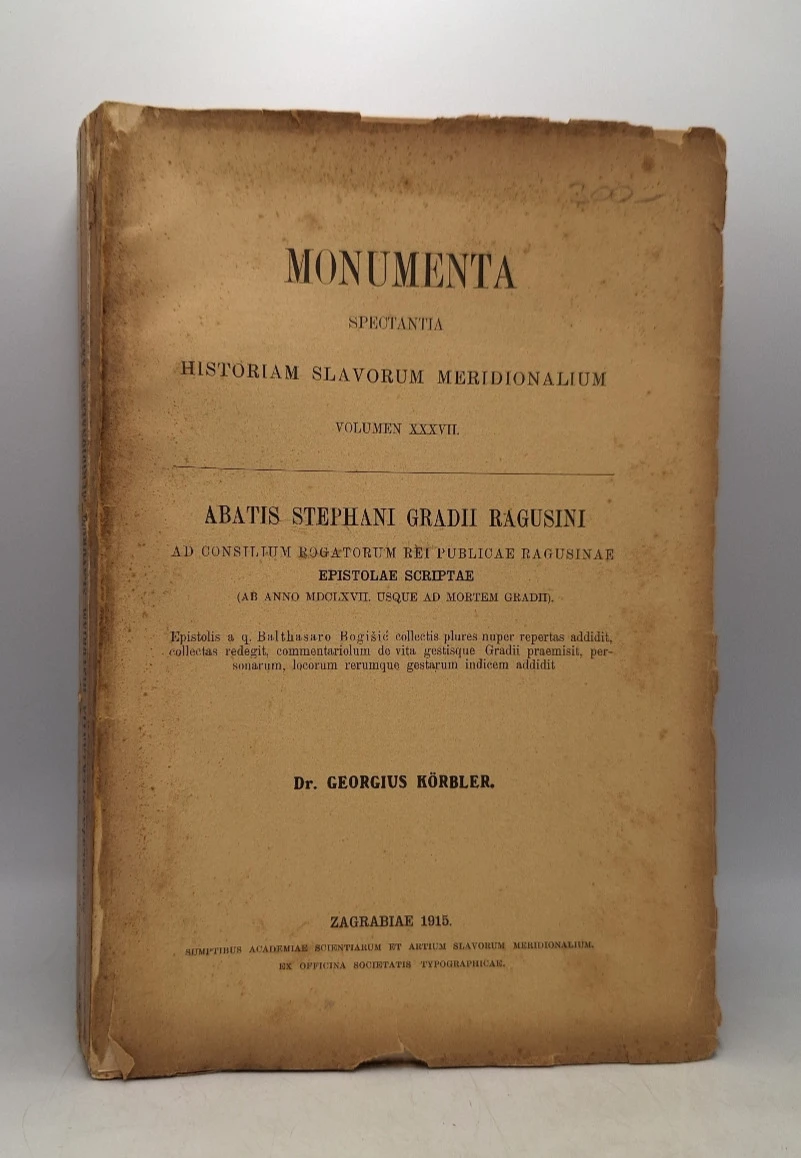
Pisma opata Stjepana Gradića Dubrovčanina
Basic information
- Author: Korbler Ðuro
- Publisher: Tisak dioničke tiskare
- Availability: Available
- Condition: Excellent
- Code: 46344
Shipping options
Payment methods
Explore more
Pisma opata Stjepana Gradića Dubrovčanina
Korbler Ðuro
Summary
Đuro Korbler: Abatis Stephani Gradii Ragusini ad consilium rogatorum Rei publicae Ragusinae epistolae scriptae : (ab anno MDCLXVII. usque ad mortem Gradii) / epistolis a q. Balthasaro Bogisic collectis plures nuper repertas addidit, collectas redegit, commentariorum de vita gestisque Gradii praemisit, personarum, locorum rerumque gestarum indicem addidit Duro Koerbler = Letters of Abbot Stjepan Gradić of Dubrovnik to the Senate of the Republic of Dubrovnik: from 1667 to 1683 / Bogišić's transcript supplemented, edited for printing, wrote an introduction about Gradić's life and work, then added a list of persons and places Đuro Körbler
GRADIĆ, Stjepan, diplomat and polymath (Dubrovnik, 6. III. 1613 — Rome, 2. V. 1683). Son of Miho, statesman and humanist. He received his first education in his hometown at a private Jesuit school. Year In 1629, at the invitation of his uncle P. Beneša, a high official of the Roman Curia, he went to Rome, where until 1634 he attended a humanities class and three years of philosophy at the Collegium Romanum Jesuit University. He studied civil and ecclesiastical law at the university in Fermo in 1634–36. and Bologna in 1636–38, obtaining a doctorate in both laws. Returning to Rome, he studied theology for four years and was apparently ordained a priest there. In Bologna, he listened to mathematical lectures by Galilei's friend and collaborator B. Cavalieri, and in Rome by Galilei's student B. Castelli. Year In 1643 he returned home and soon became the prebendary abbot of the Benedictine abbey of St. Cosmas and Damjan on the island of Pašman, canon of the cathedral choir in Dubrovnik and deputy of the Dubrovnik archbishop. After a private trip to Rome in 1653, he was the official diplomatic representative of the Republic of Dubrovnik to the Holy See there until his death. In Rome, he established close relations with many of our people, whom he particularly helped as president of the Croatian Choir of St. Jeronima (1659–63, 1665–67, 1674–76 and 1680–83). In particular, he was at the service of the historian I. Lučić, who for many years he provided hospitality in his rented house, helped in his scientific work and, as the curator of the Vatican Library, made its rich funds available. With him, he also successfully defended the honor and reputation of his native region against unfair attacks by some Italian and French writers. G. earned his greatest merits in the service of his own homeland. Most of all, thanks to its capture, the Jesuits in Dubrovnik opened the Collegium Ragusinum secondary school in 1658. He wholeheartedly advocated that local sons come to the leading positions in the small but important Benedictine Congregation of Mljet. He led a persistent diplomatic and political fight against the conspirators, who wanted to hand over the island of Lastovo to the Republic of Venice. He invested a lot of effort and diplomatic skills in the defense of Dubrovnik's sea and land trade, which the Venetians tried to disable, which is why in 1674/75. traveled from Rome to Venice. He gained particular merit after the catastrophic earthquake (1667), seeking material, professional and military help from all sides. He sent experts, money, food, machines and even weapons to Dubrovnik, extracted Dubrovnik's capital from Italian banks and secured international political and diplomatic support for Dubrovnik against Turkish and Venetian pressure and blackmail. With Roman architects, he drew up a plan for the reconstruction of the city and proposed a whole series of far-sighted political, social, economic, cultural and religious reforms, which were to place the Republic of Dubrovnik among the most advanced states. He actively advocated for a change in Dubrovnik's foreign policy, for its reliance on France, then the leading power in Europe, instead of the previous reliance on Spain and Turkey, which had already passed the zenith of their power. He resolutely fought for the full recognition of the sovereignty of the Republic of Dubrovnik by some Italian principalities and republics. He provided her with international political and diplomatic support in her most difficult conflict with the Turks, when they in the 1670s - on behalf of the property of the citizens who died in the earthquake and the alleged damage caused to them by the Dubrovnik areas during the Candian War ta (1645–69) by charging increased customs duties – demanded that she pay them 2,150,000 thalers, threatening to put an end to her independence. Year 1679 in Paris by Louis XIV. asked for diplomatic and material assistance. For his merits, the Senate wanted to appoint him archbishop of Dubrovnik in 1680, but he resolutely refused, explaining that as an ordinary priest in Rome he could better serve his country than as an archbishop in Dubrovnik. G. was also in the service of the Holy See, first as an official of the Secretariat for correspondence with Christian rulers in the Latin language, then as an expert advisor to the Congregation of Indexes for the Censorship of Books in 1658, and as the second curator from 1661 and 1682 as the chief manager of the Vatican Library, excelling in cataloging existing and acquiring new valuable funds and books. In 1662, as an experienced diplomat, he was one of the two representatives of Pope Alexander VII, who in San Quirico near Siena conducted official negotiations with the French governor about a peaceful solution to the conflict between the Papal States and France, and two years later he traveled to Paris as the secretary of the papal delegation for the ceremonial signing of the Peace of Pisa. In the Papal State Secretariat, he enjoyed the voice of an expert on the Slavic peoples and the question of the Turks, advocating for their expulsion from Europe with the help of an alliance of European states. In diplomacy, he successfully used his poetic and oratorical talent. He performed several times as an excellent speaker in ceremonial occasions before the Pope and cardinals, at the funerals of famous people, for the solemn entry into Rome of the Swedish emigrant queen Kristina (1655). As an excellent poet and gifted writer, he enjoyed a great reputation under Pope Alexander VII. and his niece Cardinal F. Chigi, to whom he composed Latin letters and wrote speeches. He spoke and understood several languages (Italian, Latin, Greek, French, Spanish, Portuguese, Russian and Turkish), which facilitated his communication and pursuit of science. As an outstanding polymath, G. was engaged in cultural and scientific work all his life. His first literary work was a verse drama in Latin, which he wrote as a first-year philosophy student in Rome. He then wrote poems, poetic epistles, satires, speeches and scientific treatises and translated from Greek to Latin, which earned him a reputation among the scholars gathered around Pope Alexander VII. and the Swedish Queen Kristina gained a great reputation. He showed interest in literature, theology, philosophy, law, history, mathematics, physics, meteorology. He experimented and dealt with the practical application of theoretical knowledge in optics, shipping, nautical and hydromechanics, leaving behind several books, discussions and articles. He devoted special attention to studying the history of Dubrovnik and wrote comprehensive biographies of well-known contemporaries (J. Palmotić, P. Beneša, L. Allacci and C. Rasponi) and some older Greek mathematicians, making him one of the first biographers of Dubrovnik. He was a member of the literary academy Dei Ricovrati in Padua and the Royal Literary and Scientific Academy of Queen Christina in Rome, and successfully collaborated with the scientific academy Del Cimento in Florence. He collaborated and maintained connections with numerous writers and scholars not only in Rome and Italy but also in France, Germany, Belgium and the Netherlands (V. Viviani, M. Ricci, B. Castelli, B. Cavalieri, G. A. Borelli, L. Magalotti, I. Boulliau, A. Auzout, H. and A. Valois, P. Corneille, E. Bigor, G. Ménage, J. B. Bossuet, N. Steensen, C. Huygens, D. Papenbroeck), as well as those in Dubrovnik, Split, Trogir and Zadar. The fact that only in Dubrovnik until half XVIII. century kept more than 2000 of his letters. Although less than a quarter of them have been preserved, they are still a notable source for knowledge of the political, cultural, economic and religious circumstances in Dubrovnik in the 17th century. He left behind about ninety printed and handwritten works, some of which have been lost. In the manuscript they are with guarded by: De basilica Lateranensi; Discorso sopra la Congregatione Melitense di monaci di Sr. Benedetto; Discorso sopra la fortificatione della Città; De praesenti statu Ottomanici imperii; Vita Petri Benessae; Discorso sopra l'augmento dell'entrate publiche di Ragusa; Discorso sopra il titolo di czar da darsi al Gran Duca di Moscovia; Discorso sopra le lagune di Venetia; L'oratione sopra l'aggregatione alla nobiltà di Ragusa nel Consiglio Grande di quella Republica et al.
Additional information
- Author: Korbler Ðuro
- Publisher: Tisak dioničke tiskare
- Year of publication:1915
- Place of publication:Zagreb
- Pages:528
- Dimensions:17x23 cm
- Script:Latin script
- Condition:Excellent
- Binding:Softcover
Reviews
0 reviewsWrite a review
Share your experience and help other readers choose.
This item has no reviews yet. Be the first to share your experience.
More books from Tisak dioničke tiskare




You may also like







Recently viewed